

Sentry South 26-2 applied joint and combined warfighting doctrine against realistic and integrated enemy threat systems while operating under controlled conditions. The training was designed to prepare participating units for complex operational scenarios.
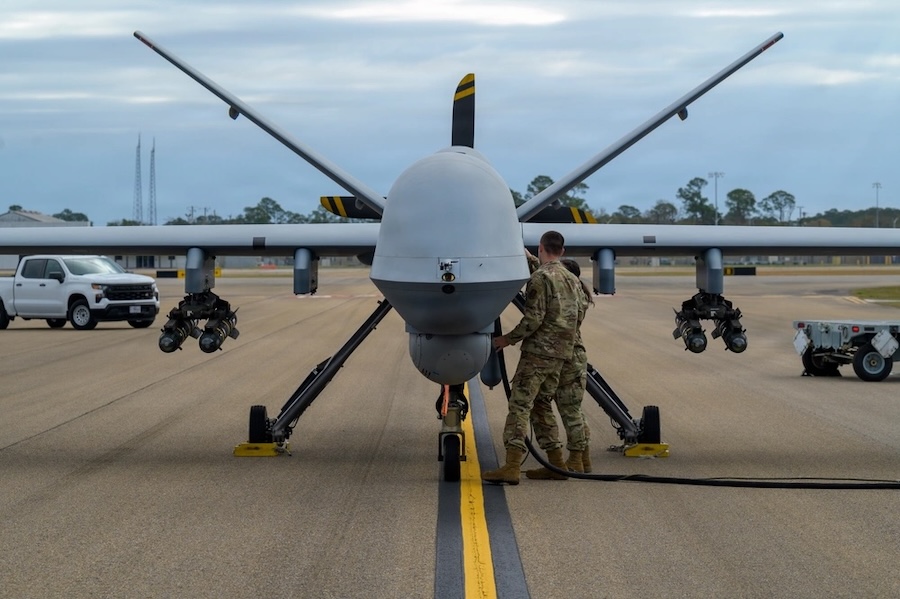
Maintainers from the 174th Attack Wing played a key role in supporting MQ-9 Reaper operations during the three-week exercise. Although the aircraft used belonged to the 147th Attack Wing from Houston, Texas, planners coordinated with the Texas unit after adverse weather prevented the use of a Syracuse-based aircraft.
Once the aircraft arrived in Gulfport, the 174th maintenance team serviced it to ensure continuous mission readiness throughout the exercise. Their work supported sustained MQ-9 operations and the effective execution of assigned training tasks.
The exercise marked the first time an MQ-9 operating at Sentry South conducted flight operations using 100 percent satellite communications without C-band line-of-sight backup. In previous exercises, local crews at the training center initially controlled the aircraft via C-band before handing it over to remote crews at their home station.
Through coordination among the 188th Wing, CRTC airfield management, local air traffic control, and the Gulfport-Biloxi Regional Airport Authority, the aircraft launched and recovered while being flown entirely from Arkansas. The operation proceeded smoothly and demonstrated the feasibility of fully remote MQ-9 operations within Gulfport airspace.
Before the MQ-9’s first sortie, the 174th munitions team assembled the aircraft’s full combat payload while also training other Air National Guard units in munitions building procedures. Personnel from the CRTC, the Mississippi Air National Guard, and the 137th Special Operations Wing of the Oklahoma Air National Guard took part in the training.
“I couldn’t be more proud of our munitions team,” said Staff Sgt. Morgan Piazza, munitions specialist, 174th Attack Wing, New York Air National Guard. “To build a full combat payload while also training other units at the same time really shows the level of expertise and teamwork we have. We balanced speed and precision without cutting corners and that speaks to the commitment of our Airmen to getting the mission done right.”
The exercise also marked the first time an MQ-9 participating in Sentry South launched with Hellfire missiles loaded on the aircraft. The milestone was achieved through coordination among the 174th maintenance team, CRTC airfield management, and Master Sgt. Michael Anderson, the munitions accountability systems officer assigned to the CRTC.
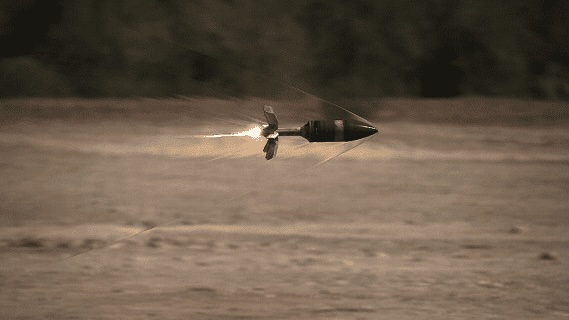
During the exercise, GBU-38 Joint Direct Attack Munitions were released over Rattlesnake Range at Camp Shelby Joint Forces Training Center in Hattiesburg, Mississippi. AGM-114 Hellfire laser-guided missiles were also launched at inflatable maritime targets in the Gulf of America in coordination with the U.S. Coast Guard.
All munitions used during the exercise resulted in successful target engagements. Pilots and sensor operators from the 188th Wing, Arkansas Air National Guard, conducted the live-fire missions.
The training allowed crews to refine their ability to employ precision-guided munitions in nontraditional environments, including maritime strike scenarios. Two pilots and two sensor operators from the 188th Wing conducted their first Hellfire engagements during the event.
Maritime targeting presents unique challenges compared to land-based operations due to environmental conditions and movement on the water’s surface. The engagements also marked the first Hellfire employment by the 188th Wing under its continental United States training allocation.
“Shooting live weapons presents our crews with an element of exposure usually not attainable in a training environment,” said Maj. Nick Barron, lead planner and liaison officer, 188th Wing, Arkansas Air National Guard. “This, in turn, gives them the confidence and experience to employ in real-world scenarios.”
MQ-9 operations during Sentry South generated 56.7 flight hours across nine sorties. Crews fired four live Hellfire missiles and employed eight inert GBU-38 munitions while conducting 50 simulated Hellfire engagements and 17 simulated GBU engagements.
A total of 12 pilots, 11 sensor operators, and six intelligence analysts from the 188th Wing supported MQ-9 operations from Arkansas. Additional liaison officers, communications specialists, and weather personnel supported the mission from Gulfport.
Mission taskings included close air support, counter-unmanned aircraft operations, combat search and rescue support, and intelligence, surveillance, and reconnaissance missions. These activities demonstrated the MQ-9’s flexibility across multiple mission sets.
For the 174th maintenance team, the live Hellfire mission represented an important training milestone. The unit had not conducted a live Hellfire load for several years, providing Airmen an opportunity to refresh and validate critical skills.
The wing also achieved several logistical milestones during the exercise. Airmen successfully conducted a static load of deployment materials, including a truck and trailer connex, onto a C-130J Super Hercules aircraft.
Historically, the wing deployed equipment using the C-17 Globemaster III. Demonstrating compatibility with the C-130 expands deployment flexibility and supports rapid mobilization using multiple airlift platforms.
In addition to operational and maintenance duties, 174th Airmen participated in mass casualty training with Air and Army National Guard medical units. The training improved medical response capabilities and reinforced the importance of joint integration during high-stress contingency situations.
“Sentry South has been a prime example of the 174th Maintenance Group’s unwavering readiness to deploy and deliver mission-capable aircraft and equipment worldwide,” said 1st Lt. Tyler Heggelke, director of operations of the 174th Aircraft Maintenance Squadron, 174th Attack Wing, New York Air National Guard. “Our Airmen consistently demonstrate flexibility, dedication to their craft, and the ability to overcome challenges, regardless of their difficulty.”
Through joint integration, live-fire training, and expanded deployment capabilities, Sentry South 26-2 strengthened the 174th Attack Wing’s ability to project combat power. The exercise also enhanced the unit’s readiness to operate in complex and contested environments.