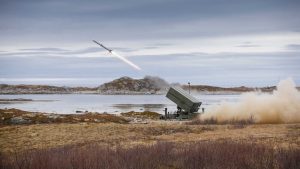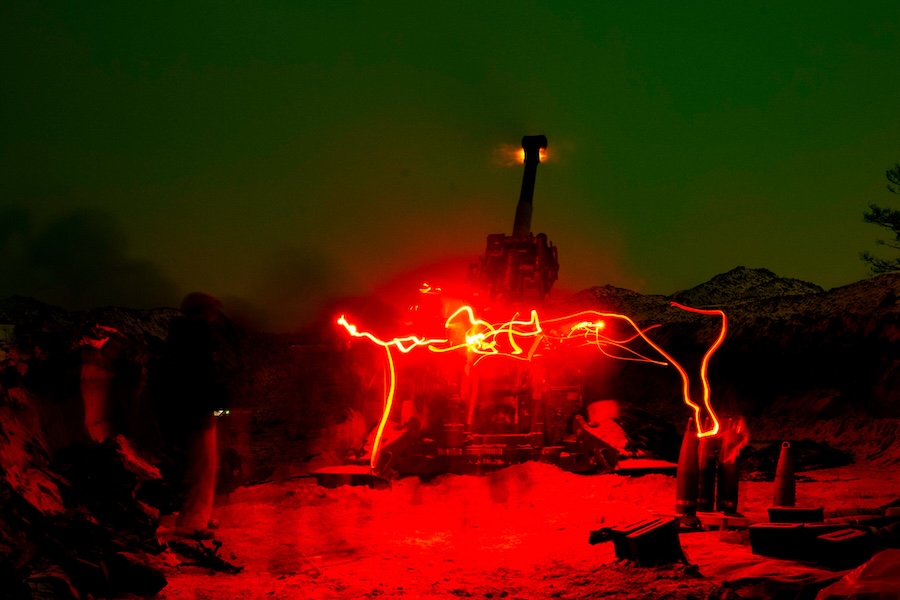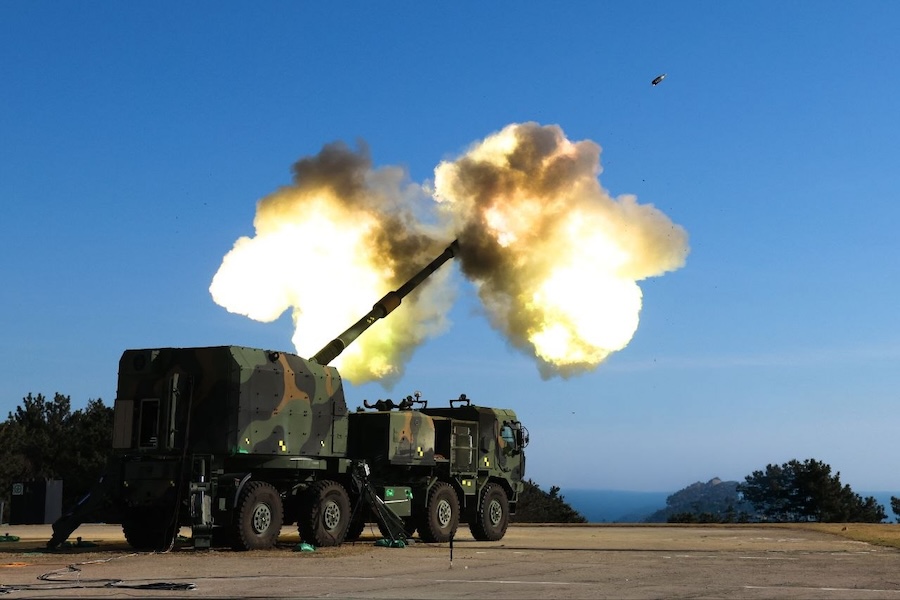
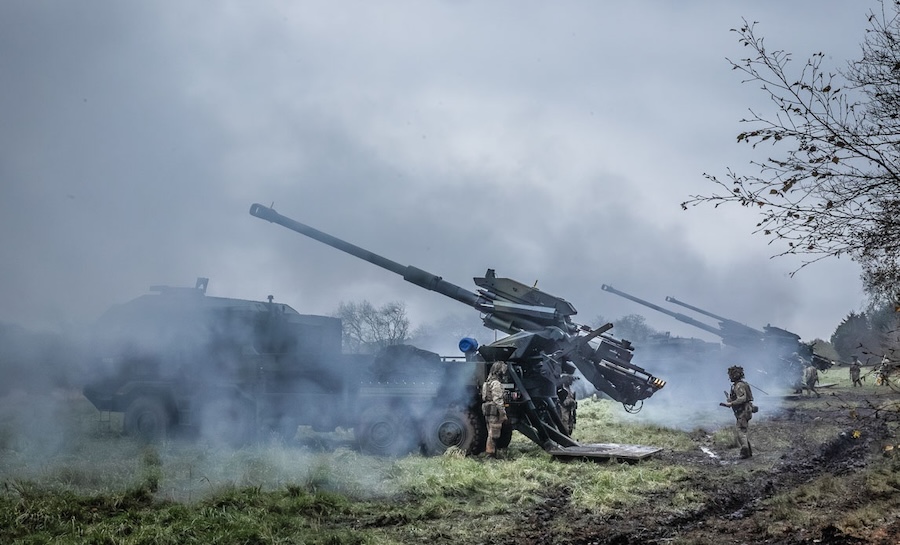
The final units of the ATMOS artillery system have now arrived in Denmark, completing the country’s purchase of nineteen vehicles. Their range and firepower were recently demonstrated during live-fire exercises carried out by 1st Artillery Battalion in the Borris training area.
The training took place in the dim winter conditions where daylight is limited and the terrain appears only in silhouette. Under these circumstances, the battalion conducted live firing with its new fire support systems to verify their operational readiness.
Denmark’s nineteen ATMOS units combine a vehicle platform with a gun mounted on the rear and require a crew of five to operate. The system fires 155 mm shells capable of striking targets up to forty kilometres away, roughly the distance from Horsens to Aarhus.
The ATMOS systems are operated daily by the 1st Artillery Battalion at Oksbøl Barracks, which serves as the operational arm of the Danish Artillery Regiment. The battalion forms part of the 1st Brigade and its primary task is to provide heavy, long-range fire support.
Lieutenant Colonel Kenneth Riishøj, Commander of the 1st Artillery Battalion, said, “One of the biggest differences between ATMOS and CAESAR is that ATMOS has more operating modes. If, for example, a function fails, we can switch to manual and still retain combat capability. This gives ATMOS a much longer ‘uptime’, meaning the time it can remain on the battlefield rather than in the workshop.”
He also highlighted the system’s mobility, adding, “Truck-based vehicles like ATMOS do not leave anywhere near as many tracks in the terrain as, for example, tracked vehicles do. It can move quickly into position, fire, and hide again. This makes it harder for the enemy to detect it, both from the ground and from the air via, for example, drones.”
Because of its long range, suitable training areas in Denmark are limited, so the solution was to operate the system from civilian land and fire into the Borris training area. Although unconventional, this method has been used for many years by artillery units, particularly around Borris and Oksbøl.
ATMOS was introduced into Danish service last year after the CAESAR systems were donated to Ukraine, and from next year conscripts will operate parts of the system. Before arriving in Denmark, the system had been tested by the supplier and other users, followed by additional Danish test firings.
Artillery crews at Oksbøl brought extensive experience from other systems, which eased the transition to ATMOS. As Riishøj explained, “The retraining itself was only at crew and practical level in terms of how ATMOS is constructed. The concept behind and the overall principles for using artillery systems are the same for the 1st Artillery Battalion as, for example, with CAESAR.”
The ATMOS systems remain owned by the Defence Acquisition and Logistics Organisation, which expects to transfer them to the Army during the coming spring.
Source: Danish Armed Forces.