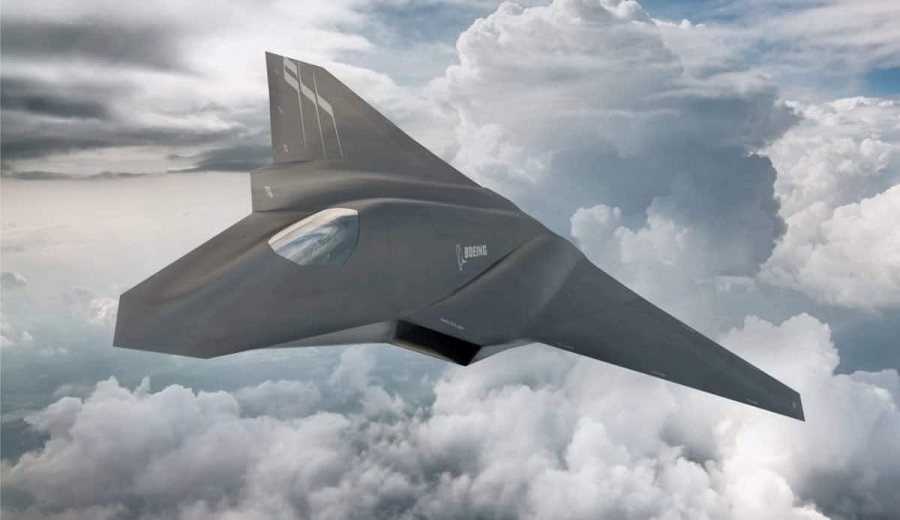
The Navy effort was reactivated after a period of budget uncertainty and congressional pressure to accelerate decisions and restore significant research-and-development funding. Recent public reporting cited in the same account indicates the competition has narrowed to Boeing and Northrop Grumman after Lockheed Martin was removed from contention.
In Stavatti’s published overview, the SM-39 is described as a next-generation air-dominance fighter and fighter-bomber intended to perform missions associated with aircraft including the F-47, F-22, F-15, and F/A-18E/F, as well as roles linked to the retired F-14 Tomcat, A-5 Vigilante, and A-6 Intruder. The company describes the Razor as a twin-engine, low-observable aircraft designed for piloted or unpiloted autonomous operations and positioned as a “direct bridge between atmospheric aircraft and future reusable space fighters.”
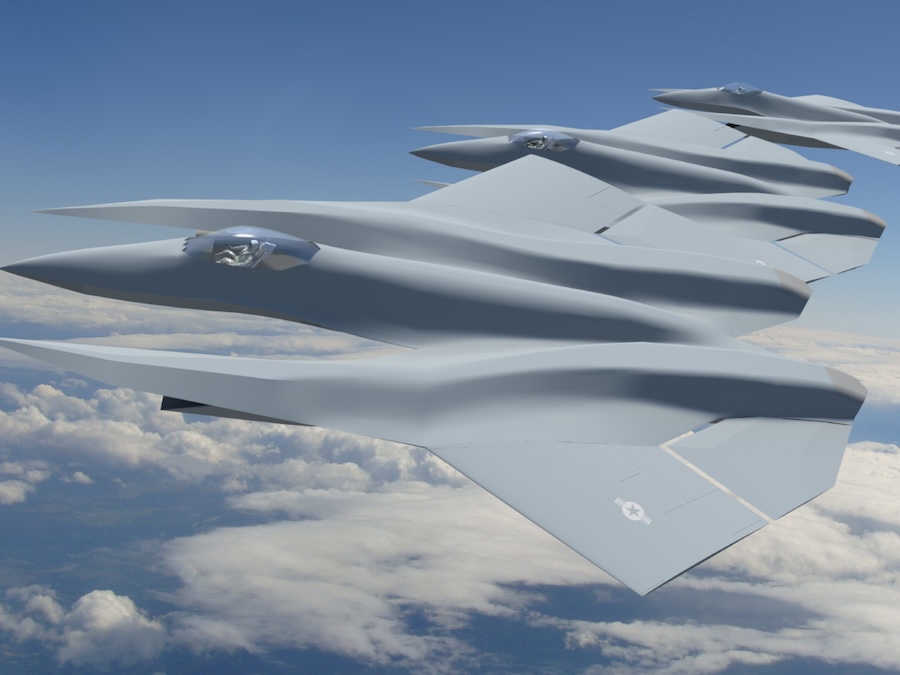
The design centers on a radical triple-fuselage planform with a streamlined center primary fuselage and two laterally mounted secondary fuselages that begin as highly swept wing strakes. Stavatti says this configuration is intended to reduce supersonic wave drag and produce a volume distribution close to the Sears–Haack ideal, supporting supercruise by placing the wing leading edge within the shock cone of the secondary-fuselage strakes at high Mach numbers.
Stavatti’s description places major avionics—including the radome and an AESA radar—along with the cockpit, nose landing gear, and two internal weapon bays in the center fuselage, while locating a serpentine variable-geometry internal-compression intake, a variable-cycle afterburning powerplant, and the main landing gear in each secondary fuselage. Fuel tanks, sensors, and electronic countermeasures are described as distributed across both the center and secondary fuselages, with the company asserting that the arrangement increases internal volume while lowering overall wave drag compared with supersonic fighters now in service.
Performance targets described by Stavatti include airspeeds above Mach 4 and level supercruise speeds above Mach 2.5, while the earlier report also cited a maximum speed of Mach 4 and cruise at Mach 2.5 alongside a tactical combat radius exceeding 2,200 kilometers. The company further states the SM-39 is designed to sustain operations across a wide envelope from 103 KTAS up to 2,005 KTAS, with a landing-configuration stall speed as low as 103 KTAS.
For propulsion, Stavatti describes two next-generation variable-cycle afterburning engines in the 50,000-pound-thrust class, with candidates including a General Electric Aircraft Engines Adaptive Cycle Engine concept and Stavatti’s NeoThrust E1400 variable-cycle engine family. In its baseline description, Stavatti cites a hypothetical E1400 VCE delivering up to 52,400 pounds of maximum static thrust per engine at sea level, a projected maximum military thrust of 42,700 pounds, and a thrust-vectoring nozzle paired with a low-observable afterburner.
Structural choices in the overview emphasize high-speed durability and corrosion resistance, including “non-carbothermic titanium diboride metal sandwich skins with a titanium diboride foam metal core” supported by “laser welded titanium frames, bulkheads and longerons.” Stavatti also highlights aerodynamic and control features such as all-moving horizontal stabilizers with no vertical tail, double-slotted flaps with boundary-layer blowing, thrust vectoring, and a titanium foam metal sandwich construction approach.
Stavatti’s armament description aligns with the previously summarized concept of a fixed internal 20 mm M61A2 Vulcan cannon with 1,000 rounds and two internal weapon bays, while adding detailed bay dimensions and example loads. The forward weapons bay is described as 162 inches long and rated to 5,000 pounds at 7.5 g, while the mid-fuselage bay is described as 174 inches long and rated to 12,000 pounds at 7.5 g, with options including ejector racks or a rotary launcher and the potential to fit an internal “ferry tank” for up to 12,000 pounds of additional fuel when weapon racks are removed.
External carriage is described as four wing hardpoints rated at 4,500 pounds each, with the hardpoints described as jettisonable and compatible with stores including weapons such as the GBU-24, AGM-84, AGM-88, and AGM-154 and 370- and 600-gallon external fuel tanks. Stavatti describes a total combined internal and external rated warload of 25,000 pounds and states weapons integration is planned via a MIL-STD-1760 weapon interface data bus.
Directed-energy provisions are also included in Stavatti’s overview, ranging from potential contractor-provided systems to a company-described gas dynamic directed-energy weapon concept as an alternative to the internal cannon. Stavatti notes the SM-39 is designed with internal power and cooling reserves for future directed-energy integration and separately describes a gas dynamic laser approach that would use heat from the powerplant rather than relying on aircraft-generated electrical energy.
In accommodation and autonomy, Stavatti says the SM-39 will be produced in single-seat (SM-39S), two-seat tandem (SM-39T), and unpiloted/autonomous (SM-39U) configurations, with a modular cockpit and the ability for piloted variants to fly with or without a human onboard. The company states dedicated unpiloted versions would replace the cockpit module with additional fuel and equipment for recording and communications, using a proprietary “Synthetically Intelligent” autonomous flight control architecture built around open architecture systems and power-by-wire flight controls.
On sensors and survivability systems, Stavatti describes an open-systems avionics approach and outlines export and standard configurations, including references to specific systems it says may be used on prototype/export aircraft, such as a Raytheon Advanced Combat Radar AESA radar, an AN/ASQ-242 communications/navigation/identification system, and an electro-optical targeting system derived from the F-35’s EOTS concept. For electronic warfare, Stavatti describes an integrated self-protection suite for radar- and infrared-guided threats and references an export suite based on an F-35-derivative AN/ASQ-239 system alongside a distributed aperture system concept and countermeasures components, while also describing a future standard-production fully integrated digital electronic warfare system.
The earlier report also stated Stavatti plans to build a new US production facility capable of producing up to 200 aircraft per year and supporting about 1,600 skilled jobs over two decades. No direct, attributable quotes from individuals were included in the provided materials, so none can be reproduced or translated verbatim in this article.
Source: Stavatti Aerospace.