

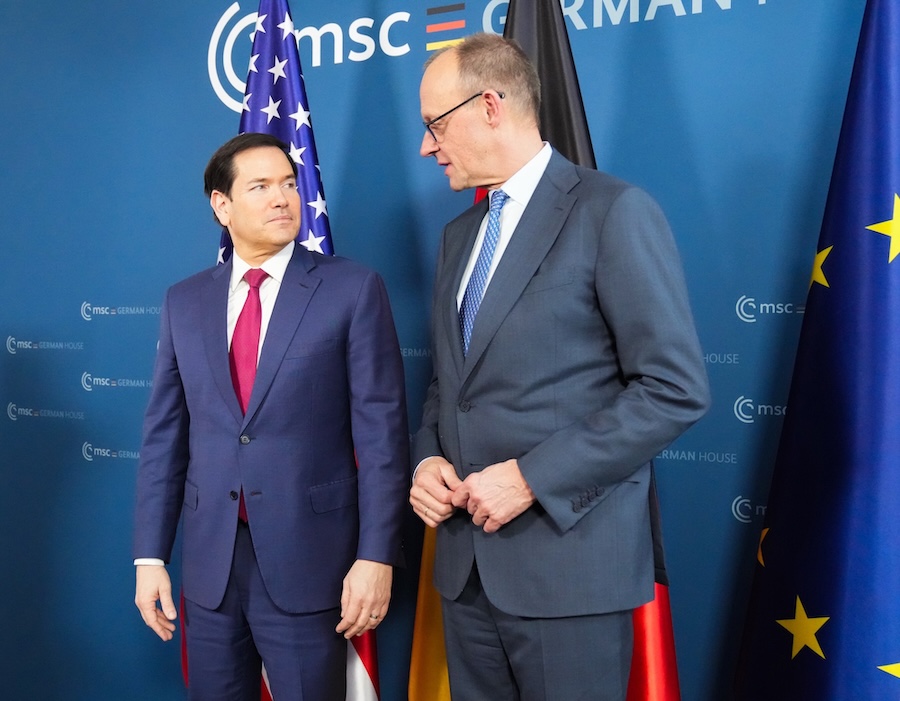
He said the end of the Cold War produced “a dangerous delusion” that the world had reached “the end of history,” that “every nation would now be a liberal democracy,” and that a “rules-based global order” would replace the national interest, calling it “a foolish idea that ignored both human nature and it ignored the lessons of over 5,000 years of recorded human history.” Rubio argued that “deindustrialization was not inevitable,” but “a conscious policy choice” that weakened Western economies, and said mass migration “was and continues to be a crisis which is transforming and destabilizing societies all across the West,” adding that controlling borders “is a fundamental act of national sovereignty.”
It is time to unshackle our ingenuity and build a new Western century. pic.twitter.com/KJjGQ24bCd
— Secretary Marco Rubio (@SecRubio) February 14, 2026
Rubio said Washington under President Donald Trump was pursuing “renewal and restoration,” adding, “while we are prepared, if necessary, to do this alone, it is our preference and it is our hope to do this together with you, our friends here in Europe.” He stressed, “We want Europe to be strong,” and warned that “the fate of Europe will never be irrelevant to our own,” arguing that national security is not only about defense spending but about “what exactly are we defending, because armies do not fight for abstractions,” but rather “for a people; armies fight for a nation. Armies fight for a way of life.”
I am reminded by my own story that both the history and fate of the United States and Europe will always be linked together. pic.twitter.com/wXHfymCV6d
— Secretary Marco Rubio (@SecRubio) February 14, 2026
On Ukraine, Rubio said “the issues that need to be confronted to end this war have been narrowed,” describing that as “the good news,” but cautioned that they have been “narrowed to the hardest questions to answer.” He said, “we don’t know the Russians are serious about ending the war; they say they are,” and that Washington would “continue to test it,” while noting additional U.S. sanctions on Russia’s oil, what he described as India’s commitment “to stop buying additional Russian oil,” continued European steps, and ongoing support including “the Pearl Program” as the United States seeks “a negotiated settlement to this war so long as the conditions are just and sustainable.”
Addressing global institutions, Rubio said the United Nations “still has tremendous potential to be a tool for good in the world,” but argued that on major conflicts “it has no answers and has played virtually no role,” asserting that “we do not live in a perfect world” and that threats cannot be allowed to “shield themselves behind abstractions of international law which they themselves routinely violate.” He said the alliance Washington seeks is “not paralyzed into inaction by fear – fear of climate change, fear of war, fear of technology,” but one ready to “boldly race into the future,” adding that “we do not seek to separate, but to revitalize an old friendship and renew the greatest civilization in human history.”
Asked about China ahead of an expected summit between Trump and President Xi Jinping, Rubio said it would be “geopolitical malpractice to not be in conversations with China,” while acknowledging that “our national interests will often not align.” He said the objective of diplomacy is “to try to navigate those times in which our national interests come into conflict with one another, always hoping to do it peacefully,” stressing that “nothing that we agree to could come at the expense of our national interest,” and warning that “there are some fundamental challenges between our countries and between the West and China that will continue for the foreseeable future.”
Source: U.S. Department of State.