The government said global instability and rapid technological change require a new approach to defence investment. It argued that procurement has been too complex, too slow and overly dependent on international suppliers, limiting opportunities for Canadian workers and businesses and leaving the military without essential equipment.
The new strategy aims to prioritise Canadian suppliers and materials, invest in innovation and commercialisation, and streamline procurement processes. It is intended to enable domestic aerospace, cyber and other industries to scale up, expand exports and create high-paying careers across defence supply chains.
Over the next decade, the strategy positions Canadian industry to pursue 180 billion dollars in defence procurement opportunities and 290 billion dollars in defence-related capital investment opportunities in Canada. The government anticipates a downstream economic benefit of 125 billion dollars by 2035, alongside the creation of 125,000 high-paying careers, a 50 per cent increase in defence exports, a rise in the share of defence acquisitions awarded to Canadian firms to 70 per cent, and a 240 per cent growth in defence industry revenues.
Within ten years, maritime fleet serviceability is expected to reach 75 per cent, land fleets 80 per cent and aerospace fleets 85 per cent. In total, the Defence Industrial Strategy represents an investment of over half a trillion dollars in Canadian security, prosperity and sovereignty.
A central element of the plan is the new Defence Investment Agency, which will streamline processes, reduce administrative barriers and accelerate delivery of equipment to the Canadian Armed Forces. The agency will prioritise Canadian manufacturing and strategic partnerships, including with small and medium-sized enterprises, and will lead Canada’s participation in joint procurement initiatives.
The strategy is built on five pillars, including positioning Canada as a leader in defence production and making it easier to build domestically by breaking down barriers between government and industry. It also includes scaling up defence and dual-use innovation, protecting workers and supply chains, and coordinating efforts with provinces, territories and Indigenous rights holders, including in the North and the Arctic.
Funding measures include a new 4 billion dollar Defence Platform at the Business Development Bank of Canada, 379.2 million dollars for a Regional Defence Investment Initiative, and 656.9 million dollars to support the development and commercialisation of defence and dual-use technologies. The plan also establishes a Drone Innovation Hub at the National Research Council, creates a Bureau of Research, Engineering and Advanced Leadership in Innovation and Science, and launches a Canadian Defence Industry Resilience Program, including initial steps to produce nitrocellulose in Canada.
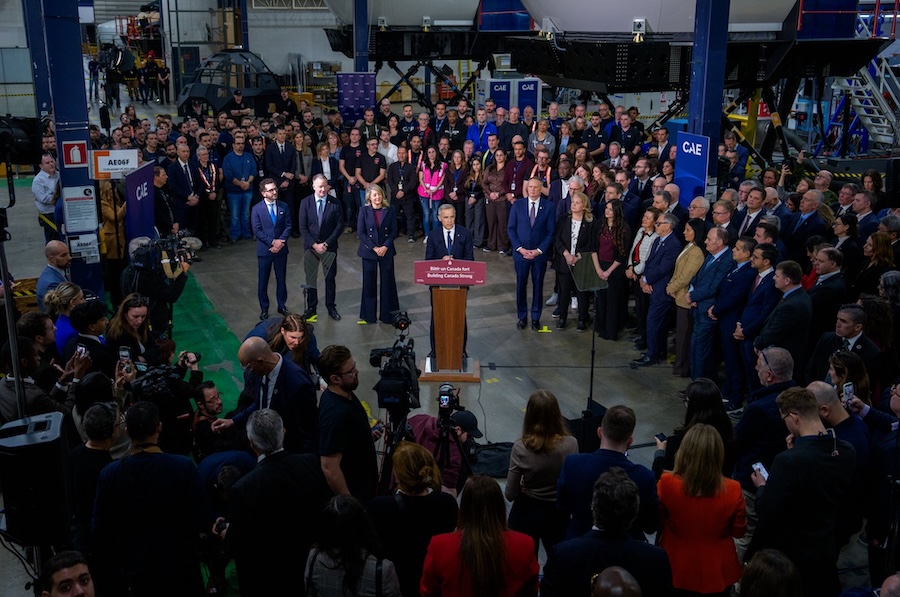
“The work of defending Canada is the work of building Canada. Security and prosperity are mutually reinforcing foundations of the true North, strong and free. Our new Defence Industrial Strategy ensures Canada remains a sovereign nation, in charge of its own destiny. That’s Canada strong, and that’s what we are building, together,” said Carney.
The Minister of National Defence, David J. McGuinty, said: “Today’s announcement reflects the government’s clear commitment to ensuring Canada has secure, timely, and reliable access to the capabilities required to defend our country, protect our sovereignty, and confront current and future threats. This is the time to be ambitious. By investing in Canada’s future, we are strengthening the Canadian Armed Forces’ ability to defend, deter, and defeat threats to Canada and Canadians – an investment we cannot afford to miss.”
The Minister of Industry, Mélanie Joly, said: “At a time of growing global uncertainty, Canada must strengthen its economic security and protect its sovereignty by investing at home. Canada’s new Defence Industrial Strategy will grow our domestic industrial base, create high-quality jobs in every region of the country, and position Canadian companies to compete and win globally. By building, innovating, and manufacturing in Canada, we are ensuring our industries benefit directly from defence investments while supporting the modernisation of the Canadian Armed Forces. Our government is meeting the moment for Canadians by driving growth, creating jobs across the country, and ensuring Canadians benefit from a stronger, more resilient defence economy.”
The Secretary of State for Defence Procurement, Stephen Fuhr, added: “With the launch of this strategy and the Defence Investment Agency, we are delivering the capabilities the Canadian Armed Forces need, when they need them, while growing Canada’s economy. By investing in our defence industrial base, we can build stronger supply chains, drive innovation, and create up to 125,000 good-paying jobs for Canadians.”
Doug Guzman, Chief Executive Officer of the Defence Investment Agency, said: “The Defence Industrial Strategy strengthens Canada’s capacity to deliver critical capabilities to the Canadian Armed Forces with greater speed, certainty, and strategic coherence. It supports the Defence Investment Agency’s mandate by enabling more agile procurement and more secure, resilient supply chains. Through a coordinated, whole-of-government approach, the DIA is well positioned to support Canadian industry and ensure Canada can meet its evolving defence requirements with confidence and credibility.”
Christyn Cianfarani, President and Chief Executive Officer of the Canadian Association of Defence and Security Industries, said: “This is an ambitious, landmark strategy that shows real leadership at a time of profound uncertainty and change. It’s a rallying cry – for the public service and the Department of National Defence to execute, and for industry to deliver on a new vision for Canada’s defence, economic resilience, and national security. Today’s outcome is an example of what’s possible when the public and private sectors listen to each other, and work toward the same goals.”
Source: Prime Minister of Canada.