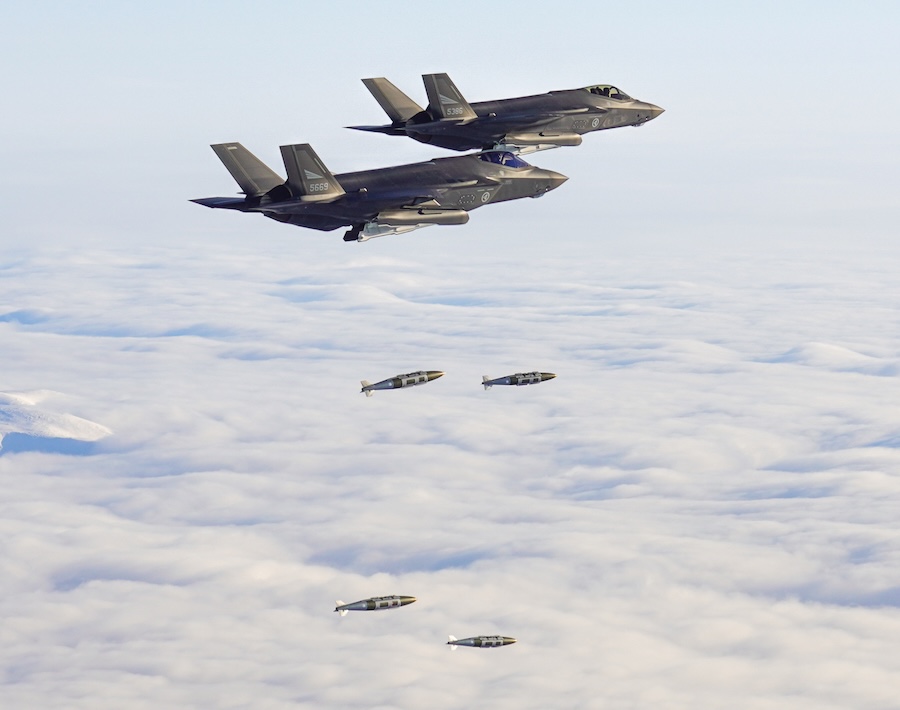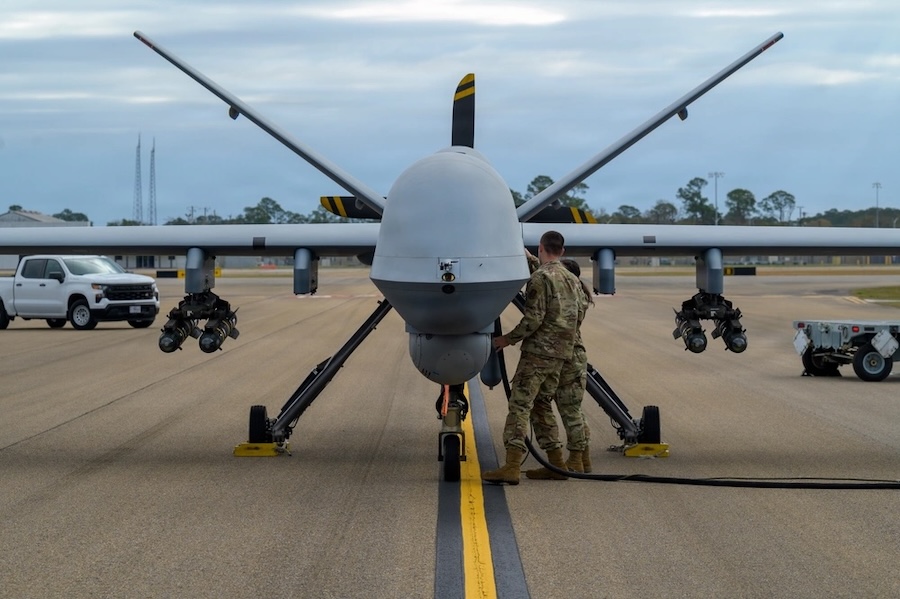


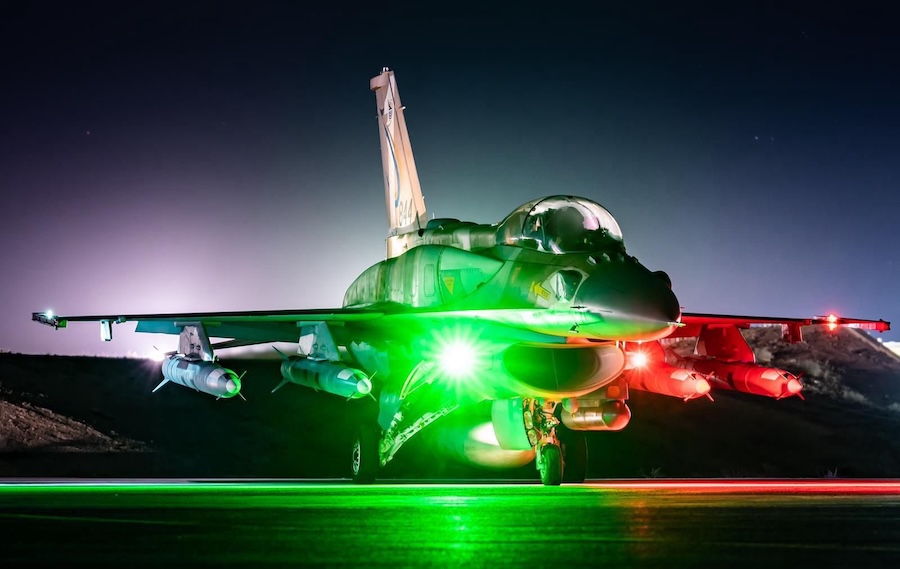
The loadout represents a development compared with configurations seen at the start of Operation Lion’s Roar. The image also offers a rare view of Israel’s evolving deep-strike posture during ongoing regional operations.
According to available information, the aircraft configuration appeared amid intensified joint U.S.–Israeli activities conducted under Operation Epic Fury and Operation Lion’s Roar. These operations continue to shape the broader regional air campaign.
The Israeli Air Force has operated F-16 Fighting Falcon aircraft since 1980. Since then, the aircraft family has participated in every war and military operation conducted by Israel.
After the retirement of the oldest F-16A/B Netz aircraft in December 2016, the service continues to operate F-16C/D Barak and F-16I Sufa fighters. These aircraft are unique within the global F-16 fleet due to the integration of Israeli-developed systems and weapons.
Israel purchased 75 F-16C/D Block 30 aircraft in August 1983 under the Peace Marble II programme. The aircraft, including 51 single-seat F-16C and 24 two-seat F-16D fighters, were delivered between 1987 and 1988 and received the name Barak, meaning “Lightning”.
Many systems installed in the aircraft were produced by Israel’s defence industry. The F-16C variant features an enlarged fairing at the base of the vertical stabiliser, while the F-16D version has an extended dorsal fairing between the crew cockpit and the vertical tail containing additional equipment, including an advanced Israeli-made electronic warfare self-defence system.
Following the cancellation of the domestic IAI Lavi fighter programme in August 1987 and the ageing of Israel’s F-4E Phantom II and Kfir fleets, the country ordered 60 additional F-16C/D Block 40 aircraft in May 1988 under the Peace Marble III programme. Deliveries took place between 1991 and 1993 and the aircraft also received the Barak designation, sometimes informally referred to as Barak II.
Between 2010 and 2012, all F-16C/D aircraft remaining in service were upgraded to the Barak 2020 standard. The upgrade introduced Israeli mission computers and colour cockpit displays similar to those used in the F-16I, as well as modern Israeli helmet-mounted targeting systems.
F-16C/D fighters currently serve with three squadrons based at Ramat David Air Base. These include the 101st “First Fighter” Squadron, the 105th “Scorpion” Squadron and the 109th “Valley” Squadron.
After the retirement of the most heavily used aircraft, around 53 F-16C and 48 F-16D fighters remain in active service. The F-16C is used primarily for ground-attack missions, while the F-16D is often assigned to complex suppression of enemy air defence tasks.
The F-16I Sufa was developed following a decision by Israel’s Ministry of Defence in July 1997 to procure additional combat aircraft. The aircraft were intended to replace ageing A-4 Skyhawk, F-4E Phantom II and early F-16A/B fighters.
Initial plans considered the purchase of F-15I aircraft or additional F-16C/D fighters. Eventually, on January 14, 2000, Israel signed a contract for 50 two-seat F-16D Block 52 aircraft under the Peace Marble V programme, with an option for additional units.
The option was exercised in December 2001 with the order of 52 additional aircraft, bringing the total purchase to 102 F-16D Block 52 fighters valued at approximately 4.5 billion dollars. These aircraft received the designation F-16I and the name Sufa, meaning “Storm”.
The Israeli version differs significantly from other export variants of the F-16. It includes Israeli-developed head-up displays, mission computers, flight-data computers, graphics processors, colour cockpit displays, video data-link systems, helmet-mounted sights, satellite communications radios and electronic warfare self-defence systems.
The aircraft also uses conformal fuel tanks and additional under-wing fuel tanks produced in Israel. These features allow the aircraft to carry a wide range of Israeli air-to-air and air-to-ground weapons.
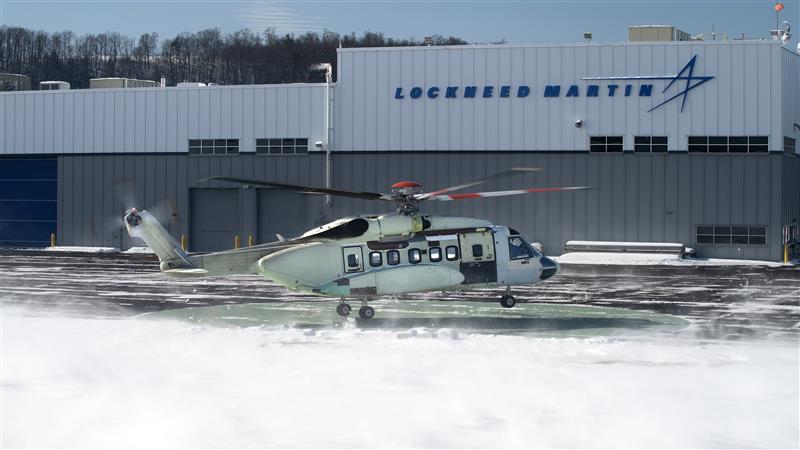
The first F-16I aircraft was formally rolled out at Lockheed Martin’s facility in Fort Worth, Texas, on November 14, 2003. Another aircraft conducted the first flight on December 23 of the same year.
Two months later, on February 19, 2004, the first two F-16I aircraft arrived at Ramon Air Base in Israel. Deliveries continued until February 2009, when the entire contract was completed.
The F-16I Sufa is primarily used for ground-attack missions, including operations aimed at suppressing enemy air defences. Currently, 96 aircraft remain in service with the Israeli Air Force.
These aircraft are operated by three squadrons at Ramon Air Base, including the 119th “Bat” Squadron, the 201st “The One” Squadron and the 253rd “Negev” Squadron. Another unit, the 107th “Knights of the Orange Tail” Squadron, operates the aircraft from Hatzor Air Base.