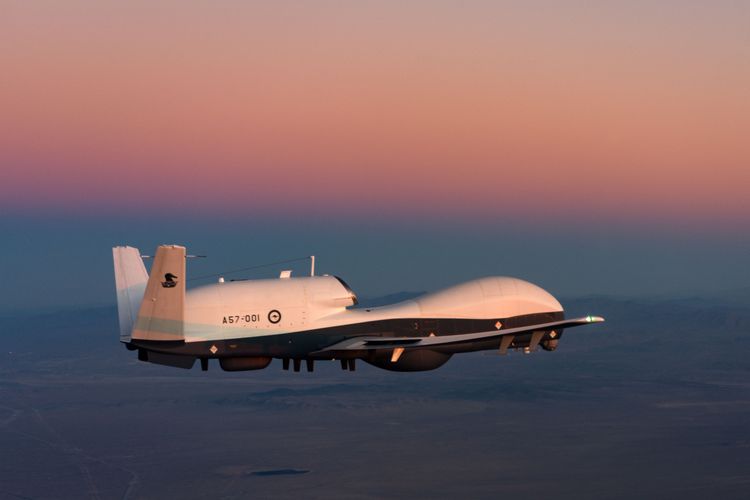
The MQ-4C Triton achieved Initial Operational Capability with the U.S. Navy in 2023. Since then, the aircraft has provided persistent surveillance designed to help predict adversary behavior and improve the planning of joint military operations.
The aircraft is classified as a high-altitude, long-endurance system built specifically for wide-area maritime ISR missions. According to Northrop Grumman, this configuration allows the Triton to deliver capabilities better suited to large-scale maritime surveillance than medium-altitude, long-endurance platforms.
Operating at altitudes above 50,000 feet, the aircraft combines long range with advanced sensor coverage. This allows the system to conduct surveillance and targeting while remaining well above and away from potential threats.
Northrop Grumman states that Triton’s altitude, range and sensor package allow the aircraft to perform missions more effectively with fewer flight hours than medium-altitude platforms. These characteristics make it particularly suitable for persistent monitoring of large maritime areas.
The MQ-4C Triton is designed to provide commanders with enhanced maritime domain awareness. Its multi-intelligence sensor suite allows the aircraft to monitor activities across vast ocean regions and deliver detailed situational awareness.
The unmanned system also operates alongside crewed surveillance aircraft. By covering large areas for extended periods, Triton enables commanders to assign manned aircraft to other operational tasks.
Continuous development of the aircraft is supported through research and development funding provided by the U.S. Navy. According to Northrop Grumman, these investments ensure the platform receives ongoing capability upgrades and improvements designed to keep pace with evolving threats.
The MQ-4C Triton builds on the company’s experience in high-altitude autonomous systems. The platform draws on technologies proven in Northrop Grumman’s RQ-4B Global Hawk and RQ-4D Phoenix aircraft.
Australia has played an important role in the cooperative development of the system. Its participation helped shape the operational requirements for the aircraft’s design and capabilities.
U.S. and Australian forces share data collected by their respective Triton aircraft. This capability is considered particularly important in one of the world’s most dynamic security regions.
The Royal Australian Air Force recently received its second and third Triton aircraft from a planned fleet of four. The system is operated by Number 9 Squadron from RAAF Base Edinburgh in South Australia and RAAF Base Tindal in the Northern Territory.
As the United States and its allies assess their maritime ISR capabilities, Northrop Grumman states that the MQ-4C Triton remains a proven option for future operations. The company says the aircraft is ready to support battlefield commanders and strategic decision makers by delivering persistent maritime intelligence and surveillance capabilities.
Source: Northrop Grumman.