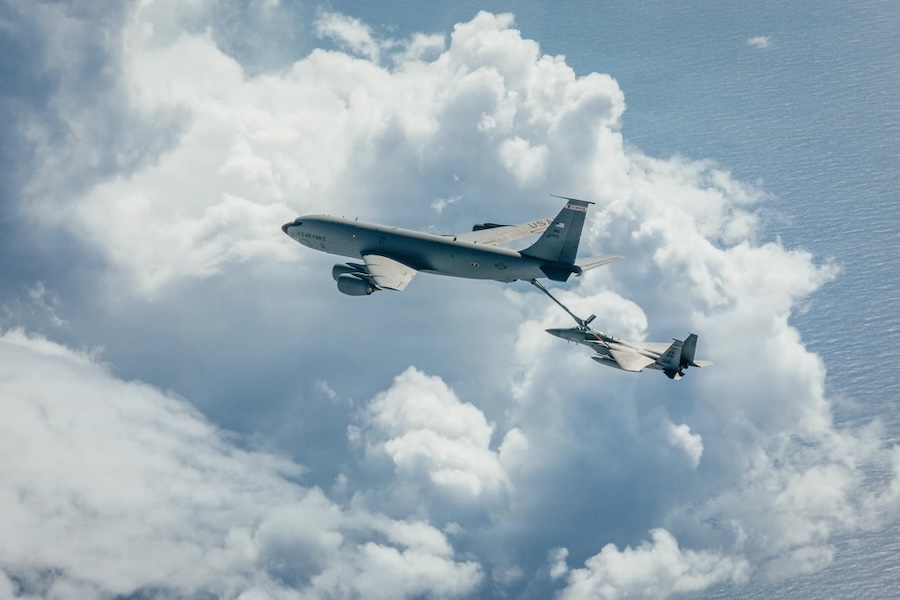
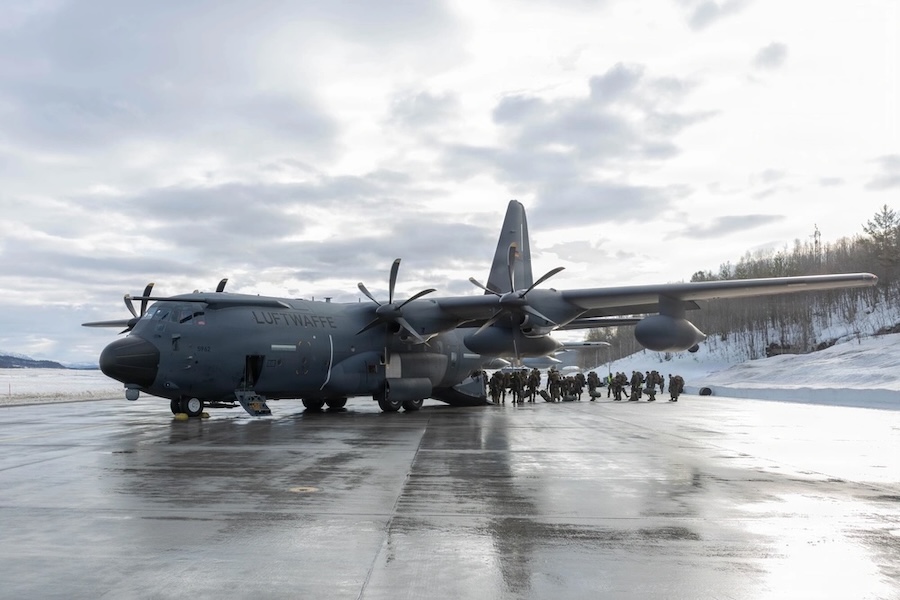
The mission involved two German-operated KC-130J Super Hercules aircraft from the Binational Air Transport Squadron (BATS) based in Évreux, France, along with another KC-130J from the U.S. Marine Corps’ Marine Aerial Refueler Transport Squadron 252 (VMGR-252). The aircraft transported Marines from Echo Company, 2nd Battalion, 6th Marine Regiment from Bardufoss, Norway to Rovaniemi, Finland.
BATS represents a unique example of European defense integration. Established in 2022, the squadron consists of around 300 French and German pilots, mechanics and support personnel who operate and train together as a single unit.
A BATS KC-130J pilot described the unit’s role in multinational training operations. “We are a young and ‘one of a kind’ squadron,” the pilot said, adding that “CORE26 is a great opportunity to benefit from training alongside NATO-allies in a joint and combined training approach.”
The squadron routinely trains in harsh conditions to prepare for operations in the High North. As a tactical air transport unit, BATS conducts exercises in sub-zero temperatures to maintain readiness for Arctic missions.
The pilot emphasized the unit’s operational flexibility across different environments. “The BATS is capable of operating world-wide, in all climatic zones and under a wide range of operating conditions,” the pilot said, adding, “We have proven that in the recent years. Anytime, anywhere is our motto, and we live it.”
Upon arrival in Finland, the Marines linked up with equipment and supplies that had already been transported by a long-range ground convoy. The convoy, organized by Combat Logistics Battalion 6 (CLB-6), had traveled across Norway, Sweden and Finland over several days.
The movement ensured that Echo Company was fully prepared for training with soldiers from the Swedish Army’s 4th Mechanized Brigade (MekB4). The integration activities were scheduled ahead of a simulated force-on-force exercise involving other NATO forces beginning on March 14.
Coordinating both air and ground logistics is considered essential for projecting military capability across the Arctic region’s vast and challenging terrain. The KC-130J aircraft is designed to support such missions, with the ability to conduct assault support operations at austere airfields or landing zones with limited infrastructure.
U.S. Marine Corps Maj. Rich Webb, a KC-130J pilot and Weapons and Tactics Instructor with VMGR-252, said such capabilities are increasingly important for modern operations. “As we continue to shape the future of distributed aviation operations and maneuver warfare, long-range assault support platforms will play an increasingly pivotal role,” Webb said.
He also emphasized the importance of cooperation between allied forces. “This flight underscored the vital importance of fostering enduring partnerships,” Webb added.
The mission was coordinated through the Combined Air Operations Center (CAOC) in Bodø, Norway. The center, opened in October 2025, oversees air operations across the Nordic region, the Baltic Sea, the North Atlantic and the Barents Sea.
According to Webb, the mission demonstrated the ability of allied forces to quickly respond when support is required. “It was an absolute privilege to fly alongside our German counterparts during this insertion,” Webb said.
He added that such missions highlight the value of multinational coordination. “These integration flights exemplify how deliberate joint planning and seamless execution transform two capable units into a unified, effective team.”
The Arctic airlift illustrated how synchronized logistics and aviation support can rapidly deploy ground combat forces into operational areas. In this case, the coordination of CLB-6, BATS and VMGR-252 enabled Echo Company and Swedish Army units to integrate quickly for upcoming exercises.
The operation was conducted during Cold Response 26, a Norwegian-led winter exercise involving more than 25,000 personnel from over a dozen NATO allies and partner nations. The exercise is intended to strengthen collective defense and ensure forces can operate effectively in demanding Arctic conditions.