

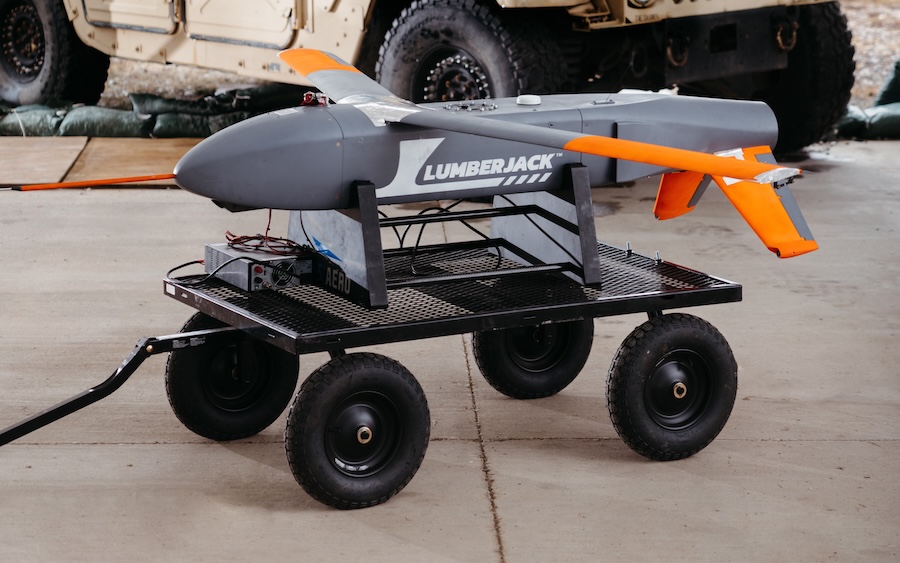
The demonstration focused on the system’s ability to support autonomous targeting, precision strike and intelligence, surveillance and reconnaissance missions. Officials said the exercise marked progress towards rapid field deployment of autonomous combat capabilities.
Lumberjack was tested using the U.S. Army’s Maven Smart System for full autonomous mission control. Personnel were able to evaluate its performance under operational conditions.
The system also demonstrated precision strike capability using simulated deployments of the Hatchet miniature munition. This lightweight weapon is designed to provide effects typically associated with larger systems.
During the exercise, Lumberjack integrated artificial intelligence-enabled targeting tools. These allowed rapid adaptation to changing battlefield scenarios under human supervision.
The system maintained beyond line-of-sight communications via satellite datalink. This enabled the transmission of real-time mission updates and damage assessments.
Following simulated strike operations, Lumberjack transitioned to a surveillance role. This demonstrated its ability to perform multiple mission types within a single deployment.
“After going from concept to flight in under 14 months, we demonstrated Lumberjack’s ability to adapt across diverse missions and payloads at the U.S. Army’s Operation Lethal Eagle exercise,” said Michael Bastin.
“This highly attritable system represents a practical approach to cost-effective uncrewed platforms – changing not just how they operate, but how they dominate the battlefield,” he added.
The system is designed as a low-cost, one-way attack platform with a modular payload bay. This allows operators to switch between kinetic and non-kinetic mission configurations.
As an attritable platform, Lumberjack is intended to be expendable while maintaining operational effectiveness. Its range and speed enable deployment from stand-off distances in contested environments.
“While primarily focused on readiness training, Operation Lethal Eagle also provided a unique opportunity to test and evaluate multiple new emerging systems from across the defense industrial enterprise,” said Jonathon Bless.
“Northrop Grumman’s Lumberjack was one of many systems tested during the exercise that provided insight into how collaboration between military and industry can drive innovation in defense,” he added.
The system can be launched from both air and ground platforms, offering operational flexibility. Its mission kit converts a third-party airframe into a combat-ready system.
Developed in partnership with Empirical Systems Aerospace and Palantir Technologies, Lumberjack progressed from concept to first flight in under 14 months. Officials said this timeline reflects an accelerated approach to innovation in defence systems.