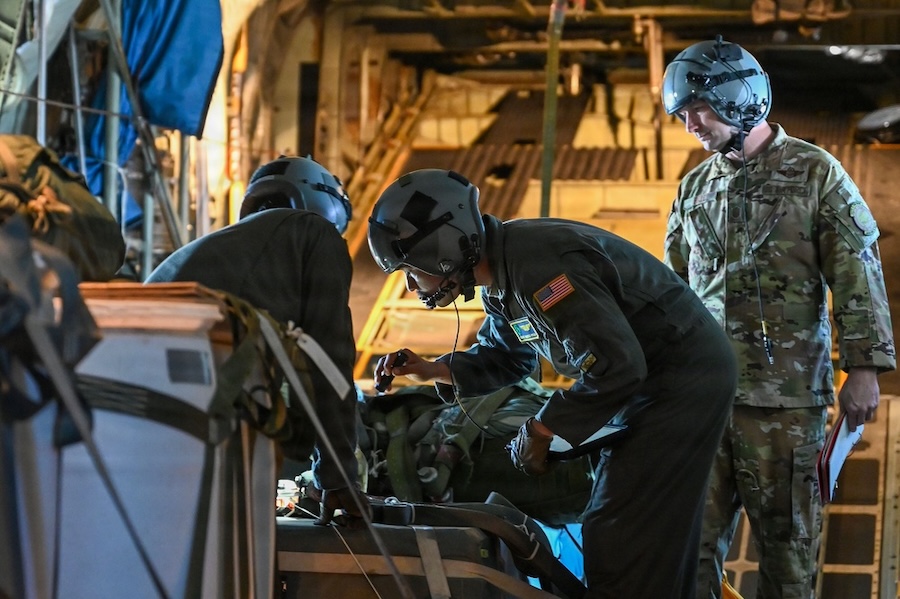
At the center of the initiative is a Combined Test Force made up of Air Force Reserve and Air National Guard personnel working with the 417th Test and Evaluation Squadron. The collaboration draws on extensive institutional knowledge of the C-130H fleet to support the modernization effort.
The program includes retaining six multifunction displays in a revised cockpit configuration with ergonomic hand controls. It also preserves both the flight engineer and navigator positions to maintain critical crew redundancy for tactical airlift missions.
The Avionics Modernization Program replaces legacy analog systems with integrated digital avionics to enhance navigation and communication capabilities. It also addresses the declining availability of parts for older components, which have increasingly limited the aircraft’s access to regulated international airspace.
Lt. Col. Eric Dueno, director of the C-130 Combined Test Force overseeing the program, highlighted the importance of the upgrades. “This effort is essential to maintaining the C-130H’s operational relevance and ensuring it can execute its global mission set without restriction,” Dueno said.
He added that the program goes beyond incremental improvements. Dueno said it is “fundamentally modernizing these aircraft to meet current and future airspace requirements worldwide.”
A central element of the modernization effort is the integration of a new flight management system. This transition moves aircrews from the flexibility of analog controls to structured navigation inputs typical of modern airliners, with crews building proficiency through operational flying and focused training.
Testing and evaluation are being carried out by the Combined Test Force under operationally realistic conditions. The effort reflects a broader total force approach to ensuring the aircraft remains effective across all units that operate it.
Lt. Col. Andy “DAT” Kraemer, who oversees aspects of testing, said the focus remains on how crews interact with the new systems. “At the operational level, our focus is on the user experience,” Kraemer said. “We evaluate how these systems perform for aircrews in demanding tactical airlift environments.”
Jeff Thelander, an employee at the Aircraft Airlift Test Center with more than 40 years of experience supporting the platform, described the scope of the changes. “We have essentially transitioned from a completely analog cockpit to a fully digital environment,” Thelander said.
“These upgrades are non-negotiable. They are the assurance that the C-130H will continue to deliver personnel and cargo precisely where they are needed, anywhere in the world,” he added. As the program moves toward key acquisition decisions and broader implementation, it reinforces the aircraft’s role in supporting tactical airlift and global readiness for decades to come.