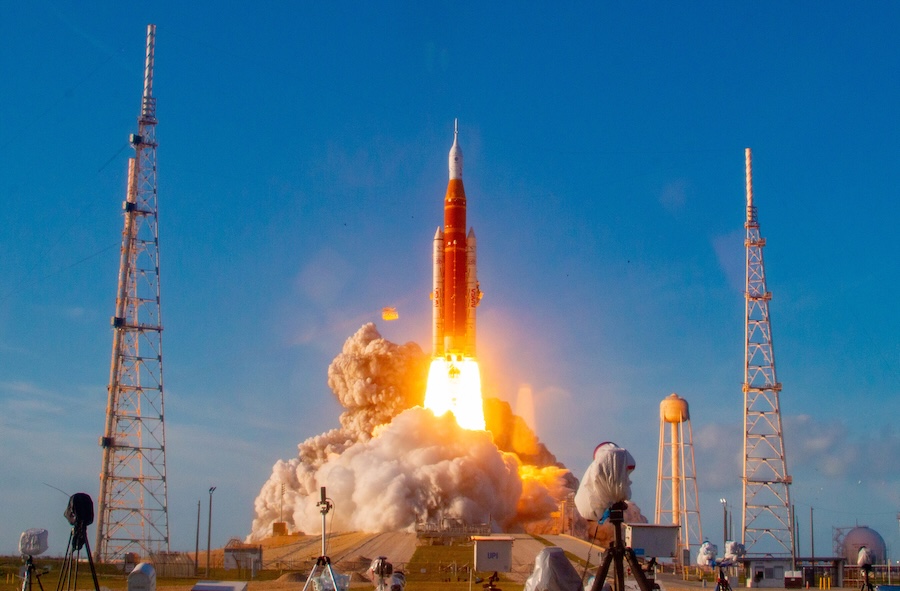
The core stage completed its role approximately eight and a half minutes into flight before separating from the upper stage. This allowed NASA’s Orion spacecraft, named Integrity, to continue the mission carrying astronauts on a lunar trajectory.
The crew includes NASA astronauts Reid Wiseman, Victor Glover and Christina Koch, along with Canadian Space Agency astronaut Jeremy Hansen. They are expected to conduct a 10-day mission that includes travel around the Moon.
“We’re honored to support NASA in restoring a capability vital to our nation’s interests and future,” said Steve Parker, president and chief executive officer of Boeing Defense, Space & Security. “Boeing and our Space Launch System partners are committed to NASA’s mission to return astronauts to the moon, to establish a sustained lunar presence, and continue our exploration of deep space.”
Boeing said the core stage demonstrated a series of critical operations during the launch sequence. These included fueling both propellant tanks, activating hydraulic systems, engine ignition, thrust vector control, fuel depletion, engine shutdown and separation maneuvers.
“Today we witnessed our friends embark on a historic mission aboard our rocket,” said John Shannon, vice president of Boeing’s Exploration Systems business. “Our focus has been on prioritizing the quality of the vehicle and the safety of the crew as they begin their journey. This rocket is designed to withstand incredible forces while speeding through the atmosphere, and it performed exactly as intended. I want to extend my heartfelt thanks to our dedicated team and partners for their hard work in making this part of the mission a success.”
The core stage stands 212 feet tall and includes a liquid oxygen tank with a capacity of 196,000 gallons and a liquid hydrogen tank holding 537,000 gallons. It is equipped with four RS-25 engines that generate a combined 2.2 million pounds of thrust.
The stage is manufactured at NASA’s Michoud Assembly Facility in New Orleans, Louisiana, with components supplied from more than 38 U.S. states. Boeing said teams are currently preparing additional core stages for future Artemis missions.
Production is underway for core stages that will support Artemis III through Artemis V missions. These units are being assembled at Michoud and Kennedy Space Center as part of NASA’s long-term lunar exploration plans.
Boeing said it continues to support NASA’s objectives to return humans to the Moon and advance deep space exploration.