

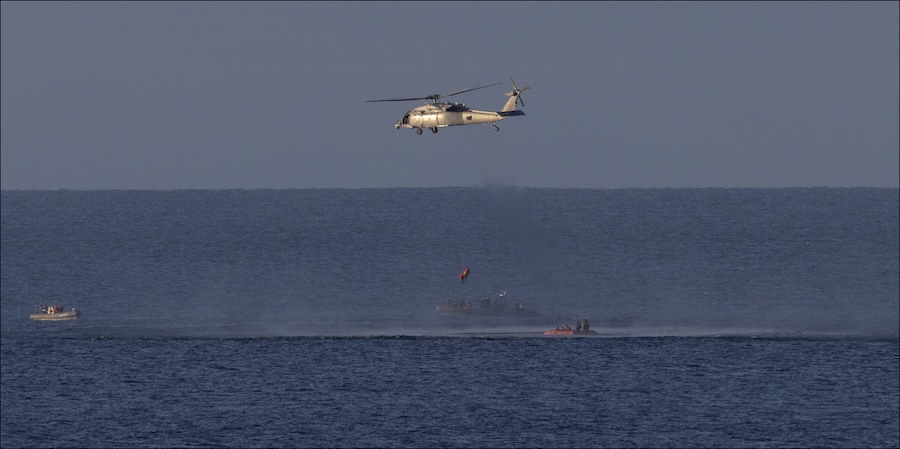
NASA astronauts Reid Wiseman, Victor Glover and Christina Koch, along with Jeremy Hansen of the Canadian Space Agency, traveled a total of 694,481 miles during the mission. At its farthest point, the crew reached a distance of 252,756 miles from Earth.
The Artemis II mission surpassed the previous human distance record set by Apollo 13 in 1970. It also marked the first crewed flight of NASA’s Orion spacecraft and Space Launch System rocket.
Jared Isaacman, NASA Administrator, highlighted the mission’s significance. “Reid, Victor, Christina, and Jeremy, welcome home, and congratulations on a truly historic achievement. NASA is grateful to President Donald Trump and partners in Congress for providing the mandate and resources that made this mission and the future of Artemis possible,” he said.
Artemis II may have splashed down, but our photos and videos from the mission are still rolling in! Keep an eye on the latest: https://t.co/rzM1P0QbOl pic.twitter.com/HahXb0gCYC
— NASA (@NASA) April 11, 2026
“Artemis II demonstrated extraordinary skill, courage, and dedication as the crew pushed Orion, SLS (Space Launch System), and human exploration farther than ever before,” Isaacman added. He noted the risks accepted by the crew in advancing future exploration.
Following splashdown, recovery teams assisted the astronauts from the spacecraft and transported them to the USS John P. Murtha. The crew is expected to return to NASA’s Johnson Space Center in Houston for further evaluation.
The mission launched on April 1 from Kennedy Space Center using the Space Launch System rocket. Producing 8.8 million pounds of thrust, the rocket delivered the Orion spacecraft into orbit with precision.
During the flight, Orion’s systems were tested extensively. The crew verified life support capabilities and conducted manual piloting demonstrations to support future missions.
On the second day, Orion’s service module engine placed the spacecraft on a trajectory toward the Moon. The spacecraft passed within 4,067 miles of the lunar surface during its closest approach.
Amit Kshatriya, NASA Associate Administrator, said the mission validated key systems. “The Artemis II crew is home. The entry, descent, and landing systems performed as designed and the final test was completed as intended. This moment belongs to the thousands of people across fourteen countries who built, tested, and trusted this vehicle,” he said.
“Their work protected four human lives traveling at 25,000 miles per hour and brought them safely back to Earth,” Kshatriya added. He emphasized the role of international collaboration in the mission.
The astronauts also conducted scientific research during the mission. Experiments focused on human health in deep space and the effects of microgravity and radiation.
During the lunar flyby on April 6, the crew captured more than 7,000 images of the Moon and surrounding space. The images included views of lunar terrain, solar eclipse conditions, and deep-space phenomena.
The mission provided data to support future lunar exploration. It will help prepare for long-duration missions and the establishment of a sustained human presence on the Moon.
With Artemis II completed, NASA is now preparing for Artemis III. The next mission aims to return astronauts to the lunar surface and advance long-term exploration goals.
Source: NASA (press release).






![CENTCOM chief says U.S. forces remain ready after ‘generational’ defeat of Iran despite fragile ceasefire [VIDEO]](https://defence-industry.eu/wp-content/uploads/2026/04/centcom-chief-says-us-forces-remain-ready-after-generational-defeat-of-iran.jpeg)
![Team Lynx details XM30 infantry fighting vehicle concept as U.S. Army program nears key decision [VIDEO]](https://defence-industry.eu/wp-content/uploads/2026/04/team-lynx-details-xm30-infantry-fighting-vehicle-concept.jpeg)