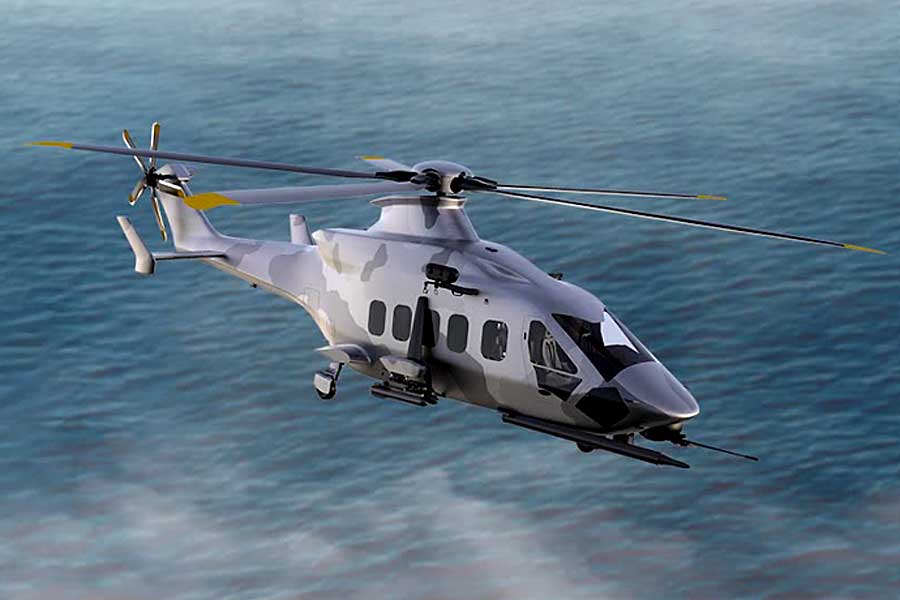



The submission includes two concepts: a high-performance conventional helicopter and a novel high-speed compound rotorcraft. According to Airbus, the twin approach is intended to ensure operational efficiency and fleet complementarity for military partners.
Modularity and simplicity form the core principles of the proposal. The design philosophy is based on delivering platforms that are straightforward to manufacture, maintain and upgrade, supporting long-term affordability through a Modular Open System Architecture approach.
Both concepts are designed to be highly connected and to share common elements in maintenance, training, weapons and systems. Airbus states that this commonality will contribute to operational efficiency and cost control over the platforms’ lifecycle.
Bruno Even, CEO of Airbus Helicopters, said: “We want to ensure that Europe is in a position to propose a platform that will best fit our military partners’ needs in terms of affordability, operational efficiency and maximum availability for both the conventional helicopter and for the high speed rotorcraft. These two concepts are a basis to further exchange with our military partners on their vision and need for future military operations.”
He added: “Airbus Helicopters is actively working on the future of its military range. On the one hand, we are preparing the evolution of our legacy range with a continuous improvement policy. With the Block 1 and 2 studies, we have a long-term NH90 evolution roadmap. Our dual product range, the H145M, the H160M, and the H225M, is setting new standards for military helicopters in terms of affordability, connectivity, and maintenance.”
Even continued: “On the other hand, we are working on the next generation of rotorcraft systems, leveraging modular multi-platform technologies such as connectivity, cybersecurity, crewed-uncrewed teaming, multi-domain collaborative combat, survivability and battle damage repair.” His remarks outline both the modernisation of existing platforms and the development of future systems.
In July 2024, the NATO Support and Procurement Agency awarded a contract to Airbus Helicopters to lead a concept study under the NGRC project. The participating nations are combining efforts to design, develop, deliver and support a medium multi-role helicopter.
Airbus’ advanced concept builds on its experience in military rotorcraft and high-speed flight, particularly through its compound configuration demonstrators, the X3 and Racer. This configuration enables significantly higher speeds than conventional helicopters and extends the flight envelope, allowing rapid acceleration and deceleration as well as fast climb and descent capabilities.
The advantages of added wings and propellers were confirmed during flight evaluations by military pilots on Racer within the European Next Generation Rotorcraft Technologies programme. Airbus states that this extensive flight-test knowledge, supported by operational feedback from customers, underpins the proposed next generation capability.