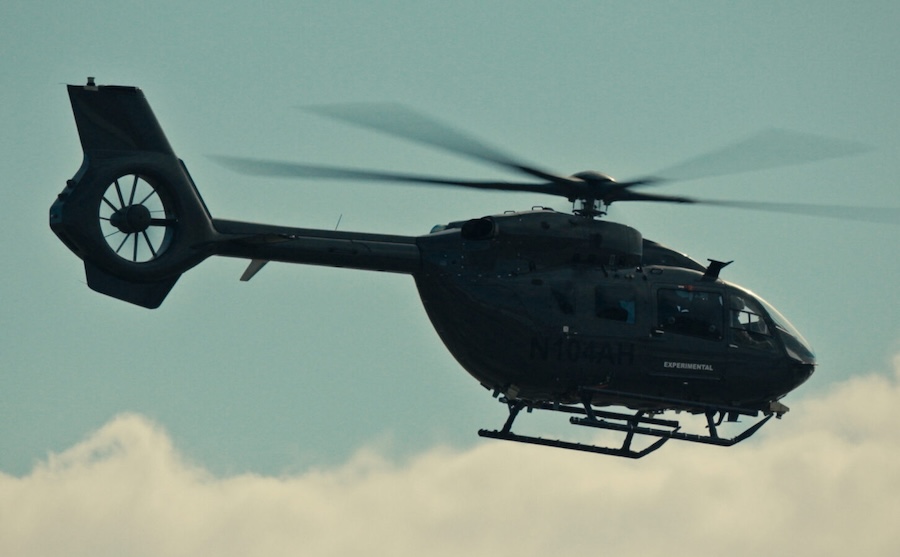
The test flights took place at Airbus facilities in Grand Prairie, Texas. They focused on refining the aircraft’s perception system to ensure it delivers accurate, real-time data to an autonomous pilot for obstacle avoidance within landing zones.
Rob Geckle, Chairman and Chief Executive Officer of Airbus U.S. Space and Defense, said: “This test was vital for us to show the Lakota Connector’s development in performing aerial logistics missions for the U.S. Marine Corps.” He added: “Perception systems can make or break the success of an unmanned mission in the field, and I am excited to see our aircraft perform so well under uncertain conditions.”
During the tests, the integrated technologies enabled the H145 aircraft to autonomously assess landing zones, detect obstacles, and redirect to alternative sites when necessary. The demonstration highlighted coordinated performance across all partner systems.
Jason Lambert, President of Intelligence, Surveillance and Reconnaissance at L3Harris, said: “L3Harris is delivering the digital backbone that advances autonomous aviation from concept to combat-ready capability.” He added: “Our Modular Open System Architecture enabled this team to integrate four partner technologies seamlessly, demonstrating the speed and interoperability that will define the future of unmanned logistics for the Marine Corps.”
Shield AI’s Hivemind autonomy software demonstrated core capabilities, including autonomous perception of the aircraft. The system supported the aircraft’s ability to operate without direct human control during mission scenarios.
Christian Gutierrez, vice president of Hivemind Solutions at Shield AI, said: “This H145 flight test proves Hivemind delivers scalable autonomy across rotary and fixed-wing aircraft without custom redesign.” He added: “That speed and flexibility are critical in contested logistics.”
Parry Labs contributed edge computing and autonomy-enabling software infrastructure to support onboard perception and real-time decision-making. The company’s systems enabled rapid processing of mission data during flight operations.
John “JD” Parkes, Chief Executive Officer of Parry Labs, said: “Autonomy only works when perception and mission software operate together at the edge.” He added: “This flight test showed how partner technologies can be rapidly integrated to deliver real-world operational capabilities.”
The program is part of the Aerial Logistics Connector Middle Tier of Acquisition Rapid Prototyping initiative, now in its second year. The effort aims to deliver aircraft prototypes and demonstrate capabilities to the U.S. Marine Corps through operational testing.
In May 2024, Naval Air Systems Command awarded Airbus U.S. Space & Defense a Phase I Other Transaction Authority under the Naval Aviation Systems Consortium. The award was based on the company’s unmanned UH-72 Logistics Connector concept, derived from the UH-72 Lakota platform.
The Aerial Logistics Connector programme is one of several Department of Defense initiatives focused on delivering logistical support in distributed environments. These efforts are intended to support operations in potential peer or near-peer conflict scenarios.