

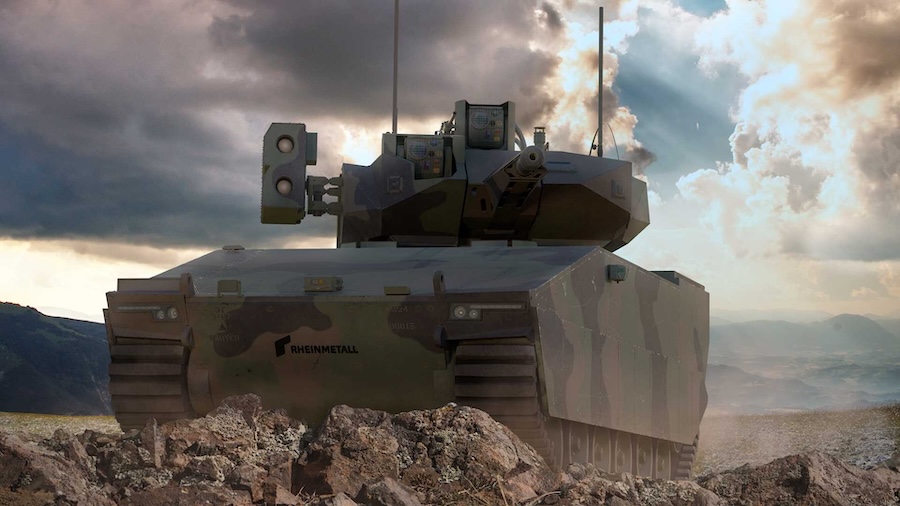
“At American Rheinmetall, that philosophy isn’t new,” said Matt Warnick, CEO of American Rheinmetall. “We don’t wait for government R&D dollars to start moving. We invest first because that’s how we get capability to the Soldier faster.”
The company says it has long funded production lines, technology rigs and factory modernisation before receiving contract awards to shorten development timelines. It adds that this model reduces programme risk and delivers equipment faster than traditional acquisition approaches.
Rheinmetall says the approach has been proven globally through the KF41 Lynx infantry fighting vehicle and KF51 Panther main battle tank, both developed without government RDT&E funding. By comparison, the government-funded Main Ground Combat System programme launched in 2017 is targeting delivery around 2040.
In the United States, American Rheinmetall invested more than $40 million ahead of the XM30 competition to build engineering capability and infrastructure. The company says this early spending created a mature technical baseline when the programme began.
In 2024, Rheinmetall invested $950 million to acquire Loc Performance Products, expanding manufacturing capacity for XM30 and other programmes. It is also investing $31.7 million in 2025 and 2026 to consolidate Michigan sites into a new 168,000-square-foot facility, creating 450 jobs.
American Rheinmetall says it is also investing across the wider supply chain, working with Tier-2 and Tier-3 suppliers in multiple U.S. states. The company says new composite research partnerships are helping smaller firms enter defence manufacturing and strengthen supply resilience.
Warnick said the company continues to invest despite historic programme cancellations because it sees Army modernisation as a long-term mission. “Modernization should deliver a return on investment for the nation, not just the balance sheet,” he said. “Every dollar we invest flows through American jobs, new supplier entrants, and greater production readiness.”
The company says its internal research and development spending exceeds the U.S. defence industry average and is supported by digital engineering and automation. It adds that digital twins and integrated quality controls reduce rework and accelerate production without compromising precision.
Warnick described the acquisition of Loc Performance Products as “a major step forward in strengthening our ability to deliver critical defense technologies to the U.S. military. It’s a direct investment in American manufacturing capacity and the skilled workforce that powers it.” The deal added nearly two million square feet of manufacturing space and more than 1,000 skilled employees.
More than 1,500 employees now support American Rheinmetall’s U.S. operations across vehicle systems, munitions and electronic subsystems. These efforts are supported through Team Lynx, partnering with Textron Systems, Raytheon, L3Harris Technologies, Allison Transmission and Anduril Industries.
“This is what a responsive industrial base looks like, one that’s ready before the requirement arrives,” Warnick said. “Stable, predictable programs, like those we’ve demonstrated in the U.S. and abroad, amplify modernization and unlock private-sector capital that flows directly into American factories, supplier networks, and skilled jobs.”
Warnick said alignment between government and industry allows innovation to scale faster and reach soldiers sooner. “As the Department of War looks to accelerate acquisition reform, American Rheinmetall stands as proof that when private capital leads, modernization doesn’t have to wait for appropriations,” he said.