The company said today’s night vision goggles remain fundamentally limited, as they provide sight but not perception. Unlike legacy systems, Anduril’s technology aims to fuse multiple spectral bands, integrate battlefield data and enable direct control of robotic teammates from a single display.
Anduril said that current command systems are still designed largely for static command posts and not for soldiers in contested, communication-degraded environments. It explained that squad leaders are forced to rely on maps, radios, and ad hoc applications to form a common picture of the fight, often losing valuable time in decision-making.
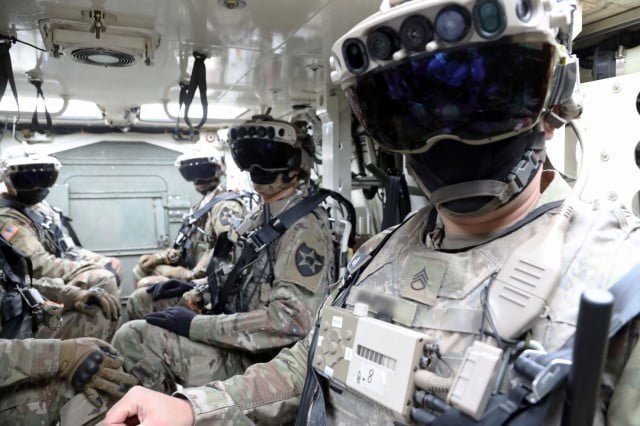
The solution proposed by Anduril reimagines the battlefield interface by merging advanced night vision with augmented reality overlays through a helmet-mounted mixed reality system. Working with partners including Meta, OSI, Qualcomm Technologies, Inc. and Gentex Corporation, Anduril is developing a perceptual layer that unifies day, night and thermal imagery with real-time battlefield intelligence.
The Soldier Borne Mission Command-Architecture (SBMC-A) will serve as the software backbone for the Army’s new systems. Built on Anduril’s Lattice platform, it is being developed in partnership with companies including Palantir Technologies, L3Harris Technologies, Persistent Systems, Sierra Nevada Company, DTC, Maxar Intelligence and Kägwerks, to advance integrated capabilities across the SBMC ecosystem.
Anduril said it has drawn on over 260,000 hours of soldier input from the IVAS programme and has already integrated IVAS 1.2 headsets with Lattice for field testing. The system has undergone four soldier exercises and combat training scenarios, including demonstrations of drone command and control directly from the headset without a dedicated pilot.
The company added that 14 industry partners are engaged in SBMC-A, with third-party developers already onboarded via the Lattice Software Development Kit. It noted that software update timelines have been reduced by 99 per cent, from two days to just 15 minutes, enabling daily updates in the field and faster delivery of new capabilities.
According to Anduril, the SBMC and SBMC-A systems together focus on human perceptual augmentation. They are designed to give soldiers the ability to see beyond the limits of human senses, process information faster, and act decisively across multiple domains of the fight.