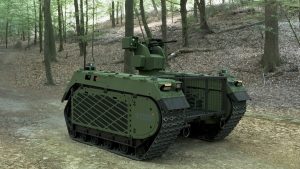
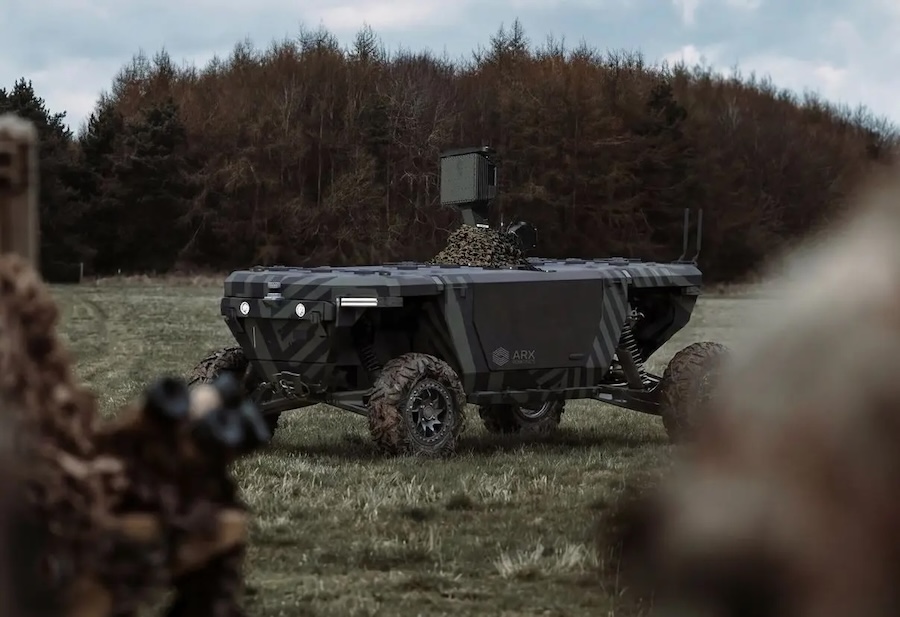
Hector is designed to be crew-driven to the edge of a mission area before switching to teleoperation or supervised autonomy. This concept is intended to multiply force effectiveness by extending reach, increasing flexibility and reducing the logistics burden.
The company said European land units currently lack a mass-producible medium-class UGV that can keep pace with manoeuvre forces while maintaining secure autonomy and integration with existing command structures. Hector is intended to close this capability gap through a modular, software-first design that supports a wide range of missions.
The platform will be available in two variants, including a combustion version with a top speed of up to 120 km/h and a range of up to 350 km, and a fully electric version with low acoustic and thermal signatures. Both share a common modular chassis, payload-ready interfaces, encrypted communications and an onboard compute module running Mithra OS.
ARX Robotics described Hector as a capability rather than just a vehicle, designed for industrial production and deployment at scale. Its software-defined architecture and open payload interfaces are intended to support interoperability and adaptability across missions.
Marc Wietfeld, CEO of ARX Robotics, said: “European land forces need unmanned systems that move faster, go farther, and connect seamlessly into existing command structures. This new platform does exactly that. It extends our fleet’s reach while staying true to our mission of increasing survivability at the front.”
Stefan Röbel, COO of ARX Robotics, added: “With a software-first architecture powered by Mithra OS, we can field, update, and scale capabilities across a mixed fleet. This UGV brings the speed and range customers asked for, without compromising integration or security.”