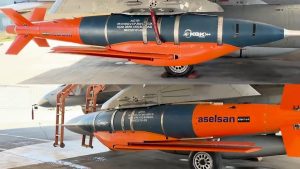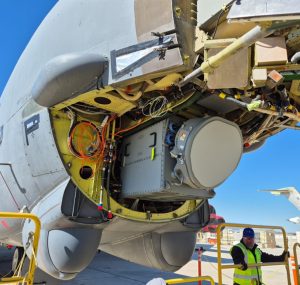
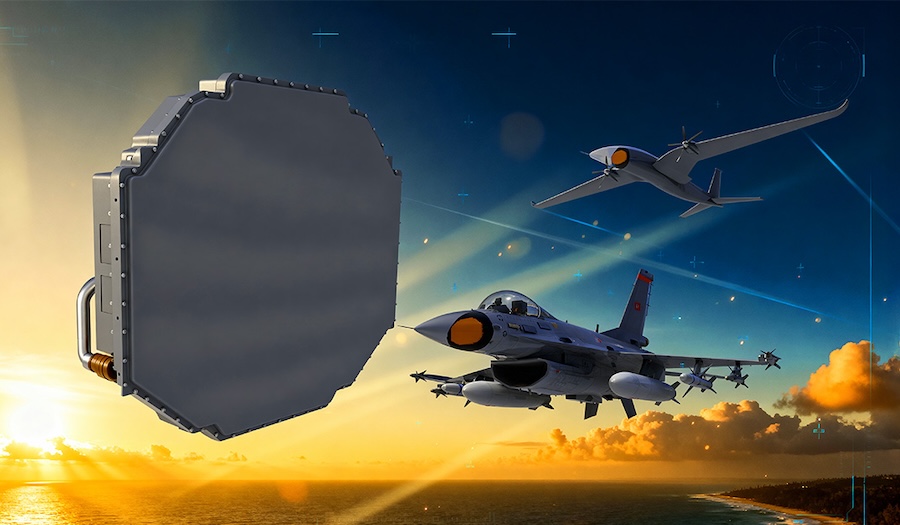
According to Aselsan, integration work for the Murad AESA radar is continuing on the Anka-III and other platforms. The report, titled “AESA Radar Capabilities and Aselsan Solutions on the Modern Battlefield,” was published via the company’s official social media channels.
Aselsan also highlighted a recent Kizilelma test in which, for the first time globally, an unmanned combat aircraft successfully engaged and destroyed an airborne target using a beyond-visual-range air-to-air missile. The engagement was carried out using a fully indigenous sensor and guidance chain enabled by Aselsan technologies at every stage.
During the test, the Murad AESA nose radar detected and tracked the target and provided mid-course guidance, while the Gokdogan missile developed by TUBITAK SAGE achieved a direct hit using an Aselsan RF seeker radar. Aselsan said the Murad 100-A offers simultaneous air-to-air and air-to-ground engagement capabilities and plays a central role in modern air warfare by combining target tracking with BVR missile guidance.
The company stated that the Murad AESA radar family has been developed domestically from chip level and can be integrated on both manned combat aircraft and unmanned platforms. “In the future, with the spread of higher power density, digital beam forming, software-defined radar architectures and integrated electronic warfare-communication-radar concepts, AESA radars will continue to be at the center of defense in areas such as autonomous platforms, unmanned air platforms and unmanned combat aircraft,” Aselsan said.