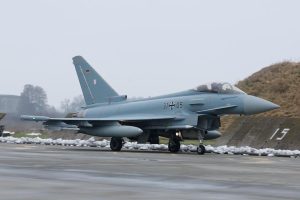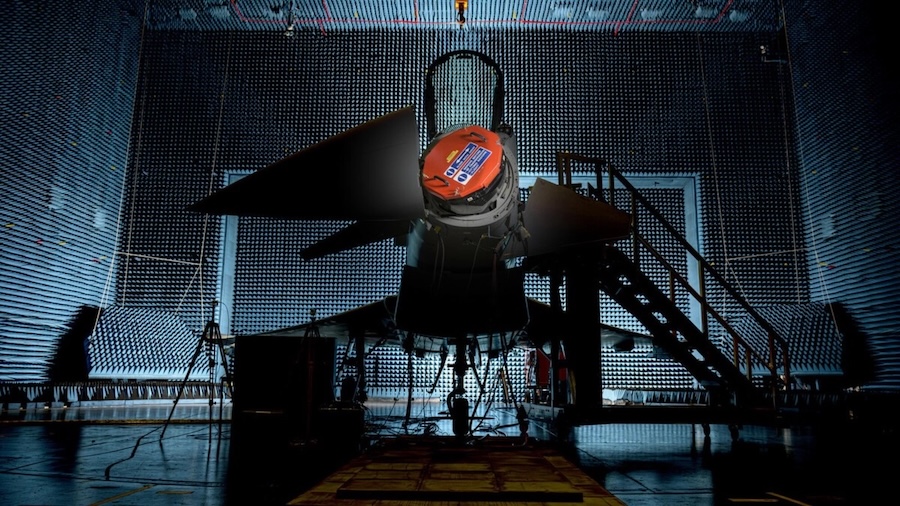
Defence Secretary John Healey visited Leonardo UK’s Edinburgh site to confirm the award of a £453 million contract to manufacture advanced radar systems for Typhoon aircraft. The contract will secure 300 skilled jobs in Edinburgh, 120 jobs in Lancashire and more than 100 in Luton, while supporting up to 1,300 roles across the UK supply chain.
Under the agreement, BAE Systems, Leonardo UK and Parker Meggitt will equip RAF Typhoons with new European Common Radar System Mk2 radars over the coming years. The wider Typhoon programme currently supports more than 20,000 jobs across 330 UK companies, with apprentices and specialist engineers in Scotland expected to benefit directly from the work.
The radar investment follows a £205 million contract announced earlier this week with QinetiQ for long-term Typhoon engineering support, sustaining up to 250 UK jobs. Together, the two contracts demonstrate how defence spending is being used to create skilled employment while strengthening national security, as the UK works towards increasing defence spending to 2.6 per cent of GDP from 2027.
John Healey said: “Our Typhoon fleet is the backbone of UK and NATO air defence, operated across Europe by the Royal Air Force and our allies to protect our skies and security.” He added: “As the threats we face increase, and as Russian drones continue to strike Ukraine and violate NATO airspace, this cutting-edge radar capability will keep Britain secure at home and strong abroad for many years to come.”
Scottish Secretary Douglas Alexander said: “This £453 million contract award to build state-of-the-art radar systems for Typhoon fighter jets shows just how vital Scottish expertise is to the UK’s national security and why Scotland is globally recognised as a centre of defence excellence.” Mark Hamilton of Leonardo added: “This contract secures 300 highly skilled jobs at Leonardo’s Edinburgh site, and 100 at our Luton site,” while Richard Hamilton of BAE Systems said: “The continued investment in Typhoon capability is crucial and ensures we’re able to maximise the UK’s investment in the aircraft.”