

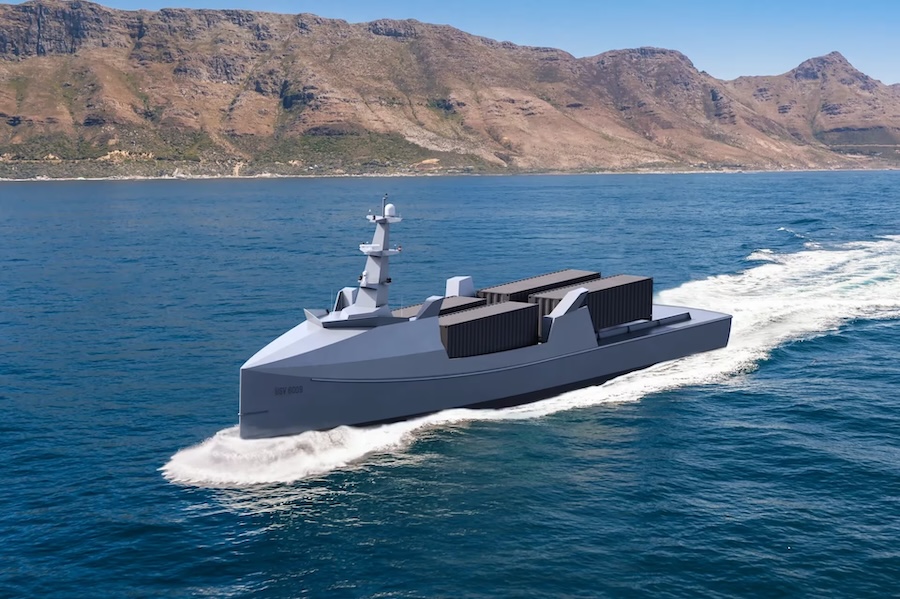
The Liberty Class is designed for long-duration, unmanned operations, offering a range of over 10,000 nautical miles and a payload capacity exceeding 150 tonnes. As the U.S. Navy seeks to expand fleet capacity through unmanned systems that complement crewed ships, the vessel is intended to support missile, sensor and logistics missions using existing U.S. shipyards and commercial supply chains.
Blue Water selected Damen’s Stan Patrol 6009 hull because of its Axe Bow, a patented vertical bow shape developed with Delft University of Technology that minimizes slamming and improves wave re-entry. More than 300 vessels worldwide operate with the Axe Bow design, which Damen holds exclusive rights to use, with licence fees reinvested in research at Delft University through the Collaborative Axe Bow fund founded by Damen and the university.
“The Liberty class reflects our focus on building autonomous ships that are designed from the start for long-duration operations and repeat production,” said Rylan Hamilton, CEO of Blue Water Autonomy. “By adapting a proven hull and re-engineering it for unmanned operations, we’re delivering a vessel that can operate for extended periods without crew while being produced at a pace the Navy urgently needs. This is a modern take on an old idea: building capable ships quickly and at scale.”
To enable autonomy, Blue Water redesigned the vessel’s internal systems, including the engine room and mechanical and electrical systems, configuring fault-tolerant propulsion to allow automated control and fault management during months-long deployments. The steel hull retains its seakeeping, payload and performance characteristics while supporting scalable serial production.
Damen is supporting the programme through its Damen Technical Cooperation licensing model, which has been applied globally, including in the United States. “The Axe Bow hull was designed for demanding operational requirements, from speed and range to seakeeping,” said Mark Honders, Design and Licence Manager at Damen. “Seeing the Stan Patrol 6009 adapted for autonomous operation underscores the flexibility of the design and demonstrates how proven commercial designs can serve new and emerging maritime missions.”
The vessels will be built at Conrad Shipyard in Louisiana, which operates five yards and employs about 1,100 workers, producing more than 30 ships per year using automated panel lines and welding techniques. “Conrad has a long history of building complex vessels for both commercial and government customers,” said Cecil Hernandez, President and CEO of Conrad Shipyard. “We have the infrastructure, workforce, and production readiness to begin construction and support serial builds, helping translate advanced vessel designs into operational capacity.”
Named after the Liberty Ships of World War II, the class is intended to signal rapid and scalable production to meet national needs. After delivery of the first vessel, Blue Water plans to move into serial production of 10 to 20 ships per year, leveraging existing shipyard capacity and prior experience building Damen-designed hulls at Conrad Shipyard.