

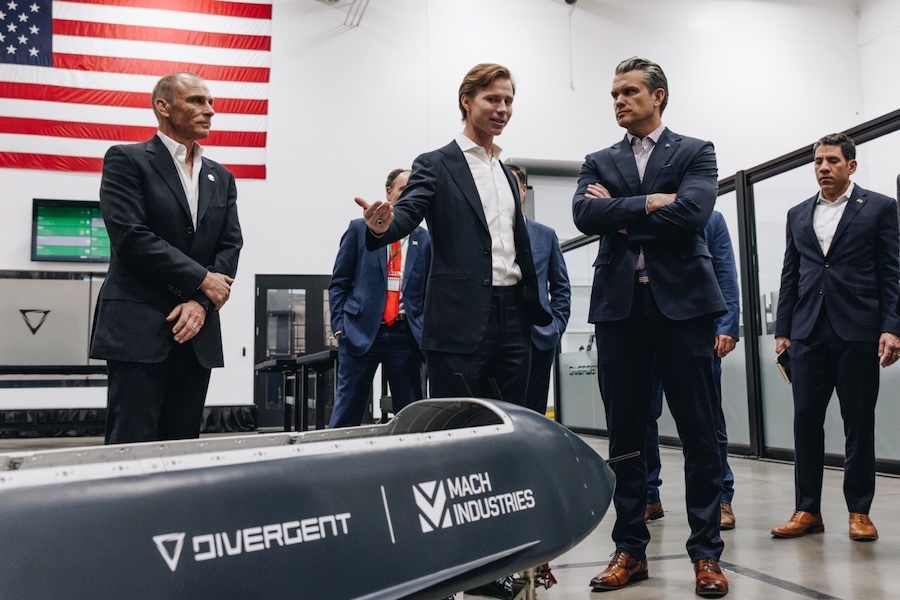
“This partnership between Mach Industries and Divergent demonstrates a pivotal capability for the nation. By combining Mach’s innovative systems with Divergent’s revolutionary digital manufacturing platform, we’ve moved from concept to a flight-ready prototype in 71 days,” said Alex Lovett, the Principal Deputy Assistant Secretary of War for Mission Capabilities in the Office of the Under Secretary of War for Research and Engineering (OUSW(R&E)). “This isn’t just an impressive metric—it’s a direct enabler of our strategy to achieve affordable mass and support the SECWAR’s ‘Drone Dominance’ vision. ODASW(P&E) is committed to sponsoring collaborations like this that accelerate rapid acquisition and deliver urgent, low-cost munitions to the warfighter.”
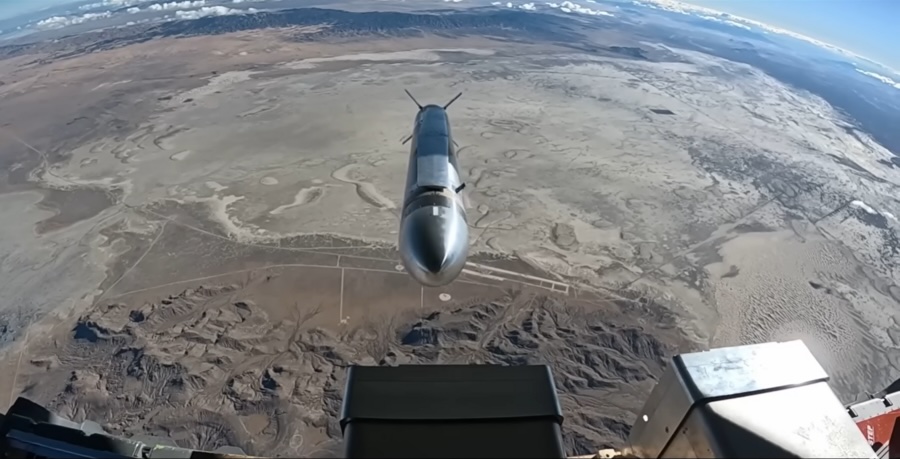
Mach Industries established the baseline requirements and architecture for the aircraft, leveraging avionics and simulation from existing, flight-proven technology stacks with a modular, open-systems architecture. Divergent executed the digital design and 3D printing of the Venom structure, including wings, fuselage, skins, and control surfaces as monolithic assemblies rather than conventional multi-part builds.
“Going from inception to flight in 71 days is a clear demonstration of what’s possible when Divergent’s Adaptive Production System is utilized from day one. This is what production at the speed of relevance looks like,” said Lukas Czinger, Co-Founder and CEO of Divergent. “Most importantly, Divergent will drive the rapid scale-up of this system, producing thousands of airframes annually. Partnering with Mach has been an immediate win and reflects two mission-aligned, innovative companies executing at maximum pace.”
Enabled by Divergent’s Adaptive Production System (DAPS), the company said it collapses traditional multi-hundred-part assemblies into unified additively manufactured structures to accelerate production, improve mass and performance, and significantly reduce part counts. By leveraging a common simulation and controls foundation, Mach supported high-fidelity prototyping and adaptable iteration across hardware and software, enabling parallel development and accelerated validation.
“Over the last 18 months Mach has taken four products from concept to flight test through rapid iteration, and Divergent’s adaptive tech stack has been instrumental in accelerating that iteration,” said Ethan Thornton, Founder and CEO of Mach. “Mach’s selection for a production contract is the first of many opportunities to show not only speed to prototype, but speed to scaled manufacturing.”
The companies said the Venom program demonstrates a new model for autonomous systems, replacing tooling-heavy aerospace processes with a software-defined manufacturing approach that enables rapid iteration and scalable production. Divergent said its Divergent Adaptive Production System is the world’s first end-to-end software-hardware production system for industrial digital manufacturing, designed to transform the economics, speed, and scalability of vehicle manufacturing by optimizing designs, dematerializing structures, and eliminating upfront capital expenditures.
Founded in 2023 and headquartered in Huntington Beach, California, Mach Industries develops advanced unmanned systems and the infrastructure to scale their production. Divergent said its platform supports customers in automotive, aerospace, and defense applications by enabling the design, additive manufacturing, and automated assembly of complex structures.