

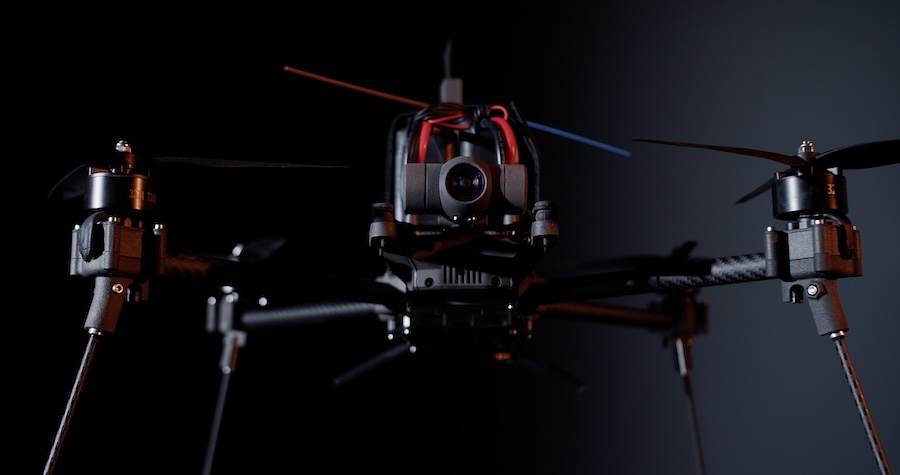
Linza 3.0 is equipped with an in-house AI-enabled visual-inertial navigation module and is offered in both day and night configurations, enabling stable hovering at altitudes of up to 200 metres, improved landing stabilisation and visualisation of completed flight routes in Loiter mode. The platform integrates optical navigation to map flight paths and stabilise over targets, and is designed to be easier to operate than commercial systems while maintaining stable performance in urban and complex terrain.
“In the media, Linza is often referred to as a ‘Ukrainian Mavic.’ The comparison is understandable, but not entirely accurate,” said Pavlo Kosolapkin, CTO of Frontline Robotics. “Unlike commercial quadcopters, we designed this drone specifically for military tasks. From day one, we focused on control and video transmission as the most critical elements for battlefield solutions. Only then did we build the airframe, which we continue to refine and improve.”
He added: “Special attention was paid to optical navigation. It allows the drone to map its flight path, stabilize over targets, and significantly lowers the entry threshold for operators. As a result, the platform is easier to use and more effective in combat conditions.” The company said the drone fills a tactical niche previously dominated by commercial platforms, offering a purpose-built military system optimised for survivability, scalability and battlefield adaptability.
“Our goal is to continuously improve our robotic systems based on the real needs of soldiers on the battlefield,” said Yevhen Tretiak, CEO of Frontline Robotics. “Linza 3.0 is a core platform for a wide range of missions – from strike and relay operations to reconnaissance, logistics, mining, and even drone evacuation. Modern warfare proves that the decisive role belongs to systems that are reliable, accessible, and scalable. Our next objective is to scale production without compromising quality.”
The 12-inch-frame drone can carry up to 4 kg over a distance of up to 15 km and remain airborne for up to 60 minutes, compared with 2 kg and 10 km for the previous version. It features a dual-band encrypted control communication system with frequency hopping resistant to electronic warfare, a one-way EW-resistant digital video transmission system, 24/7 service and technical support, and a warranty covering up to 80 flights under proper operating conditions.
The daytime version is fitted with a gyro-stabilised daylight camera with 1280×720 resolution and 6× digital zoom, while the night configuration includes a gyro-stabilised thermal imager with 640×512 resolution at 30 Hz. Linza 3.0 will be the first drone produced at the Ukrainian-German joint venture Quantum Frontline Industries, launched in December 2025 by Frontline Robotics and Germany’s Quantum Systems.