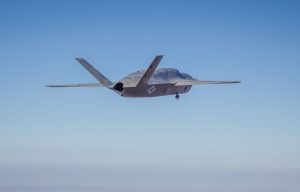


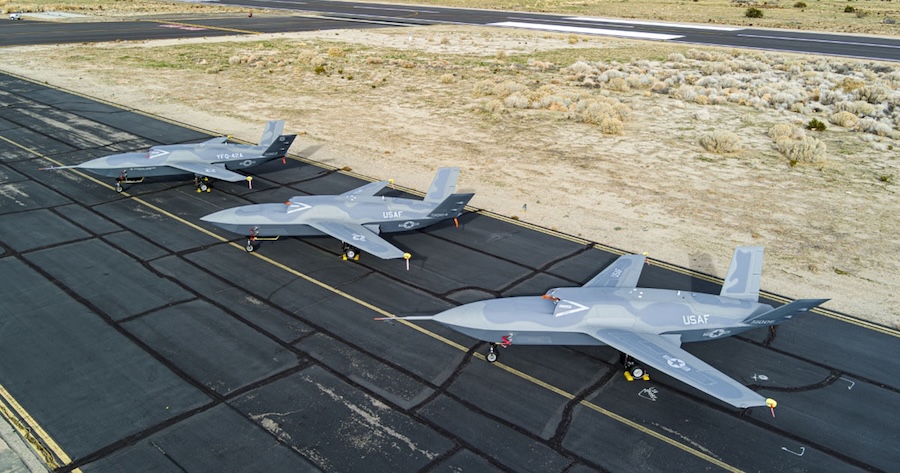
For the test, GA-ASI used mission autonomy software supplied by Collins Aerospace, an RTX business, to operate the YFQ-42A, which was designed and developed by GA-ASI for the Air Force. The Sidekick Collaborative Mission Autonomy software was integrated with the aircraft’s flight control system using the Autonomy Government Reference Architecture, enabling data exchange between the autonomy software and the aircraft’s mission systems for execution of mission commands.
During testing, autonomy mode was activated through the Ground Station Console, after which a human operator on the ground transmitted commands directly to the aircraft. The YFQ-42A executed those instructions with high accuracy for more than four hours, demonstrating what the company described as the effectiveness of Sidekick’s mission autonomy capabilities and the flexibility of the A-GRA standard.
“We are excited to collaborate with Collins to deliver enhanced autonomous mission solutions,” said David R. Alexander, president of GA-ASI. “The integration of Sidekick with our YFQ-42A demonstrates our commitment to innovation and operational excellence in unmanned aircraft technology.”
Collins Aerospace said the flight underscored its investment in collaborative mission autonomy and open systems integration. “The autonomy capabilities showcased in this flight highlight our dedicated investment to advance collaborative mission autonomy,” said Ryan Bunge, vice president and general manager for Strategic Defense Solutions, Collins Aerospace, an RTX business. “The rapid integration of Sidekick onto this General Atomics platform and its immediate ability to support a broad spectrum of combat-relevant behaviors underscores the strength and flexibility of our open systems approach.”
The semi-autonomous mission follows an accelerated development schedule that began in August 2025 with initial flights of YFQ-42A Tail One. In less than six months, GA-ASI said it built and flew multiple YFQ-42A aircraft, including demonstrations of push-button autonomous takeoffs and landings.
GA-ASI has been building and flying uncrewed jets for nearly two decades, starting with the company-funded, weaponized MQ-20 Avenger in 2008. The company said ongoing investment in the Avenger platform continues to support advanced autonomy development and testing, serving as a surrogate for Collaborative Combat Aircraft concepts in both government programs and internal research and development.
In 2025, an internally funded Avenger demonstration featured both GA-ASI’s TacACE autonomy software and Shield AI’s Hivemind software operating on the same flight, with the MQ-20 switching between AI pilots while airborne. Later that year, GA-ASI partnered with Lockheed Martin and L3 Harris on another Avenger demonstration that connected the MQ-20 with an F-22 Raptor, allowing the fighter pilot to command the Avenger as an autonomous surrogate via tablet control from the cockpit.
In 2024, GA-ASI flew its XQ-67A Off-Board Sensing Station jet, developed with the Air Force Research Laboratory, validating the “genus/species” concept under the Low-Cost Attritable Aircraft Platform Sharing program. The company’s Gambit Series builds on that common core chassis approach, with the XQ-67A focused on airborne sensing and the YFQ-42A illustrating air-to-air combat, allowing GA-ASI to adapt to diverse missions with reduced time and cost compared with developing entirely new aircraft.