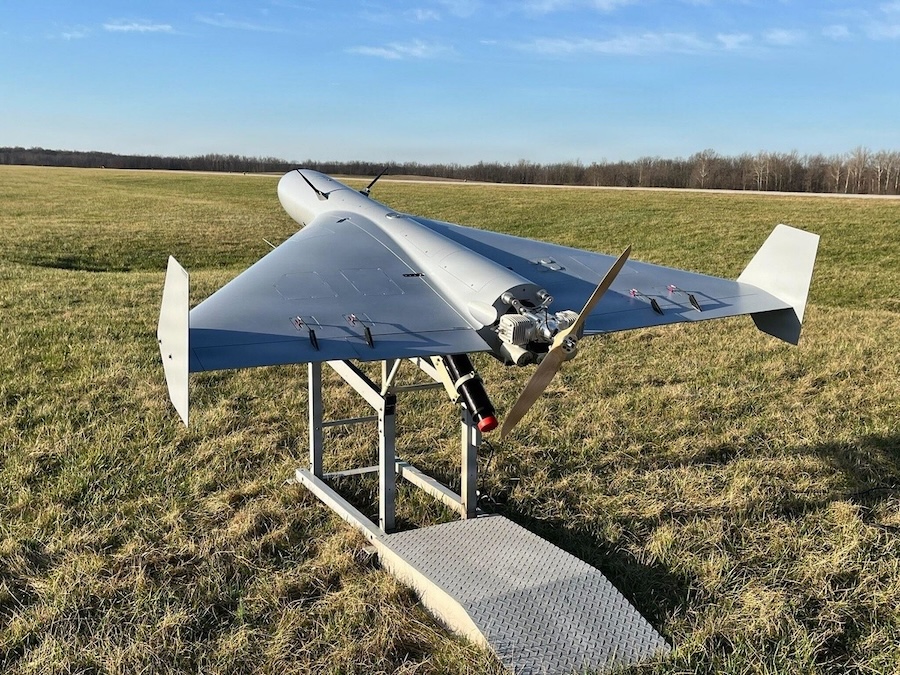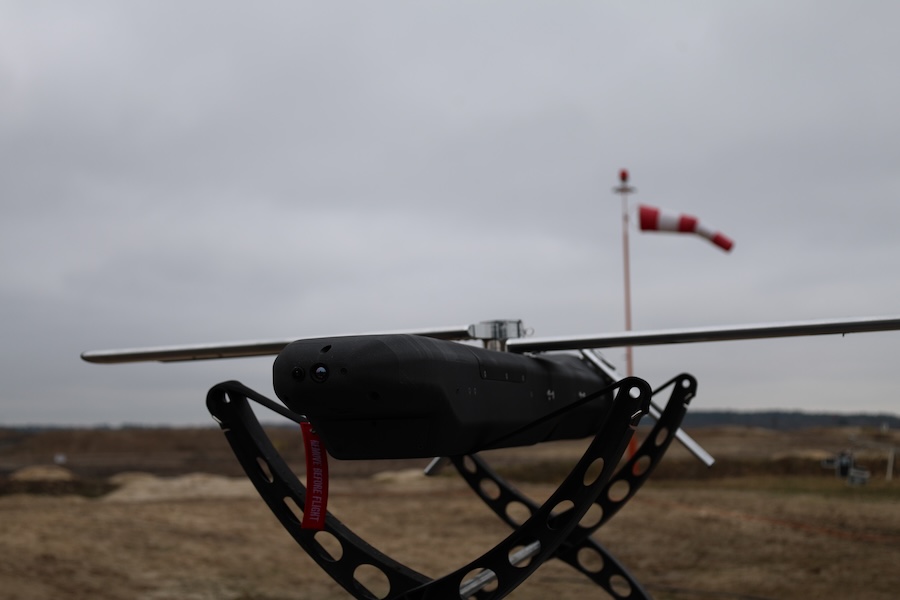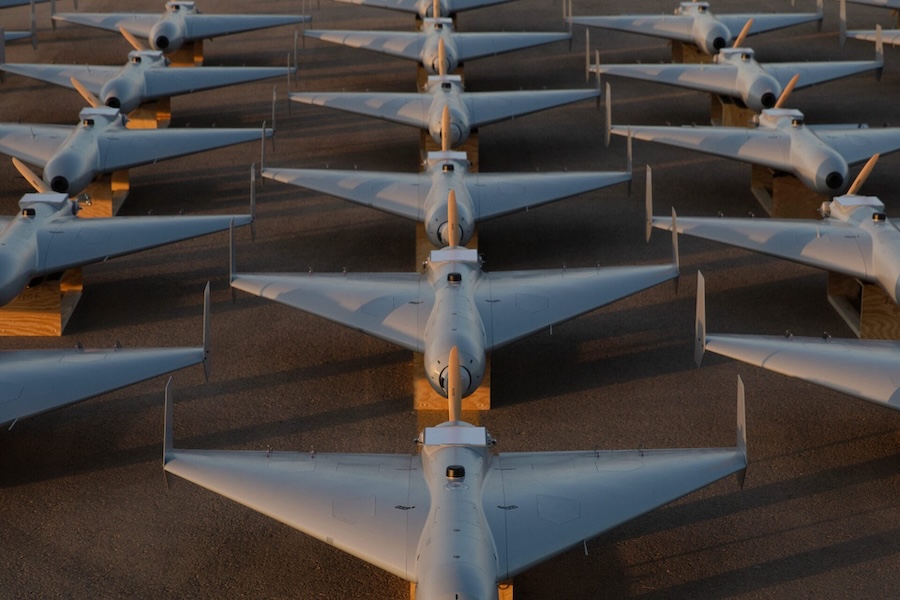
Conceptually, LUCAS is widely characterized as a development or replication of the Iranian Shahed-136 family, relatively simple delta-wing drones with a pusher engine and pre-programmed flight path. Their effectiveness lies not in sophistication but in mass deployment and low cost, as shown in the war in Ukraine, where Russia’s use of inexpensive drones, including licensed Shahed copies or similar designs, has forced traditional air defense systems into costly attrition by expending expensive interceptors against low-cost targets.
The LUCAS, or Low-cost Unmanned Combat Attack System, is produced by SpektreWorks at a unit price of approximately $35,000. Initially, the platform was unarmed and operated under the name FLM 136 as an aerial target simulating Iranian threats for air defense training.
Like its Iranian counterpart, LUCAS is designed for missions that end with the detonation of an explosive charge carried inside the airframe. It is equipped with a warhead weighing about 18 kilograms intended for soft and lightly fortified targets, with a range of approximately 822 kilometers, an endurance of up to six hours, a cruising speed of about 137 km/h, and a maximum speed of around 194 km/h, while its wingspan measures about 2.5 meters and its fuselage length about 3 meters.
The drone can be launched from catapults with rocket assistance, as well as from mobile ground launchers and ship decks, reducing reliance on airfields and enabling dispersed basing. A demonstration launch from an Independence-class vessel in the Arabian Gulf confirmed the feasibility of maritime deployment, allowing massed attacks without additional land infrastructure and enabling drones to approach from unpredictable directions, complicating Iranian defense planning around the Strait of Hormuz and the entrances to the Gulf of Oman.
The decision to use LUCAS in combat was made rapidly, with the unit’s existence publicly announced in early December 2025 and operational readiness declared less than three months later. This pace reflects wartime conditions rather than the traditional multi-year procurement cycle and signals accelerated work on doctrine, including integration with manned aviation, airspace management under heavy munitions saturation, and the development of industrial capacity capable of supplying hundreds of drones as expendable assets in a prolonged air campaign.
In a potential Iranian scenario, basing and range are central considerations, as an operational radius of more than 800 kilometers allows coverage of significant areas of southern and western Iran from the Persian Gulf and regional bases. LUCAS drones could be used to target maritime infrastructure, coastal missile batteries, or logistical nodes supporting anti-ship and ballistic systems, although their limited warhead weight makes them unsuitable for destroying deeply fortified underground facilities.
Their role is instead described as thinning out defenses by forcing exposure of positions, depleting interceptor stockpiles, and creating openings for more advanced strike systems or manned aircraft. The operational value of Task Force Scorpion Strike lies not in the performance of a single drone but in the ability to generate massed and distributed attacks, reflecting a new logic in high-intensity conflict based on large numbers of low-cost effectors used to probe and degrade defenses before deploying more advanced capabilities.
CENTCOM’s Task Force Scorpion Strike – for the first time in history – is using one-way attack drones in combat during Operation Epic Fury. These low-cost drones, modeled after Iran’s Shahed drones, are now delivering American-made retribution. 🇺🇸 pic.twitter.com/VYdjiECKDT
— U.S. Central Command (@CENTCOM) February 28, 2026
U.S. armed forces are therefore beginning strikes on Iran with what is described as a doctrinal shift. One-way attack drones are being treated as full-fledged combat systems with a defined role on the battlefield, and in the context of a potentially prolonged conflict with Iran, the ability to conduct multiple attacks at very low unit cost may prove advantageous.