

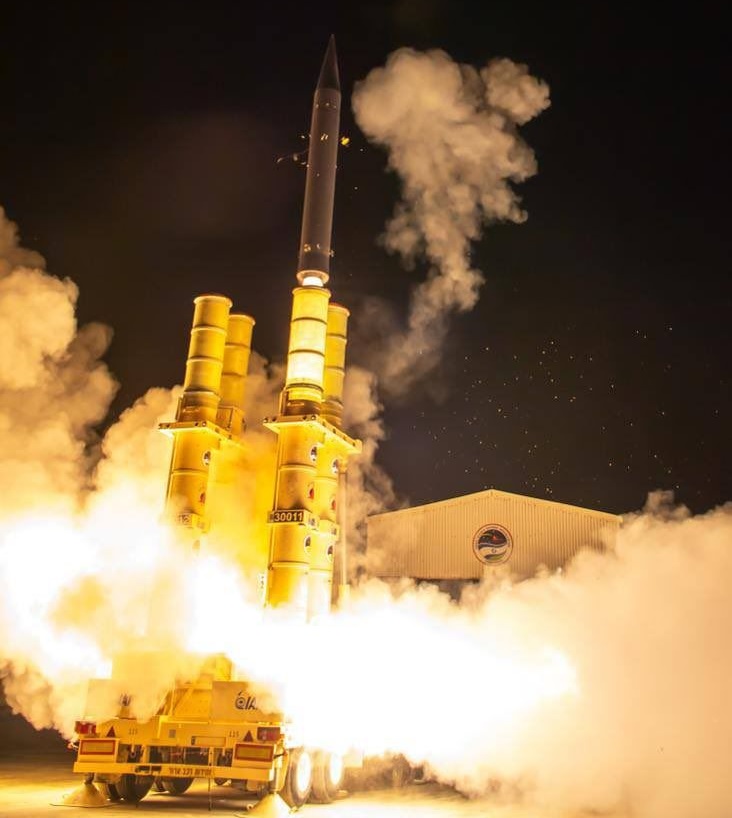
IAI CEO Boaz Levy told Globes, “We signed the agreement in September 2023, ten days before October 7. We never imagined that the world would turn upside down.” He added, “We promised two things – that Germany would receive a system ‘as it is in Israel,’ as the German Chancellor himself requested; and that we would deliver it within two years.”
Levy said the ability to prioritise delivery during wartime was “a managerial and technological achievement.” He added, “It shows dedication to meeting the goals that we are committed to,” noting that Germany would receive “a system in which all the lessons of the war in Israel, and the missile attacks on it, are embedded.”
Over the past two years, teams from IAI, the Ministry of Defense, the Israeli Air Force, the Israeli Embassy in Berlin and several companies worked to deploy Arrow 3 on German soil. An Israeli “village” was created near the German Air Force base and dozens of German soldiers underwent training in Israel.
A diplomatic source said Germany was a “European standard,” giving Israeli industries wider access across the continent. Officials said the Ministry of Defense viewed Germany becoming the first foreign customer as part of “the strategic alliance with Germany.”
Germany moved quickly after Russia’s missile attacks on Ukraine highlighted gaps in its air defence. Former Chancellor Olaf Scholz travelled to Washington to secure US approval for the purchase, and German confidence increased after Arrow systems intercepted missiles fired at Israel from Yemen and Iran.
A senior Israeli defence official said the deal, the largest in Israel’s defence industry history, strengthened both sides. He said, “We must understand that once there is another customer, and a significant one like Germany, the increase in the required production also serves Israel, both in terms of quantity and in terms of lowering the price.”
The official added that Israel had more interceptors at the start of its conflict with Iran because of the German order. He said, “So both sides benefit,” noting that system configurations were updated to improve operational flexibility.
Israel’s Ambassador to Germany Ron Prosor said ahead of the ceremony, “This year we are celebrating 60 years of diplomatic relations between Israel and Germany, Our partnership is strategic, and Germany is the most important country for Israel in Europe.” He said the system’s launch was “another milestone in this relationship.”
The milestone comes as Germany lifts a partial arms embargo imposed in August due to the war in Gaza. A senior Israeli defence official said, “There’s nothing to say, the German move hurt us,” adding that Germany’s freeze disrupted supplies including tank engines.
Israeli officials said they understood domestic pressures faced by Chancellor Friedrich Merz but stressed they hoped such an embargo “will not happen again in the future.” Berlin told Israel the embargo would be removed as soon as possible, and it was cancelled last week after the Gaza ceasefire.
Levy said German officials were pleased with the system’s wartime performance. “From what the Germans told me, they are very satisfied,” he said, adding that punctual delivery “illustrates our commitment, and the strong alliance between us and Germany.”
He said Arrow proved itself against rival Western systems during Iranian attacks. “I think, in all modesty, that the Arrow system proved its superiority in interceptions,” he said, adding that the debate on cost should compare interception to “the potential damage that one missile causes.”
A senior security official said global interest is rising because threats are immediate and countries must decide whether to rely on existing technology. Levy added, “Compared with any other system in the world, the price of interception is relatively low for the possible damage, and the operational potential of the Arrow system is high.”
Israel is not naming new potential customers, partly because US approval is required for any export. Levy said, “A country that is an ally of Israel and the US, such a country can buy the Arrow system. But it is important to clarify that there is a deal here that involves three governments.”
Germany is also expected to examine the Arrow 4, which will replace Israel’s Arrow 2. Levy said, “As the public knows, during the conflicts with Iran we used the Arrow 3 and the Arrow 2, to deal with threats at different ranges and altitudes.”
On future demand, Levy said, “The use of missiles has become more available. More countries feel threatened.” He added, “Every leader who wants to protect his country thinks about the Arrow. The potential is very large.”
Source: Globes.