

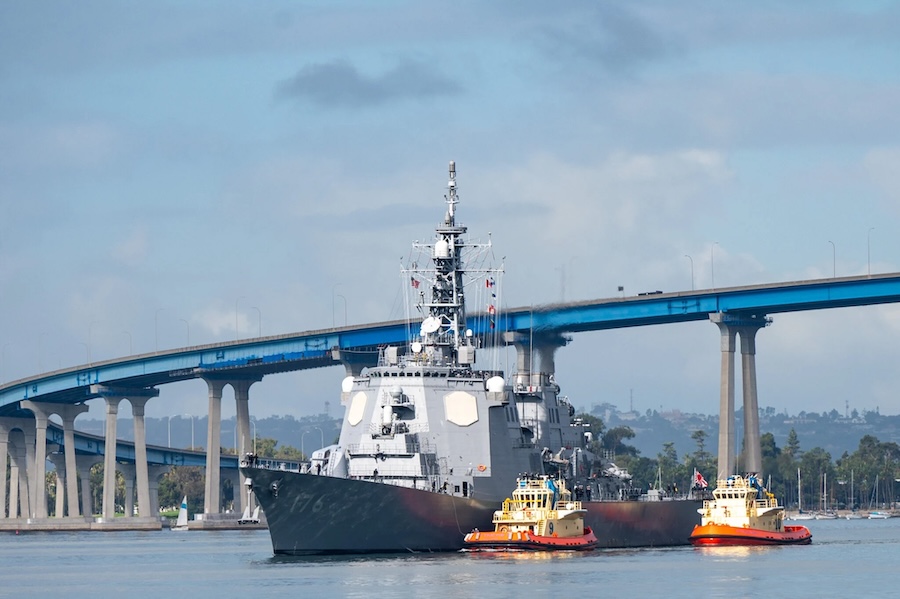
Chokai, currently deployed to the United States, began modifications and crew training in October 2025 with assistance from the U.S. Navy. The ship is scheduled to conduct live firing trials this summer to assess readiness for operational missions and crew proficiency.
“The recent acquisition of Tomahawk missile launch capability by destroyer Chokai will lead to the early realization of strengthening Japan’s deterrence and response capabilities through the acquisition of such capabilities, and we believe it is of great significance in reducing the possibility of an armed attack on Japan itself,” said Shinjiro Koizumi during a Friday press conference.
The U.S. Navy marked the milestone with a Dockside Alignment Test ceremony at Naval Base San Diego. Officials said the event highlighted operational coordination between allied forces and reinforced bilateral defense cooperation.
“The DSAT for Tomahawk Land Attack Missile installation (TLAM) formally declares the [Japan Maritime Self-Defense Force’s] acquisition of TLAM Launch Capability, showcasing the operational capabilities and coordination between Allied forces, and emphasizing the importance of strategic maritime operations, while bolstering the U.S.-Japan Alliance for a free and open Indo-Pacific,” U.S. 3rd Fleet said.
Once fully mission capable, Chokai will become Japan’s first Aegis destroyer able to operate Tomahawk missiles. The long-range cruise missile, manufactured by Raytheon, is designed for deep land-attack missions and is widely used by U.S. forces and partners.
Japan plans to expand the capability across its fleet, including its remaining Aegis destroyers and two under-construction Aegis System Equipped Vessels. Officials said the effort reflects broader plans to strengthen stand-off defense capabilities.
Japan is procuring 400 Tomahawk missiles under a contract signed in January 2024 and has already received some units, Koizumi said earlier in March. The timeline for acquisition was accelerated by one year due to what officials described as an increasingly severe security environment.
“The Ministry of Defense views the acquisition of Tomahawk missile launch capability as a testament to the steady progress of the Tomahawk project and will continue to work towards the early establishment of stand-off defense capabilities,” the ministry said in a statement.
Koizumi said the capabilities are intended as a deterrent amid growing missile threats in the region. He added that existing missile defense systems alone are becoming insufficient to counter evolving threats.
“It remains unchanged that Japan’s defense capabilities, including standoff missiles, constitute the minimum necessary defensive force for self-defense, to be exercised only in the event of an armed attack by an adversary, and do not pose a threat to other nations,” Koizumi said.
China criticized Japan’s acquisition of long-range strike capabilities, warning of potential regional instability. A Chinese defense spokesperson said Japan’s military posture was expanding beyond its stated defensive policy.
“Japan’s military ambitions continue to expand. It is constantly increasing the size of its self-defense forces, strengthening its offensive combat and long-range strike capabilities, accelerating the militarization of space, and even seeking to carry out preemptive strikes. These actions have far exceeded the scope of ‘exclusively defense-oriented policy’ and threaten regional peace and stability,” said Jiang Bin.