

According to L3Harris, many existing AEW&C fleets were designed for a different operational era and now face growing challenges. Aging system architectures, long delivery timelines, rising sustainment costs, and upgrade-dependent roadmaps are limiting how quickly and affordably governments can field credible airborne surveillance and battle management capabilities.
The company said recent delays and cancellations of AEW&C programs have further highlighted a widening gap between rising demand and available solutions. As a result, L3Harris stated that air forces are reassessing how to modernize their fleets while maintaining readiness in increasingly contested environments.
L3Harris identified this gap as the driver behind demand for AERIS, its next-generation AEW&C family built on missionized business jet platforms. The company said AERIS was designed from the outset for fifth-generation interoperability, enabling real-time connectivity with allied aircraft, sensors, and command-and-control networks to support faster decision-making.
The AERIS platform is designed to operate at higher altitudes, fly faster, and provide greater range than other AEW&C aircraft that do not require aerial refueling, according to L3Harris. The company said these characteristics allow extended radar horizons, improved survivability, and persistent coverage with fewer aircraft.
L3Harris said AERIS is equipped with an advanced Active Electronically Scanned Array radar that provides true 360-degree coverage with enhanced detection range, tracking accuracy, and resistance to jamming. The company added that these capabilities are intended to support operations in contested electromagnetic environments.
The company also highlighted AERIS’ communications architecture, which integrates advanced satellite, line-of-sight, and beyond-line-of-sight communications. L3Harris said this enables continuous connectivity across coalition forces and supports real-time information sharing even in degraded operational conditions.
AERIS employs an AI-enabled mission management system designed to reduce operator workload and accelerate threat assessment, according to L3Harris. The system is intended to shorten decision cycles and provide commanders with actionable intelligence when time-sensitive decisions are required.
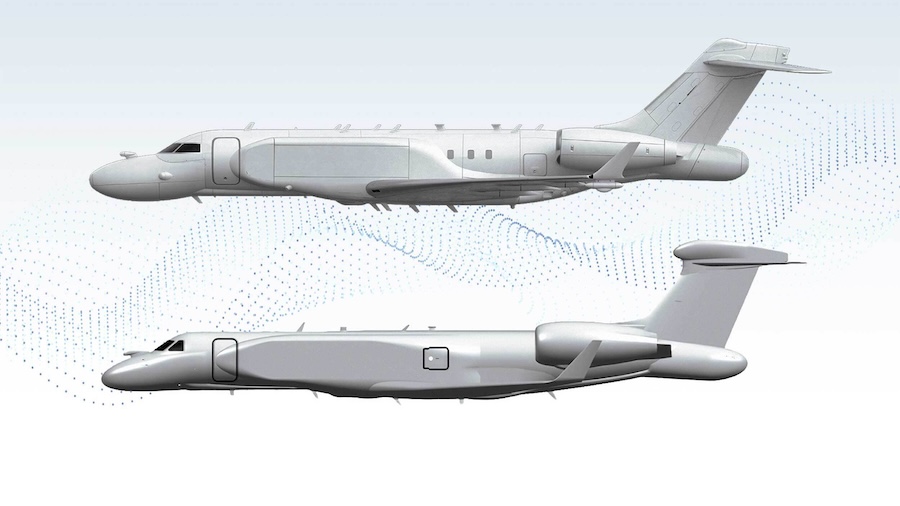
The AERIS family is available in two configurations that share a common mission system architecture. AERIS X is based on the Bombardier Global 6500 platform, while AERIS A is based on the Gulfstream G550, with both providing full air surveillance and battle management capability.
L3Harris emphasized readiness and sustainment as key differentiators, stating that AERIS is based on a mature solution ready for delivery. The company noted it has delivered more than 100 missionized business jets and has additional aircraft modifications currently on order.
The company also stated that AERIS offers lower acquisition and lifecycle costs compared with legacy AEW&C platforms. Maintenance and sustainment are designed to be supported by national air forces and local industry, enabling faster modernization without waiting for future upgrades to achieve full capability.
L3Harris cited the selection of its next-generation AEW&C solution by the Republic of Korea as validation of AERIS’ performance, interoperability, and readiness. The company said the decision reflects a broader shift among air forces toward systems that can be fielded rapidly while meeting modern operational requirements.