As space becomes increasingly contested, the ability to deploy and replace satellites quickly is gaining importance. L3Harris is addressing this challenge by shifting key thruster component production from traditional machining to additive manufacturing techniques.
Satellite thrusters are essential for deployment, orientation, and maneuvering in orbit. Traditionally, their production has taken an average of 18 months, making them a limiting factor in satellite manufacturing timelines.
Kristin Houston, President of Space Propulsion and Power Systems at L3Harris, said the company aims to significantly reduce these delays. “Our objective is to enable significantly reduced lead times on propulsion systems that traditionally have been a bottleneck,” she said.
“The goal is to remove up to 12 months from the in-space propulsion system delivery equation and we’re well on track to achieve that,” Houston added. She noted that the effort focuses on improving responsiveness for national security missions.
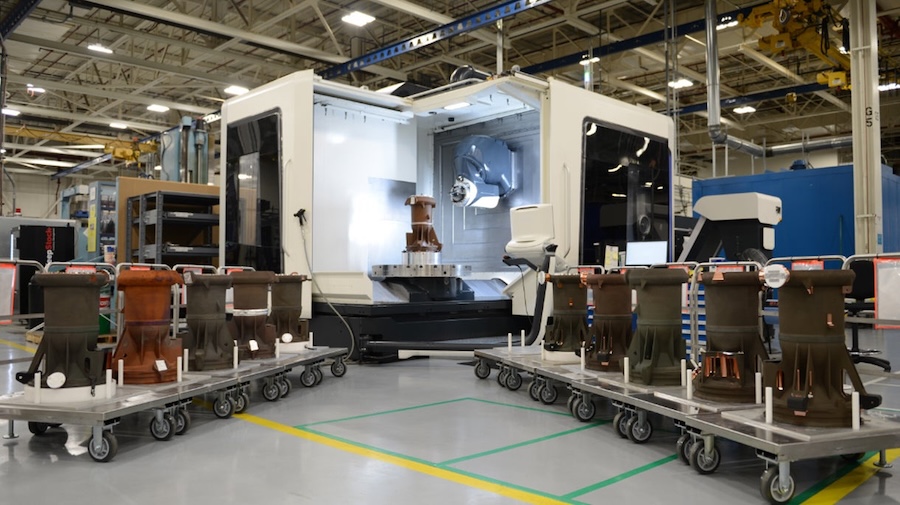
The company has expanded its additive manufacturing capabilities over the past decade. This includes the 2019 acquisition of a facility in Daytona Beach, Florida, where key components such as nozzles, manifolds, and combustion chambers are now produced.
These components are often made from high-performance metals such as niobium. Additive manufacturing allows these materials to be used more efficiently compared to traditional subtractive methods.
The production process uses techniques such as laser powder bed fusion. This method builds components layer by layer using powdered metal and high-powered lasers guided by digital designs.
L3Harris has addressed challenges related to consistency in additive manufacturing. Through testing and refinement, the company has reduced variability and enabled scalable production.
“The idea is to have multiple machines running simultaneously to achieve scale,” Houston said. “L3Harris-built thrusters with additively manufactured components are now flight proven on national security satellites, both experimental and operational.”
The company is also applying additive manufacturing to other propulsion systems. This includes components for the RL10 engine used on United Launch Alliance’s Vulcan rockets.
“We’ve been perfecting this over a decade,” Houston added. “We’ve got the infrastructure and people with the proper training in place. We’re already demonstrating high production rates.”
In addition to manufacturing changes, L3Harris is stockpiling common components such as valves. This approach further supports faster assembly and delivery of propulsion systems.
Together, these efforts aim to remove a critical bottleneck in satellite production. The company said the initiative supports faster deployment of space systems essential for national security.














![CENTCOM chief says U.S. forces remain ready after ‘generational’ defeat of Iran despite fragile ceasefire [VIDEO]](https://defence-industry.eu/wp-content/uploads/2026/04/centcom-chief-says-us-forces-remain-ready-after-generational-defeat-of-iran.jpeg)
![Team Lynx details XM30 infantry fighting vehicle concept as U.S. Army program nears key decision [VIDEO]](https://defence-industry.eu/wp-content/uploads/2026/04/team-lynx-details-xm30-infantry-fighting-vehicle-concept.jpeg)