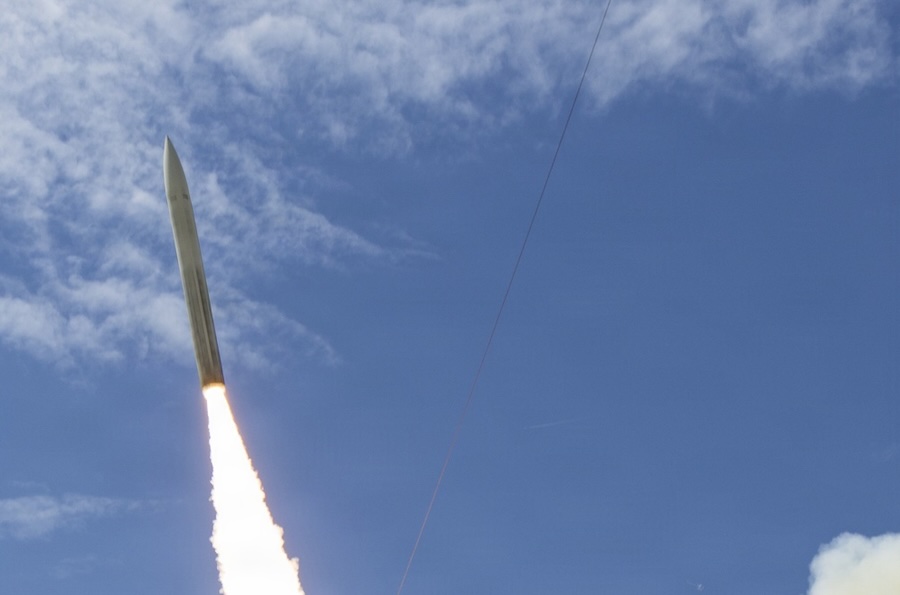


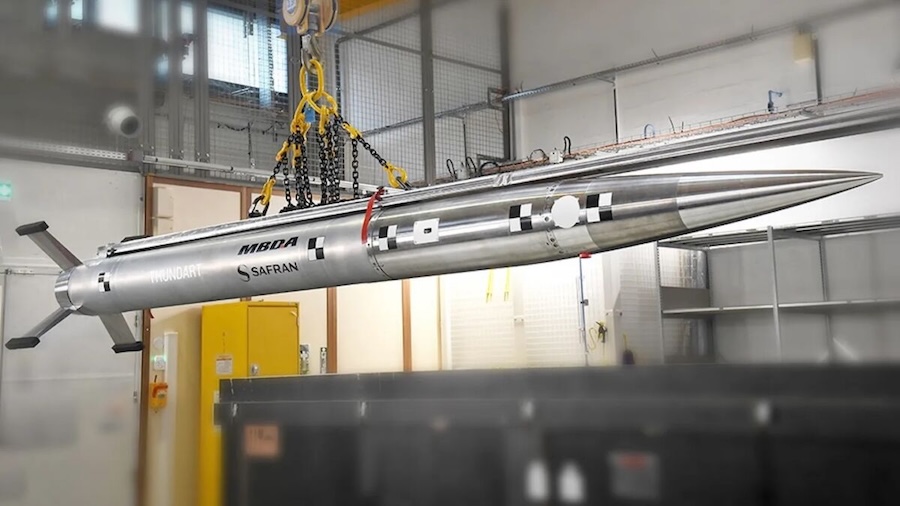
The company has released little technical detail beyond the rocket’s calibre, but it is expected to have a range of up to 150 kilometres and is being proposed by the MBDA–Safran team for the Frappe longue portée terrestre modernisation effort. It will compete with a rival bid from a consortium formed by Thales and ArianeGroup.
5h : réveil du colonel 🛎️
Champagne & sardines 🥂
Obus de 43 kg 💪
Pendant ce temps, #THUNDART se prépare : 150 km de portée, précision renforcée.
Bonne #SainteBarbe à tous les artilleurs !@SAFRAN pic.twitter.com/002D0QO1rO— MBDA France (@MBDAFrance) December 4, 2025
Work on the Thundart began at the end of 2023, and a model was first shown at the Eurosatory 2024 exhibition in Paris. The newly published photograph appears to show a test-series rocket and marks the first full visual release of the system.
The guidance arrangement is expected to resemble that used in Safran’s AASM Hamer guided bombs, which include a GPS and inertial navigation module. Optional infrared or laser semi-active seekers may be added for final guidance, enabling precision strikes against moving targets even in environments without GPS access.
Under the MBDA–Safran concept, the fire-control system for the future launcher would be derived from the solution used in the KNDS France CAESAR 155 mm wheeled self-propelled howitzer. This approach aims to standardise elements across artillery platforms and simplify integration for the French Army.
As part of the FLP-T programme, the Armée de terre plans to acquire 13 new launchers before 2030 and a further 26 between 2030 and 2035. If development continues as planned, testing and demonstration activities are due to begin before mid-2026.
The French procurement authority, the DGA, will base its final choice on the outcome of trials comparing domestic proposals. Depending on the results, it may select a national solution or opt for an off-the-shelf system to accelerate the reinforcement of long-range strike capabilities.