

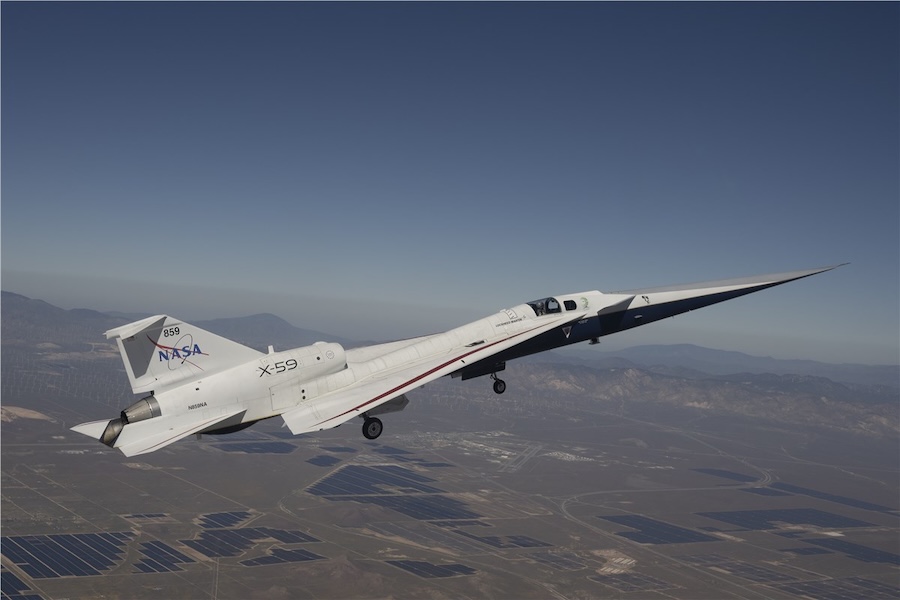
The flight was shorter than planned due to a technical issue encountered during the mission. Despite the early return, officials said the test provided valuable data for future flights.
“Despite the early landing, this is a good day for the team. We collected more data, and the pilot landed safely,” said Cathy Bahm, project manager for NASA’s Low-Boom Flight Demonstrator at NASA’s Armstrong Flight Research Center in Edwards, California. “We’re looking forward to getting back to flight as soon as possible.”
The aircraft took off at 10:54 a.m. PDT from Edwards Air Force Base and remained airborne for several minutes. During the flight, pilot Jim “Clue” Less received a system warning, prompting a return-to-base procedure and landing at 11:03 a.m.
“As we like to say, it was just like the simulator – and that’s what we like to hear,” Less said. “This is just the beginning of a long flight campaign.”
The X-59 is designed to travel faster than the speed of sound while producing a significantly reduced sonic signature. Instead of a traditional sonic boom, the aircraft is intended to generate a quieter sound described as a thump.
The aircraft is central to NASA’s Quesst mission, which aims to enable commercial supersonic travel over land. Officials said the program seeks to demonstrate technologies that could support future regulatory changes.
Testing will intensify throughout 2026 as the aircraft undergoes envelope expansion. This process will gradually increase flight speed and altitude as engineers assess performance and airworthiness.