

Officials said Iran committed to a ceasefire and to allowing two weeks of safe passage for shipping through the strait. The agreement follows sustained U.S. military operations launched on February 28.
Donald Trump described the development as significant progress. He said it was a “big day for world peace” and added, “Just like we are experiencing in the U.S., this could be the golden age of the Middle East.”
The operation aimed to dismantle Iran’s missile capabilities, naval forces and broader defense infrastructure. U.S. officials said these objectives have now been accomplished.
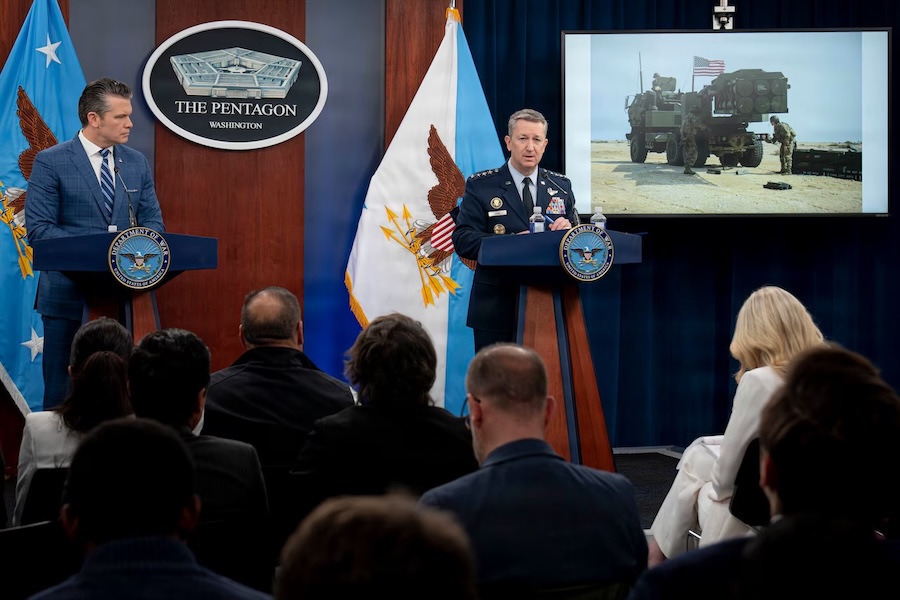
Pete Hegseth said the mission was executed as planned. “Together with our Israeli partners, America’s military achieved every single objective on plan, on schedule, exactly as laid out from day one,” he said.
He described the extent of the damage to Iranian forces. “Iran’s navy is at the bottom of the sea. … Iran’s air force has been wiped out. Iran no longer has … any sort of a comprehensive air defense system; we own their skies.”
Hegseth said the campaign targeted Iran’s industrial capabilities. “Their missile program is functionally destroyed: launchers, production facilities and existing stockpiles depleted and decimated,” he added.
He said more than 800 strikes were carried out during the operation. “We finished completely destroying Iran’s defense industrial base, a core pillar of our mission objective,” Hegseth said.
“They can no longer build missiles, build rockets, build launchers or build [unmanned aircraft systems]. Their factories have been razed to the ground, set back in historic fashion,” he added.
Dan Caine, chairman of the Joint Chiefs of Staff, said U.S. forces struck more than 13,000 targets. He noted that 4,000 of these were dynamic targets identified during operations.
“[U.S. Central Command] forces destroyed approximately 80% of Iran’s air defense systems, striking more than 1,500 air defense targets, more than 450 ballistic missile storage facilities, 800 one-way attack drones storage facilities — all of these systems are gone,” Caine said.
“We’ve devastated Iran’s command and control and logistical networks, destroying more than 2,000 command and control nodes and degrading their ability to target U.S. and friendly forces,” he added.
Caine said U.S. forces also targeted Iran’s naval capabilities. He noted that more than 90% of the regular fleet had been sunk, along with significant losses to the Islamic Revolutionary Guard Corps navy.
“It is, and we know this, incredibly frustrating right now to be a lower-level Iranian commander trying to fight your fight,” he said. He added that Iran’s defense industrial base has been largely destroyed.
“We attacked, along with our partners, approximately 90% of their weapons factories,” Caine said. “Every factory that produced Shahed one-way attack drones was struck; every factory that produces the guidance systems to go into those drones was struck.”
“Their missile defense industrial base is shattered, with more than 80% of their missile facilities gone, as well as their solid rocket motor production capability,” he added.
Officials said the strikes also targeted nuclear-related infrastructure. Caine noted that approximately 80% of Iran’s nuclear industrial base had been affected.
Despite the ceasefire, U.S. forces remain deployed in the region. Officials said the military is prepared to resume operations if required.
“A ceasefire is a pause, and the joint force remains ready, if ordered or called upon, to resume combat operations with the same speed and precision as we’ve demonstrated over the last 38 days — and we hope that is not the case,” Caine said.
Hegseth said the current situation provides an opportunity for negotiations. “Now we have a chance at real peace and a real deal,” he said.
“The War Department, for now … has done its part. We stand ready in the background to ensure Iran upholds every reasonable term,” he added.