

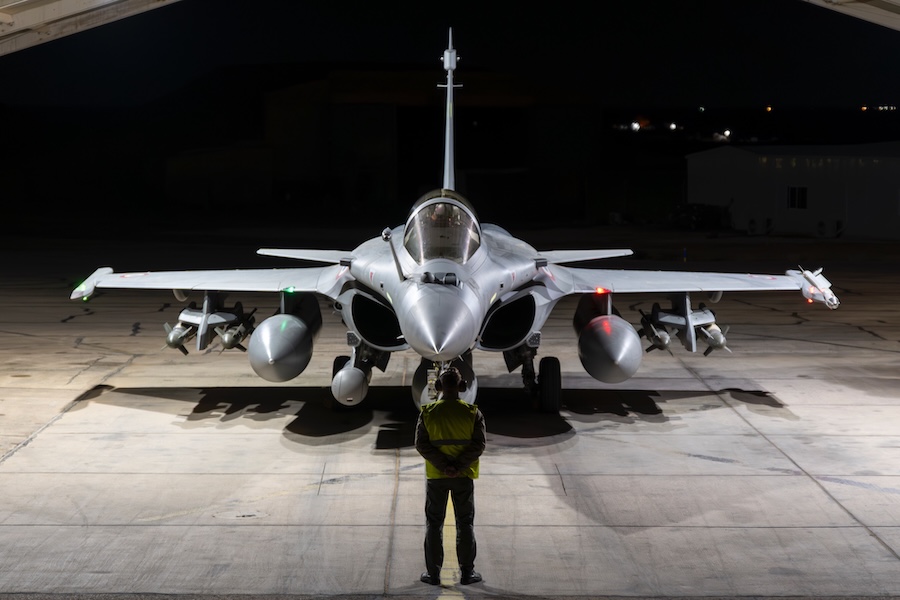
French military aircraft have been involved in defending the United Arab Emirates since the outbreak of the conflict on 28 February. Their deployment is based on a defence agreement between Paris and Abu Dhabi that allows a permanent French air contingent to operate from Al Dhafra Air Base.
Since 2016, the French presence at the base has consisted of six Rafale fighter jets. At the request of the United Arab Emirates, these forces were reinforced on 4 March with six additional aircraft from Escadron de Chasse 1/7 “Provence”.
In recent weeks the Rafale fighters have reportedly intercepted dozens of Iranian drones and cruise missiles. The aircraft achieved high effectiveness using MBDA MICA missiles, which serve as the primary air-to-air armament on the Rafale platform.
However, the intensity of these operations has exposed a logistical challenge for the French Air and Space Force. Existing stocks of MICA missiles are declining quickly due to the pace of operational use.
The situation is compounded by limited procurement in previous years and production delays affecting the missile programme. According to La Tribune, deliveries of previously ordered MICA missiles from the MBDA facility in Selles-Saint-Denis are currently running nearly two years behind schedule.
The issue has prompted a high-level response from the French government. Defence Minister Sébastien Lecornu has convened a crisis meeting scheduled for 17 March involving representatives from the General Staff, the Directorate General of Armaments, the Ministry of the Armed Forces and MBDA.
The government is expected to press the manufacturer to accelerate missile production and deliveries. Officials hope that increased output will prevent an early depletion of operational stocks.
Despite these efforts, concerns remain that accelerating production alone may not be sufficient to sustain long-term operational capability. France may therefore need to consider alternative weapons to maintain air defence capacity during prolonged operations.
One possible option could involve the older R550 Magic 2 short-range missile integrated on the Rafale aircraft. Although this missile was withdrawn from French service in 2020, existing stocks were not immediately scrapped.
Some of these missiles are currently being used by Ukraine against Russian Shahed-type drones launched by Mirage 2000-5F fighters supplied by France. However, Ukraine operates only a small number of these aircraft, meaning the consumption rate of Magic 2 missiles remains relatively limited.
The missile was widely exported in the past and may still be held in the inventories of several countries. Romania previously operated them with MiG-21 LanceR fighters retired in 2023, while Greece continues to use them on Mirage 2000 aircraft and Morocco on Mirage F1 fighters.
Other potential stocks may exist in South American countries such as Peru and Brazil. These reserves could theoretically provide additional options if France sought alternative sources for compatible missile systems.
In the longer term, France is exploring new weapons better suited to counter mass drone attacks. Rafale fighters could eventually be equipped with lightweight guided rockets carried in multi-tube launch pods designed specifically to intercept low-cost unmanned threats.
This concept is already under development as part of the future Rafale F5 standard. Announced during the Paris Air Show in June 2025, the new configuration is expected to include guided 68 mm rockets.
The Rafale F5 version is currently scheduled to enter service around 2035. However, the current operational situation could accelerate the introduction of such capabilities if required.
Source: La Tribune.