

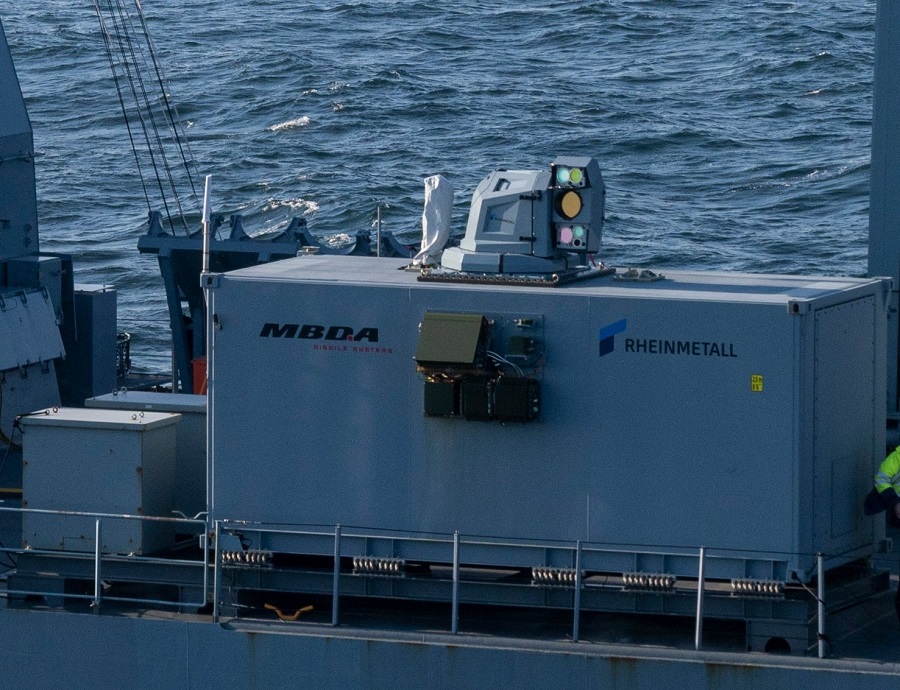
The transfer of the demonstrator was made possible with support from WTD 91 during the acceptance process. “Thanks to WTD 91’s support during the acceptance process, the demonstrator was successfully commissioned at the Laser Competence Centre in Meppen,” the companies stated.
Tested in real maritime conditions, the containerised system demonstrated strong performance and resilience over multiple trials. It is now undergoing further evaluations on land, focusing on drone defence capabilities.
The laser weapon aims to counter fast-moving, non-cooperative targets like drones, drone swarms and speedboats, offering precise and rapid neutralisation. According to the companies, “An operational laser weapon system complements cannons and guided missiles, particularly for the defence against drones and drone swarms, as well as for attacking speedboats and, if necessary, guided missiles in the closer and immediate vicinity.”
Future versions of the system may be enhanced to intercept more advanced threats such as supersonic missiles, rockets, and artillery shells. Its effectiveness stems from advanced technologies “designed and made in Germany,” using Rheinmetall and MBDA’s long-standing expertise in optics and sensors.
Since 2019, Rheinmetall and MBDA have shared responsibilities nearly equally in developing high-energy laser effectors. MBDA oversees target detection and tracking, the control console, and integration with command systems, while Rheinmetall handles the aiming system, beam control, the laser source, and overall system integration aboard naval platforms.
Sea trials on the SACHSEN involved more than 100 live-firing sessions and additional tracking exercises, proving the system’s reliability under real-world conditions. “Successful tests conducted on the frigate SACHSEN proved the demonstrator’s tracking capability, effectiveness and precision under real operational conditions for the first time in Europe, also without using the landscape as beam block (‘in front of blue sky’).”
If progress continues as planned, the German Navy could deploy an operational version of the laser system by 2029. This would offer a scalable, cost-effective supplement to existing weapons and mark a major innovation in naval defence.