During the event, the FV-014 loitering munition system simulated various mission scenarios and attack flights. The company described the successful test as another milestone in its loitering munition activities.
Rheinmetall states that the FV-014 is designed for dynamic combat deployment at ranges of up to 100 kilometres. The system combines effectiveness against armoured and soft targets with advanced sensor technology, network capability and the ability to operate in GNSS-jammed environments.
The FV-014 is conceived as a system that combines reconnaissance and effect in a single platform. It is intended to support tactical units in engaging high-value point targets, such as combat vehicles, artillery positions or command vehicles, beyond the line of sight.
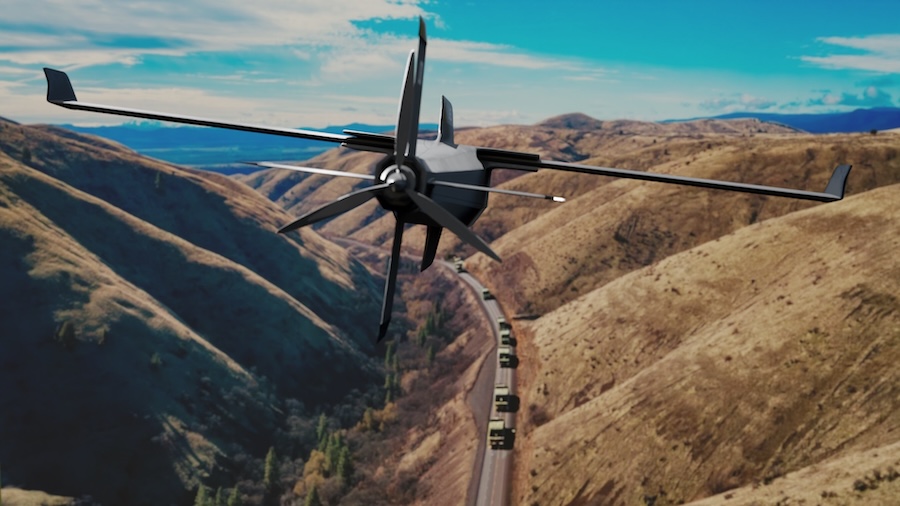
The munition is launched from a container using a booster, although it can also be deployed from a multi-launcher. After launch, folding wings extend and the system transitions to aerodynamic flight.
According to Rheinmetall, the FV-014 has an operational range of up to 100 kilometres and a flight duration of 70 minutes. This endurance is designed to allow time for observation, target selection and attack decision-making.
The system is initially designed as a portable capability for use at troop level and is controlled through a ground station. It enables permanent human-in-the-loop control, allowing the operator to identify targets, conduct a precise attack or abort the mission if conditions change.
The air vehicle follows a classic wing configuration with electric propulsion and faceted structures to reduce signatures. Rheinmetall states that it is optimised for low acoustic and thermal signatures and can operate in electromagnetically demanding scenarios where satellite navigation is disrupted.
The FV-014 has a launch weight of approximately 20 kilograms, including a payload of around 6 kilograms. Its warhead is a roughly 5-kilogram high-explosive dual-purpose charge with a penetration capacity of more than 600 mm of rolled homogeneous armour, while also being effective against unarmoured targets and infrastructure.
The system supports target reconnaissance, tracking, precise single or swarm attacks and deployment in GNSS-denied scenarios. It can be used in mobile and scalable launcher configurations on land vehicle platforms and seagoing units, and is designed for swarm operations to engage multiple targets or saturate enemy air defences.
An operator station with a data link provides real-time situational awareness and target assignment. The electric motor with propeller is intended to enable a quiet approach, and the system is designed to reduce radar and infrared signatures while remaining robust against GNSS interference.