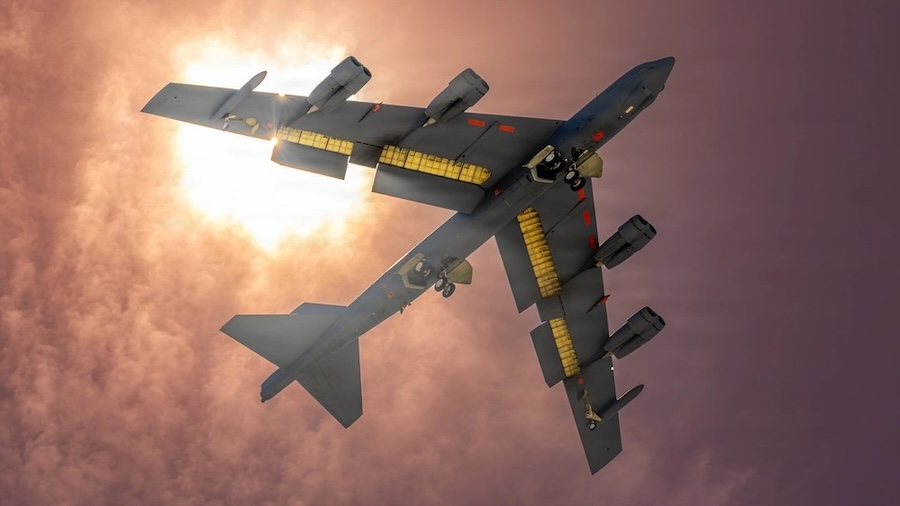
The company carried out the work at the U.S. Air Force Arnold Engineering Development Complex in Tullahoma, Tennessee. Rolls-Royce engineering teams worked alongside Air Force personnel to validate engine performance under demanding mission conditions.
At the facility, Rolls-Royce conducted altitude tests to demonstrate sustained performance during long-duration, high-altitude strategic missions. Operability testing with distortion screens replicated turbulent, real-world airflow to confirm engine stability under stress, while Integrated Drive Generator testing with Boeing verified stable and reliable electrical power in all mission scenarios.
Jennifer Schwerin, Director, Early Life Cycle & Naval Programs – Defense, said: “We are proud to deliver another milestone for our F130 engine testing program, on-time and on-budget, for the Air Force. Working closely with our partners at Boeing and the Air Force, our team has demonstrated the F130’s ability to meet mission requirements and further strengthened confidence that this engine is the right choice for the B-52J.”
Lt. Col. Timothy Cleaver, USAF Program Manager, B-52 Commercial Engine Replacement Program, said: “Throughout this F130 engine test campaign, we gathered essential data about how this engine operates across the full spectrum of flight conditions. Completing the series of tests at AEDC’s world-class facility gives us confidence in the engine and associated systems as we proceed into test aircraft modification and flight testing.”
The milestone follows completion of the program’s Critical Design Review in late 2024, which cleared the way to build the first flight test engines. The testing program has also included Rapid Twin Pod Tests at NASA Stennis Space Center, where the F130 engines were evaluated for the first time in the B-52’s dual-pod configuration to validate analytical predictions and reduce integration risk.
In addition, the first phases of sea-level testing were completed at Rolls-Royce’s recently revamped test cell in Indianapolis. During those tests, the team evaluated the initial software release for the engine and gathered key performance data to support program progress.
The next phase will focus on further system integration and additional dual-pod testing at Stennis. Throughout the program, engineering and design teams have collected performance data to validate modeling and confirm the F130 as the appropriate engine for the B-52J re-engining effort.
Designed for long life and low maintenance, the F130 is intended to reduce sustainment demands. The engines are fully interchangeable in the dual-pod configuration, replacing the current left and right engine setup to simplify logistics, improve readiness, and ease maintenance.
With more than 30 million flight hours, the F130 draws on commercial heritage to support reliability and a global supply chain. As part of the BR engine family, the BR725 has been in production for 13 years, with more than 1,000 engines currently in service.
Once production begins, Rolls-Royce will manufacture, assemble, and test the F130 in Indianapolis, its largest U.S. production facility. The company has invested more than $1.5 billion in the United States over the past decade, including modernization of its Indianapolis facilities to support advanced manufacturing with American labor.
Rolls-Royce operates at 34 locations across 26 states, employing more than 5,000 people and supporting hundreds of American suppliers. In 2024, the company’s U.S. operations contributed $6.2 billion to the national economy.





![Germany’s first F-35A reaches final assembly stage at Lockheed Martin facility in Fort Worth, Texas [VIDEO]](https://defence-industry.eu/wp-content/uploads/2026/03/germanys-first-f-35a-reaches-final-assembly-stage-at-lockheed-martin-facility-in-fort-worth-texas-video.jpg)