As Romania approaches the signing of major defence contracts under the EU’s SAFE framework later this year, the country’s leadership has sent an unusually blunt message to industry: localisation will be negotiated “la sânge” — down to the finest details.
Speaking on Digi24 last week, Economy Minister Irineu Darău said SAFE contracts, expected to be signed by the end of May, will include firm conditions to ensure military equipment is produced in Romania, by Romanians, and at the highest possible percentage.
“Investors will not just come with money and assemble things,” Darău stated. “We will have clear, firm conditions through which we can guarantee that production happens here.”
The remark was more than rhetoric. It amounted to a public declaration of evaluation criteria — one that reframes Romania’s Infantry Fighting Vehicle (IFV) programme not as a standard procurement, but as a test of industrial sovereignty.
IFV as an industrial sovereignty decision
Romania’s IFV programme, now linked to SAFE financing, has become a defining case of how Bucharest interprets Europe’s rearmament agenda. While SAFE formally requires around 65% regional production, Romanian officials are openly discussing localisation levels of 70 to 80 percent — to be contractually locked in before signatures are applied.
This approach reflects a broader policy choice. SAFE loans must ultimately be repaid by national governments. For Romania, that reality has sharpened the focus on domestic return: jobs, technology, and long-term production capacity that remains inside the country rather than dissipating across borders.
In Darău’s words, Romania must avoid becoming “just a market for assembling military equipment” and instead guarantee real production, technology transfer, and workforce development on Romanian soil.
What “deep localisation” means in practice
The concept of localisation is not new in European defence programmes. What is different in Romania’s case is the depth now being demanded.
Deep localisation, as articulated by Romanian officials, implies:
- manufacturing of core vehicle structures and systems inside Romania
- transfer of production know-how and engineering processes, not just tooling
- long-term sustainment, upgrade, and MRO capabilities based domestically
- training Romanian engineers and technicians to Western production standards
This level of localisation is difficult to reconcile with business models built around highly centralised European production hubs, where foreign facilities play a secondary or final-assembly role.
Two competing industrial logics
Against this backdrop, the contrast between the leading IFV proposals becomes increasingly structural rather than political.
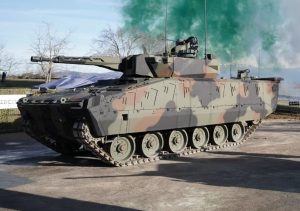
Rheinmetall has already invested heavily in a dedicated Lynx production facility in Zalaegerszeg, Hungary, opened in 2023. That site anchors the company’s IFV industrial footprint in Central Europe, while key subsystems — including armour packages, advanced optics, and electronic suites — remain distributed across Germany, Austria, Slovakia, and the Czech Republic.
Industry analysts note that this existing architecture limits how much meaningful production can realistically be relocated to Romania. Even with local participation, Romania would likely remain downstream of a supply chain whose centre of gravity sits elsewhere.
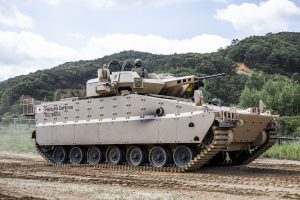
In comparison, Hanwha Aerospace Romania has put forward a proposal explicitly built around relocating production to Romania itself. The company has committed to achieving up to 80% localisation inside the country — exceeding SAFE thresholds — with manufacturing, integration, and testing conducted in Romanian facilities by Romanian workers.
Building “in Romania, for Romania, with Romania”
Central to Hanwha’s proposal is the construction of a new production facility in Dâmbovița, intended not only to support IFV manufacturing but to serve as a broader land-systems hub. The site is planned to produce K9 self-propelled howitzers already ordered by Romania, alongside potentially IFVs and other advanced defense systems such as unmanned ground vehicles.
Company executives describe this as a deliberate shift of industrial gravity rather than a satellite operation. Technology transfer would cover hull fabrication, powertrain integration, electronic architecture, quality assurance, and system testing — capabilities that would allow Romania to sustain and evolve the platforms independently over time.
In the case of turrets, Hanwha has been working closely with Elmet, a Romanian subsidiary of Elbit, to significantly increase the level of in-country turret localisation and Romanian industrial participation.
In parallel, Hanwha has also been holding discussions with Plasan, Israel’s leading specialist in armour and protection systems, to expand the transfer of protection-related manufacturing processes and deepen localisation of armour technologies inside Romania.
Taken together, these arrangements illustrate Hanwha’s approach to deep localisation: building on Romania’s existing industrial strengths, partnering with established in-country and allied suppliers, and implementing concrete, phased plans that can be executed contractually and industrially — rather than relying on notional or overlapping promises.
Hanwha has also emphasised supply-chain localisation, stating that it has already engaged more than 30 Romanian companies and aims to expand that network beyond 100 suppliers. The projected impact includes more than 2,000 direct and indirect jobs linked to K9 and potential IFV production, with employment expected to rise toward nearly 10,000 positions should additional industrial and infrastructure investments be realised.
Lessons from Australia
Romania’s IFV debate also unfolds in the shadow of Australia’s LAND 400 Phase 3 competition, one of the most comprehensive IFV evaluations conducted in recent years. Over a two-year process, Hanwha’s Redback competed directly against Rheinmetall’s Lynx KF41 across protection, mobility, reliability, and industrial criteria.
Australia ultimately selected the Redback in 2023, citing not only performance and crew survivability but also the credibility of Hanwha’s localisation and industrial-transfer model. The programme marked the first time an Asian OEM won such a competition against a European prime in an open, high-end tender.
For Romanian policymakers, the case is frequently referenced as evidence that deep localisation and accelerated delivery schedules can coexist — provided the industrial model is designed accordingly.
A question of structure, not rhetoric
None of this pre-empts Romania’s final decision. As Darău himself cautioned, any statement made before contracts are signed remains provisional. What matters is what is written into binding agreements: where production happens, who controls it, and how long it endures.
Yet by publicly insisting on “la sânge” negotiations over localisation, Romania’s leadership has effectively reframed the IFV competition. The central question is no longer which platform performs best on paper, but which proposal genuinely embeds industrial capability inside Romania.
As SAFE deadlines approach, Bucharest faces a defining choice. Will localisation be measured in percentages on slides — or in factories, skills, and production lines that stay in the country?
In the end, the question Romania must answer is the one its own Economy Minister has already posed: Who is truly prepared to build in Romania, for Romania, and with Romania — not just assemble there?