
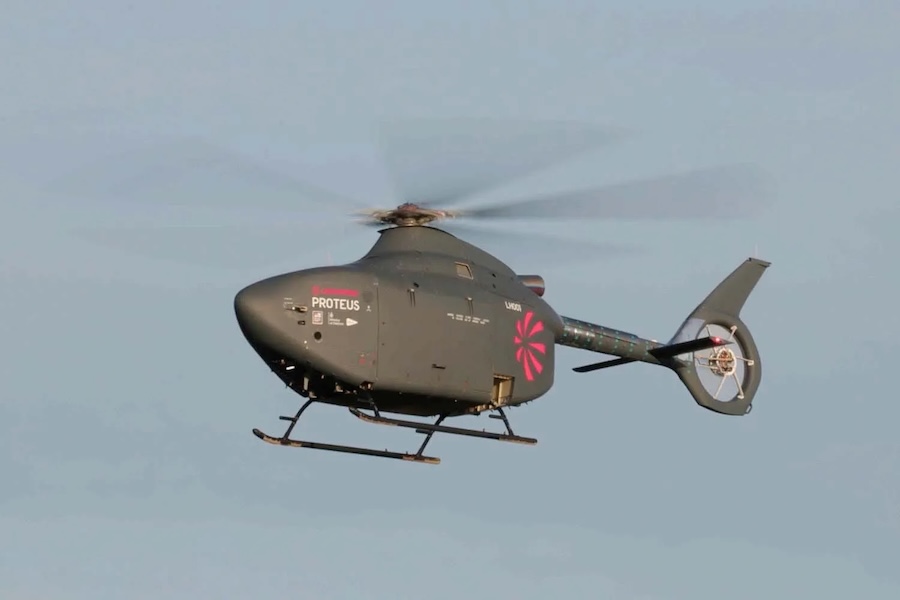
Built by Leonardo as a technology demonstrator for the Royal Navy, the helicopter is intended to operate alongside crewed aircraft in future hybrid air wings. It is also expected to support anti-submarine warfare under the Atlantic Bastion strategy to secure the North Atlantic.
The flight followed weeks of system, sensor and engine testing, with engineers and naval representatives observing the test on the Lizard Peninsula. During the sortie, the aircraft flew using its own controls without human input, while being monitored by test pilots on the ground.
The Proteus Technology Demonstrator was designed and manufactured in Yeovil under a £60 million programme supporting around 100 skilled jobs. The aircraft replaces an onboard crew with sensors and software that allow it to assess its environment and make decisions.
With a payload of more than one tonne, the helicopter is designed to operate in challenging weather and carry equipment for a range of missions. Officials say it could free crewed aircraft for other critical tasks.
Luke Pollard, Minister for Defence Readiness and Industry, said: “This maiden flight is a proud moment for British innovation. Designed and built in Yeovil, Proteus supports skilled UK jobs while helping deliver the hybrid navy outlined in our Strategic Defence Review. Autonomous systems like this will be vital in protecting our seas without putting personnel in harm’s way”.
Commodore Steve Bolton, Royal Navy Deputy Director Aviation Future Programmes, said: “The successful first flight of Proteus is a significant step in delivering the Royal Navy’s maritime aviation transformation vision, and to demonstrating our steadfast commitment to investing in autonomy as part of a hybrid air wing. This milestone signals our intent to lead technological innovation, to enhance the fighting effectiveness of the Royal Navy in an increasingly complex operating environment, and to maintain operational advantage against evolving maritime threats.”
Nigel Colman, managing director of Leonardo Helicopters UK, said: “Proteus represents a step-change in how maritime aviation can deliver persistence, adaptability and reach – conducting the dull, dirty and dangerous missions in challenging environments without putting human operators at risk. As the UK’s only end-to-end rotary wing manufacturer it has been a pleasure working with the Royal Navy and seeing Proteus take off for the first time after being designed, developed, and manufactured at Leonardo’s Yeovil site is a fantastic milestone.”
The aircraft is central to the Atlantic Bastion programme announced last month by the Ministry of Defence. The programme aims to build a hybrid naval force to help the UK and NATO allies detect, track and counter maritime threats across wide ocean areas.
Source: Royal Navy.