

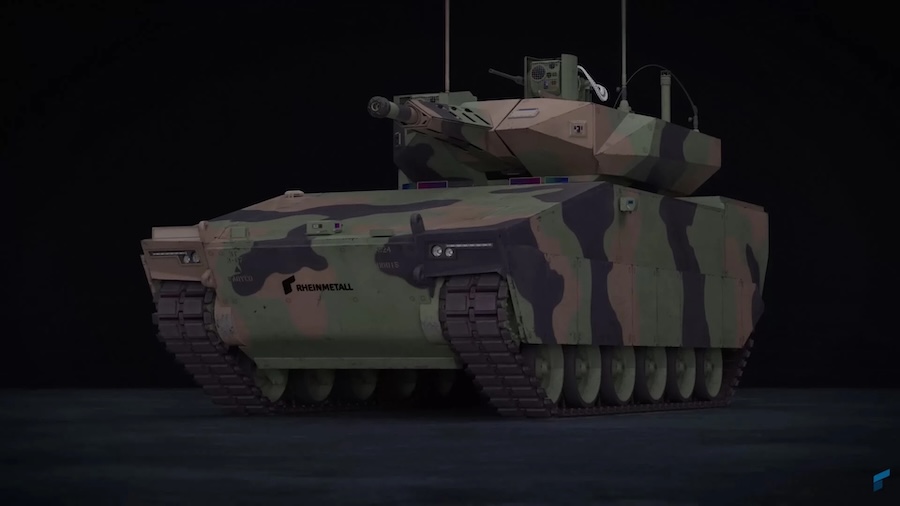
The proposal is being prepared by Team Lynx rather than Rheinmetall alone. The consortium includes American Rheinmetall Defense, Textron Systems, RTX, L3Harris Technologies, Allison Transmission and Anduril Industries.
The vehicle design differs from the Lynx infantry fighting vehicle already in service with European forces. The version proposed for the U.S. Army incorporates changes to meet specific operational requirements.
A key feature is a large unmanned turret equipped with a 50 mm XM913 cannon developed by Northrop Grumman. This reflects updated U.S. Army preferences, which have shifted from earlier expectations of a 30 mm weapon system.
The turret is also expected to include a multi-purpose launcher. This system would be capable of firing anti-tank guided missiles or loitering munitions.
Additional armament includes a remotely operated 12.7 mm M2HB machine gun. The configuration aligns with requirements for enhanced firepower and flexibility on the battlefield.
The fire control system is being developed with a primary role assigned to L3Harris Technologies. Targeting functions are expected to be supported by WESCAM MX-GSC B electro-optical systems.
The vehicle is designed to comply with the U.S. Army’s Ground Combat Systems Common Infrastructure Architecture. This approach is intended to ensure compatibility with broader digital systems used by the force.
The crew configuration includes two personnel positioned side by side behind the propulsion system. The vehicle is also expected to carry approximately six dismounted soldiers.
The design incorporates a hybrid propulsion system based on the Allison eGen Force Transmission. This system is intended to improve mobility and operational efficiency.
Developers said the vehicle concept has been shaped with input from experienced mechanized infantry personnel. The design also includes provisions for integration with uncrewed ground systems such as the Textron Ripsaw M5.
The timing of the announcement comes as the XM30 program reaches a critical phase. Team Lynx is competing with General Dynamics Land Systems for a contract potentially worth tens of billions of dollars.
The future of the program remains uncertain as the U.S. Army assesses timelines and feasibility. Concerns have been raised about the ability to meet development schedules for competing designs.
Budget documents for fiscal year 2027 include $547 million for the procurement of 19 vehicles. However, it remains unclear how these funds will be allocated among competing proposals.
A final selection and initial production contract are expected in the first quarter of fiscal year 2028. The outcome will determine whether the program proceeds or is replaced by an alternative solution.
If the program is delayed or canceled, the service life of the M2 Bradley infantry fighting vehicle may be extended. The decision will have significant implications for the future of U.S. Army mechanized forces.


![CENTCOM chief says U.S. forces remain ready after ‘generational’ defeat of Iran despite fragile ceasefire [VIDEO]](https://defence-industry.eu/wp-content/uploads/2026/04/centcom-chief-says-us-forces-remain-ready-after-generational-defeat-of-iran.jpeg)