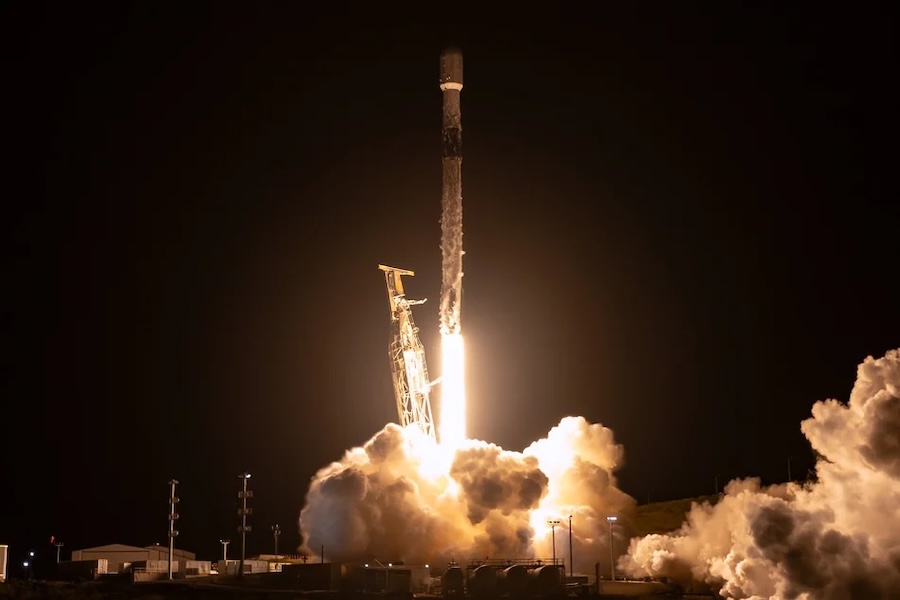


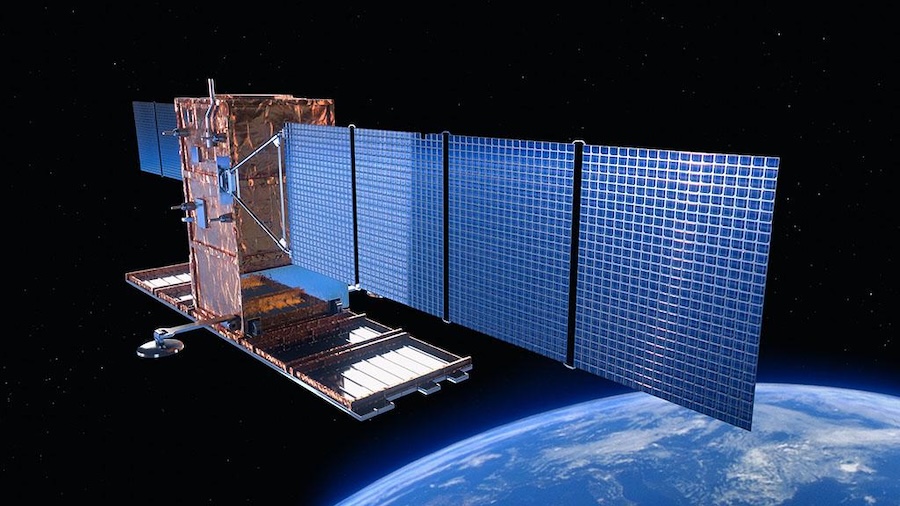
Fifty-nine minutes after separation from the launcher, the satellite’s signal was acquired by Telespazio’s Fucino Space Centre in Abruzzo, Italy, which assumed control of the spacecraft. The launch and early orbit phase is expected to last around nine days.
Massimo Claudio Comparini, Managing Director of Leonardo’s Space Division, said: “Each COSMO-SkyMed launch represents a significant achievement for the Italian national space system and its supply chain.” He added: “Earth observation and the data it provides are a strategic asset for security and sustainability, enabling increasingly targeted and timely services and interventions.”
Giampiero Di Paolo, CEO of Thales Alenia Space Italy and Senior Vice President for Earth Observation, Exploration and Navigation, said: “Being responsible for the overall COSMO-SkyMed Second Generation program, Thales Alenia Space is extremely proud of this successful launch.” He added that once fully deployed, the constellation “will provide substantial technological and performance progress, strengthening Thales Alenia Space’s global leadership in space-based earth observation infrastructure.”
The new satellite will ensure operational continuity of COSMO-SkyMed radar services and further enhance image quality and coverage, while progressively replacing the first-generation system launched from 2007. Once the four-satellite configuration is complete, the system will significantly expand the range of applications and set performance standards for space-based radar observation.
Over nearly two decades, COSMO-SkyMed has supported environmental monitoring, security and emergency management, with around 4.3 million images acquired and archived. As part of the European Copernicus programme, its data plays a key role in the Emergency Rapid Mapping service operated by e-GEOS, delivering satellite maps within hours of natural disasters or humanitarian crises.