The company confirmed that contracts covering propulsion systems, ventilation, hydroacoustic sensors and other operational systems have largely been awarded. More than 30 contracts have been placed with nearly 20 companies involved in delivering key components.
Among the largest contracts are those awarded to Aerius for heating, ventilation and air conditioning systems and to Kongsberg for hydroacoustic technologies. Additional agreements for the propulsion system were signed in 2025 with Wärtsilä, Steerprop and Aker Arctic, covering generator sets, propulsion units and associated systems.
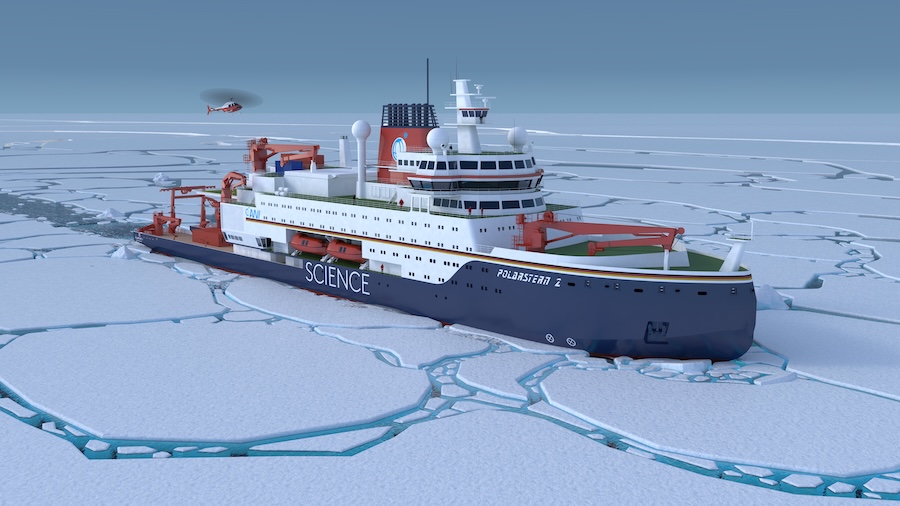
TKMS has also ordered two Airbus H145-D3 helicopters for onboard operations. The aircraft are intended to support missions with lower noise and vibration levels while offering efficient operational performance and the use of sustainable fuel.
“The awarding of the majority of contracts for relevant components and systems is a significant step toward the new Polarstern. Through our selection of partners, we are ensuring that we meet the high customer requirements for quality and operational performance,” said Oliver Burkhard, Chief Executive Officer of TKMS.
In parallel, icebreaking trials were completed at the Hamburg Ship Model Basin using a 5.66-metre-long model of the vessel. The tests simulated operations in ice conditions of approximately 1.80 metres thickness with snow cover, as well as more demanding scenarios such as pack ice ridges.
“The model tests at the Hamburg Ship Model Basin enabled us to find the optimal ship design thanks to the realistic simulation of the conditions in the operation areas – both for icebreaking and for open water navigation and scientific research. The successful completion of the model tests, which have been ongoing since last summer, marks an important milestone on the way to building the new Polarstern,” said Detlef Wilde, project director for the new Polarstern at the Alfred Wegener Institute.
The new Polarstern is intended to become the flagship of Germany’s marine and polar research infrastructure. It will replace the existing vessel, which has supported Arctic and Antarctic research for more than 40 years.
The project is funded by the Federal Ministry of Research, Technology and Space and is being constructed at the Wismar shipyard. The vessel is expected to provide advanced and sustainable capabilities for scientific research in polar regions.