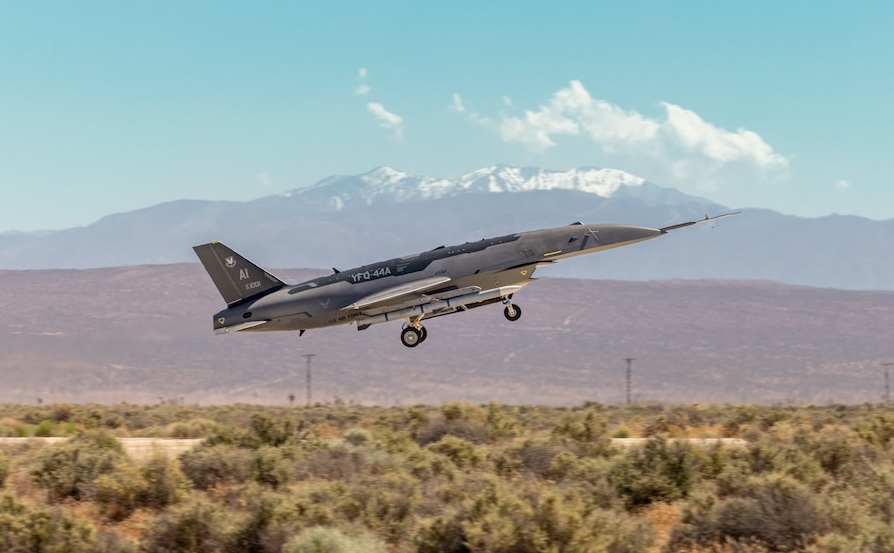
The event involved the YFQ-44A aircraft and applied principles of the Warfighting Acquisition System to refine tactics and procedures. Officials said the approach emphasizes integrating new capabilities into operational use while development continues.
Airmen from the Experimental Operations Unit worked alongside the 412th Test Wing under Air Force Materiel Command to conduct a series of sorties. These operations refined operational and logistical procedures for deploying and sustaining uncrewed aircraft in contested environments.
“This experimental operations event was executed by EOU members from start to finish. Every sortie generated and flown was done with a warfighter, not an engineer or test pilot, kicking the tires and controlling the prototypes,” said Matthew Jensen. “We are learning by doing, at a speed and risk tolerance accepted by the USAF’s most senior leaders, to ensure CCA is ready to operate and win in the most demanding combat environments.”
The exercise also marked an early step in integrating the aircraft into operational concepts, including Agile Combat Employment. Officials tested the ability to operate from dispersed locations with limited infrastructure, equipment and personnel.
During the event, Air Force personnel conducted end-to-end operations, including launch, recovery and turnaround of the aircraft. The transition of responsibilities from industry teams to operators demonstrated the system’s ability to be operated with minimal training and support.
The YFQ-44A was flown from a Southern California test site to Edwards Air Force Base, where daily sorties were conducted. Operators carried out tasks including pre- and post-flight checks, mission planning and direct control of the aircraft during taxi and flight.
The exercise also evaluated sustainment requirements, including manpower and logistics footprint. Officials found that a small number of maintainers with limited training were able to prepare the aircraft for repeated operations, supporting a reduced operational footprint.
“The collaboration we saw in this exercise is the cornerstone of our acquisition transformation. By embedding the operators from the EOU with our acquisition professionals, we create a tight feedback loop that lets us trade operational risk with acquisition risk in real-time,” said Timothy Helfrich. “This isn’t just a test; it’s a demonstration of how we are adopting a more agile process. An 85% solution in the hands of a warfighter today is infinitely better than a 100% solution that never arrives.”
The program is designed to bridge the gap between new technology development and operational use. Officials said defining tactics, workflows and trust in the system is essential to integrating Collaborative Combat Aircraft into existing force structures.
The exercise also demonstrated the use of compact command and control systems that enabled operations from a simulated forward base. This capability supports distributed operations and aligns with future concepts for dispersed airpower in contested environments.
Officials said the high tempo of flight operations provided early insights into procedures and logistics required for sustained use. Lessons learned from the exercise will inform future testing and continued development of the aircraft.
The Collaborative Combat Aircraft program is intended to deliver uncrewed systems that operate alongside crewed platforms, extending reach and enhancing survivability. The latest exercise marks a step toward delivering a combat-ready capability and integrating it into joint force operations.