To accelerate critical modernization efforts, Secretary of War Pete Hegseth established the Department of War Direct Reporting Portfolio Manager for Critical Major Weapon Systems in August of last year. Reporting to the Deputy Secretary of War, the DRPM centralizes oversight of programs such as Sentinel, MMIII, F-47 and B-21 under a single empowered leader to cut through bureaucracy and reduce decision latency across requirements, acquisition, infrastructure and operational transition.
“The DRPM has the direct authority to make decisions, informed by integrated inputs across the enterprise and in alignment with the mission priorities set by the Secretary of War and the Secretary for the Air Force,” said Gen. Dale White, director, Critical Major Weapon Systems. “That construct allows us to resolve tradeoffs quickly and move with the speed required to deliver credible deterrence — while preserving the discipline this mission demands.”
Under the DRPM structure, U.S. Strategic Command remains the combatant command responsible for deterring strategic attack, while Air Force Global Strike Command leads operational transition and readiness. The Department of the Air Force continues to execute acquisition and infrastructure delivery, now synchronized through a single accountable decision authority to enable faster resolution of cross-cutting issues that previously required sequential coordination.
Following a detailed review after assuming his position, White worked with the Sentinel team and determined the program is on track to complete its restructure phase this calendar year. The comprehensive assessment, conducted in close collaboration with requirements and readiness stakeholders, reinforced the early 2030s as the firm target for delivering initial capability as expeditiously as possible.
Sentinel represents a once-in-a-generation modernization of the entire land-based leg of the nuclear triad, replacing the missile, launch systems and command-and-control infrastructure with a new architecture built for digital adaptability. The system is designed to serve as a key component of the nation’s integrated deterrence posture.
Throughout the restructuring process, the Air Force and its industry partners continued executing critical technical work on the air vehicle, command-and-launch systems, wing command centers and supporting infrastructure. These sustained efforts reduced technical risk and informed future integration activities.
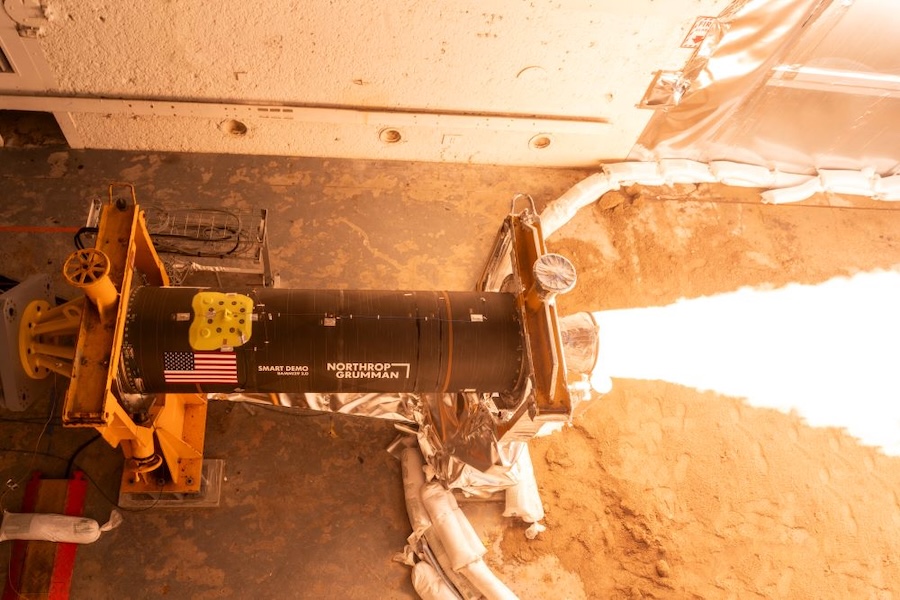
Last fall, the program assembled its first complete three-stage ground test missile, described as a digital model brought to life that will be used for transportation and emplacement pathfinder activities ahead of the first flight. In July 2025, the Air Force and Northrop Grumman completed a full-scale qualification test of Sentinel’s Stage-2 solid rocket motor, building on a successful Stage-1 qualification in March 2025 and a developmental Stage-2 motor test in January 2024.
In September, the program completed the critical design review for the Sentinel Launch Support System, which will support all test and operational launches throughout the system’s life cycle. Together, these milestones provide tangible evidence of technical maturity and underpin confidence in advancing program decision timelines.
“The Sentinel team did the hard work to demonstrate readiness to advance key decisions, and they brought forward the data to support it,” said White. “The restructured Sentinel program is the product of a deliberate, data-driven process and embodies our commitment to transforming acquisition.”
As technology maturation continues, the Air Force is also preparing missile wings for operational transition to Sentinel. That effort reached a visible milestone last fall when Air Force Global Strike Command took the first Minuteman III silo offline as part of a carefully sequenced transition plan.
Site Activation Task Force detachments have been established at F.E. Warren Air Force Base in Wyoming, Malmstrom Air Force Base in Montana, Minot Air Force Base in North Dakota and Vandenberg Space Force Base in California. These teams are integrating with local units to plan the deactivation of legacy sites and oversee construction and fielding activities in a deliberate, phased manner.
“Our Global Strike Airmen operate the land-based ICBM force foundational to our nation’s defense, 24 hours a day, 365 days a year,” said Gen. S.L. Davis, commander, Air Force Global Strike Command. “The activation of these SATAF detachments and turnover of the first Minuteman III silo is a clear signal: we are making real, tangible progress in accelerating the Sentinel program and fielding significantly improved long-range strike capabilities.”
The restructured program incorporates lessons learned to maximize efficiency and reduce risk. The decision to construct new silos, rather than excavate and retrofit 450 aging structures built more than 50 years ago, is intended to avoid unpredictable costs and safety hazards while delivering capability more quickly.
The flight-testing campaign will follow a deliberate “crawl, walk, run” approach, allowing earlier testing of key components and validation of technologies before full system integration. Officials said this incremental strategy supports a more reliable and disciplined path to fielding.
Momentum is expected to become more visible in the coming year as digital designs translate into physical construction. In February, teams will break ground on a prototype launch silo at Northrop Grumman’s Promontory, Utah site to validate modern construction techniques before work begins in operational missile fields.
This summer, prototyping activities at F.E. Warren AFB will test innovative utility corridor construction methods to streamline installation of thousands of miles of secure infrastructure. At the same time, permanent facilities are advancing, including the first of three new Wing Command Centers at F.E. Warren AFB and critical test facilities at Vandenberg SFB to support the future flight test campaign.
The program’s next major operational milestone is the first missile pad launch, planned for 2027. Officials describe Sentinel as one of the most complex modernization efforts in Air Force history, but say deliberate, data-driven execution will ensure a safe, secure and credible deterrent for decades.
“A modern, reliable ICBM force complicates an adversary’s decision-making and provides the President with credible options — the very cornerstone of strategic deterrence,” stated U.S. Navy Adm. Richard Correll, commander, U.S. Strategic Command. “The deliberate progress being made on Sentinel ensures, that for decades to come, there will be no doubt in the minds of our adversaries about the credibility and readiness of our nation’s nuclear deterrent. That is the ultimate deliverable.”
Source: U.S. Strategic Command (STRATCOM).