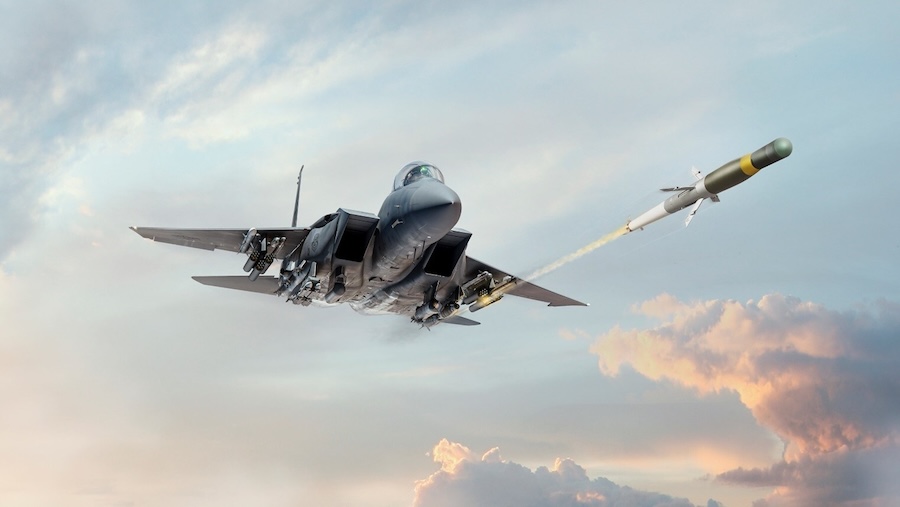
According to a Justification and Approval document published February 13, 2026, the program supports a Joint Urgent Operational Need issued by combatant commanders in August 2024. The requirement was driven by what officials described as “growing risks from mass attacks involving lower-cost Group 3 drones, potentially numbering in the hundreds,” especially within the U.S. Central Command area of responsibility.
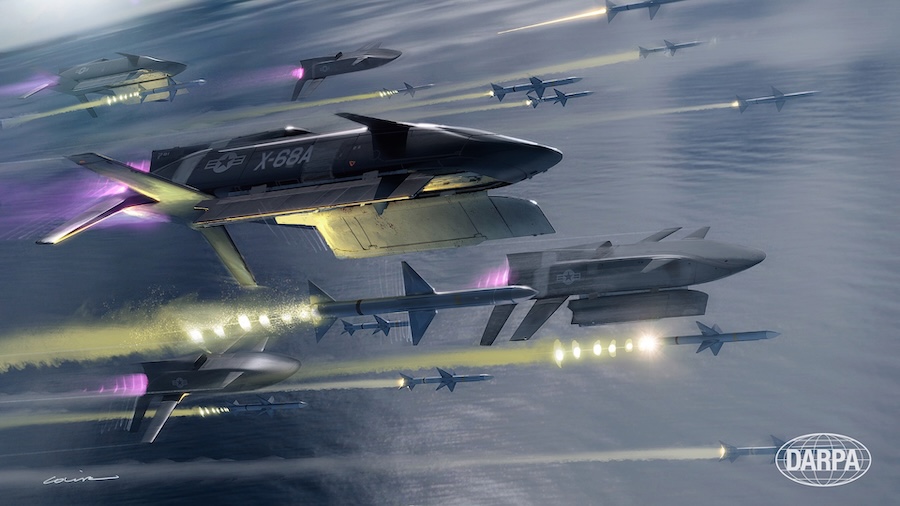
The program centers on upgrading the AGR-20F APKWS rocket, also known as FALCO, to create prototype air-to-air rounds. The new configuration adds a nose-mounted Long Wave Infrared seeker, a mid-body warhead, and a dual safe proximity fuze intended to defeat Group 3 unmanned aerial system threats.
According to the document, the design allows a handoff from laser designation to infrared homing, reducing the time aircrews must maintain laser contact with a target. The Air Force stated that “the modification minimizes exposure during engagements while allowing faster targeting cycles against multiple airborne threats,” while keeping compatibility with the existing APKWS interface developed by BAE Systems.
The contract is structured as an Indefinite Delivery/Indefinite Quantity agreement and is expected to be awarded on a sole-source basis to BAE Systems in Hudson, New Hampshire. Work must begin no later than the second quarter of fiscal year 2026 to meet operational timelines set by U.S. Central Command and Air Force Central Command.
Under the plan, government personnel will assemble 300 prototype All-Up Rounds using components delivered through the contract. Of those, 100 rounds will support integration and qualification testing, while 200 will be used as operational test assets deployed for evaluation in operational environments.
The prototypes are intended to provide an initial capability within 24 months of the original August 2024 Joint Urgent Operational Need. Integration testing is planned on the F-16 platform to validate airworthiness and operational performance requirements, with additional integration planned for the U.S. Navy’s MH-60 fleet.
Air Force acquisition officials concluded that BAE Systems was the only responsible source capable of meeting the required delivery schedule. Although a March 2025 Request for Information received 43 industry responses, officials determined that alternative proposals could not meet airworthiness standards, aircraft integration requirements, or the mandated 24-month delivery timeline, and that awarding the effort to another vendor could delay the capability by more than 44 months.
Funding includes approximately $62 million for component development, $56 million for testing and qualification of operational units, and $27 million for technical risk reduction and U.S. Navy certification activities. The program also seeks expanded government technical data rights to support future integration of alternative components and potential competitive procurement.
The Dual Mode initiative builds on operational experience from the FALCO program and previous APKWS adaptations used in counter-unmanned aerial system roles, including defense of commercial shipping in the Red Sea and Bab Al-Mandab Strait in 2023 and 2024. Program documentation outlines a 24-month development and integration phase followed by a 60-month ordering window to transition the capability toward production-ready status, reflecting broader Pentagon priorities to address the cost imbalance between high-end air-to-air missiles and lower-cost unmanned threats while increasing magazine depth against large-scale drone swarms.