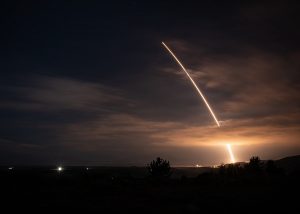
Maj. Dalton Douglas said, “The ALCS provides the nuclear forces a survivable and secondary capability to transmit launch commands to our ICBMs.” He added, “In the event launch control centers (LCCs) that hold our land-based missileers are unable to direct and execute our ICBM arsenal by presidential orders, the ALCS is the alternate means to control and employ those missiles by air.”
The 625th STOS is the Department of the Air Force’s only unit able to operate the system, drawing on missileers, engineers, maintenance specialists, cyber operators, contractors, and civilians. Contractor Shane Bristow said, “From the perspective of the men and women of the 625th STOS, GT 254 is unique because it showcased every aspect of our mission as nuclear professionals from start to finish.” He said, “We provided the missile targeting, modeled the flight path using specialized computer systems maintained by the squadron, developed the flight coordinates for the E-6B, and provided the launch commands necessary to initiate the launch sequence of the ICBM.”
The ALCS key-turn launch is carried out once a year for GT missions, supported by continuous training throughout the squadron. One of the main exercises is the Simulated Electronic Launch Minuteman test, held twice annually, which runs through all procedures up to the launch key turn.
Maj. Andrew Larson said, “SELM missions are a critical aspect of testing and verifying the safety, security, and reliability of the ICBM systems.” He added, “These missions provide the nuclear enterprise with a window into how the weapon system is able to perform on a day-to-day basis.”
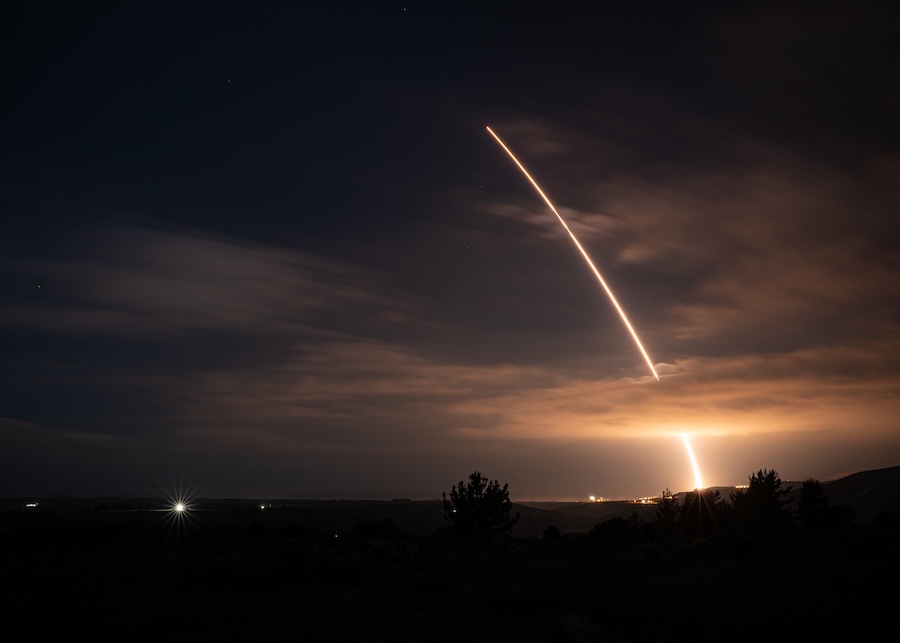
The 377th Test and Evaluation Group oversaw the planning and execution of the launch, which involved tight coordination across multiple teams. Ben Guenther said, “Challenges are always a part of these missions and reality rarely matches expectations with so many moving pieces in such a complex mission.” He said, “The professionalism of the team, extensive training, and the ability to respond with flexibility helped to ensure our focus for this mission.”
The missile’s reentry vehicle travelled about 4,200 miles to the U.S. Army’s Ronald Reagan Ballistic Missile Defense Test Site at Kwajalein Atoll. Sensors at the range collected detailed tracking, optical, and telemetry data during the final phase of flight.
Capt. Max deMayo said, “Our testing supports survivable nuclear operations and empowers strategic deterrence decision makers by providing reliable system performance data and trend analysis.” He added, “Conducting an actual ICBM launch provides unmatched real-world data and demonstrates our secondary launch capability on the world stage.”
Analysts at the test site will use the data to evaluate performance and contribute to wider research and development across defence and space programmes. Bristow said, “The ALCS is a vital and integral part of our nuclear triad that has a chilling effect on our adversaries and calms our allies.”
Airmen from all three Air Force Global Strike Command missile wings supported the mission, with F.E. Warren maintainers providing key technical work. Bristow said, “It was an honor to be part of this mission because it sends a message to every missileer, every missile maintainer, and every defender currently pulling duty at one of our missile wings that what they do matters.” He added, “The early morning briefs, late nights, braving the cold and wind; it matters to all of us that sleep under the blanket of freedom provided by these silent professionals.”
Douglas said the launch reflected the commitment of those who manage the nuclear mission. “I am deeply humbled and honored to be part of the nuclear enterprise, as an operator of one of the nation’s most lethal and powerful weapons,” he said. “It is not a responsibility to take lightly but I have full faith in the capabilities due to the highly knowledgeable and professional individuals across the enterprise.”
Source: Air Force Global Strike Command.