

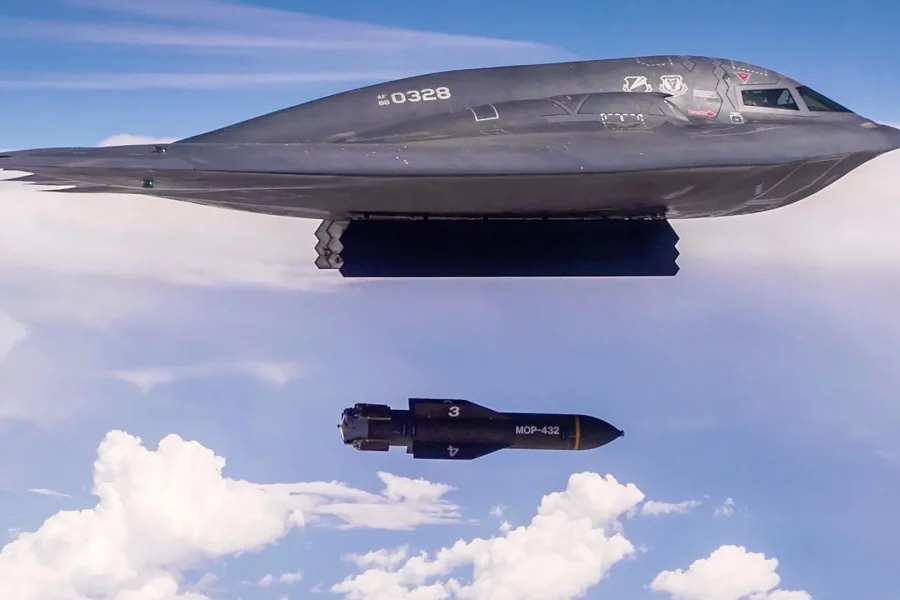
The Air Force is finalizing a deal with Boeing worth more than $100 million to replace the weapons expended in the operation, marking what is expected to be the final lot of GBU-57s before transitioning to the Next-Generation Penetrator.
In partially redacted documents released Feb. 12 on a government website, the service said the acquisition is “critically needed to replenish the inventory of GBU-57s expended during Operation Midnight Hammer.”
The documents, which justify awarding a non-competitive contract for the specially designed munition, state, “This action is essential to restore operational readiness … and ensure Air Force Global Strike Command (AFGSC) possesses the necessary assets to support strategic contingency war plans for all Combatant Commands (COCOMs).”
During the operation, U.S. Air Force B-2 Spirit stealth bombers dropped 14 of the 30,000-pound weapons, with six hitting Fordow and two striking Natanz, marking the first operational use of the bunker-busting bombs, while a third facility at Isfahan was hit with more than two dozen Tomahawk land-attack cruise missiles as part of a 125-aircraft strike package that included F-35s, F-22s, F-16s and refueling aircraft.
“The weapons functioned as designed, meaning they exploded,” Chairman of the Joint Chiefs of Staff Gen. Dan Caine told reporters after the strikes, adding that the weapons travelled down ventilation shafts at over 1,000 feet per second.
“A bomb has three effects that causes damage: blast, fragmentation, and overpressure,” he said. “In this case, the primary kill mechanism in the mission space was a mix of overpressure and blast ripping through the open tunnels and destroying critical hardware.”
The newly released documents indicate the Air Force is procuring full MOP weapon systems, including tailkits projected for delivery starting Jan. 10, 2028, to “replace expended units,” though the number of weapons being purchased and other delivery details remain redacted.
The MOP, which has a hardened casing designed to penetrate layers of rock, concrete and steel before detonating at a selected depth, achieved initial operational capability in 2011 and has undergone multiple tests and upgrades, including the Large Penetrator Smart Fuse modification validated between 2020 and 2024.
According to the documents, “The MOP program production is concluding after these procurement efforts conclude,” as the Air Force advances development of the Next-Generation Penetrator, described as “a similar MOP-like capability” with “superior technology,” for which the Pentagon is seeking a more competitive contracting approach that allows “independent development, modification, and improvement of all hardware, software algorithms, and logical interfaces related to NGP and subsequent MOP weapon systems,” adding, “This approach will empower a diverse supplier base to compete on innovation, performance, and cost, driving technological advancements.”
Source: Air & Space Forces Magazine.