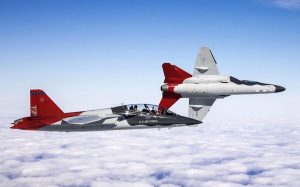

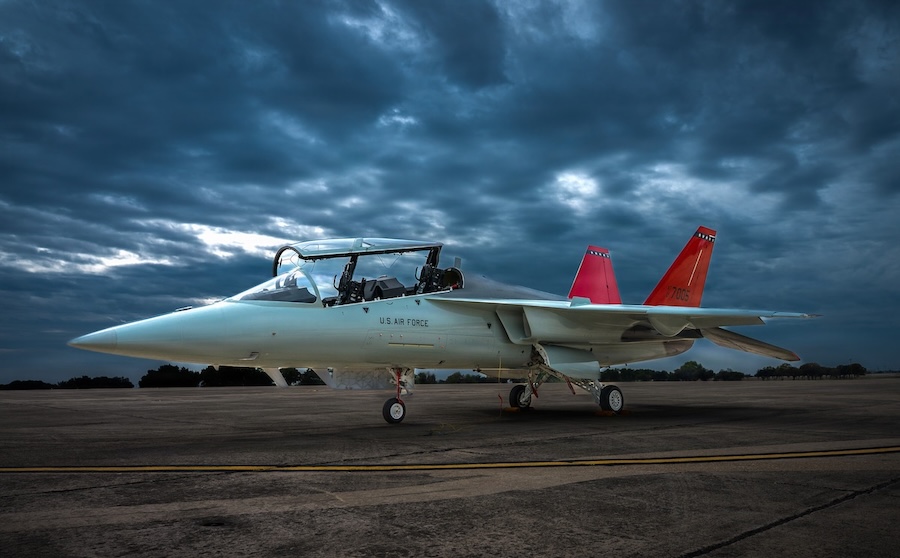
The 99th Flying Training Squadron, assigned to the 12th Flying Training Wing, became the first Air Force unit to receive the T-7A. Senior Air Force leaders and industry representatives attended, including Lt. Gen. Scott Pleus, acting vice chief of staff of the U.S. Air Force, Lt. Gen. Clark J. Quinn, commander of AETC, and Daniel Gillian, vice president and general manager of Boeing Air Defense.
“The T-7 isn’t simply a modern upgrade,” Quinn said. “It’s a generational leap that will be an important part of AETC for decades to come.”
The T-7A will replace the T-38 Talon, which has served as the Air Force’s primary jet trainer for more than 60 years. It features advanced digital engineering, modern avionics and an open-systems architecture designed to adapt to future training needs and emerging technologies.
“The arrival of the T-7A is not the finish line,” Quinn said. “It marks the beginning of the work ahead to deliver training that produces ready, capable pilots for the future of the Air Force.”
Pleus said the Red Hawk is essential to advancing pilot training for fifth- and sixth-generation aircraft. He explained that its advanced digital design and flight performance will help student pilots master the complex task management required in modern fighters.
Col. Peter Lee, commander of the 12th Flying Training Wing, said the programme goes beyond introducing a new aircraft. “It is about establishing an enterprise-wide training foundation that other wings will rely on as they develop the next generation of Air Force pilots,” he said.
As the first unit to receive the T-7A, the 99th Flying Training Squadron will lead early operational efforts to refine training concepts for future units. “The 99th will re-write what pilot production looks like and shape the future of pilot training for the next generation of warfighters for America,” said Lt. Col. Michael Trott, the squadron’s commander.