


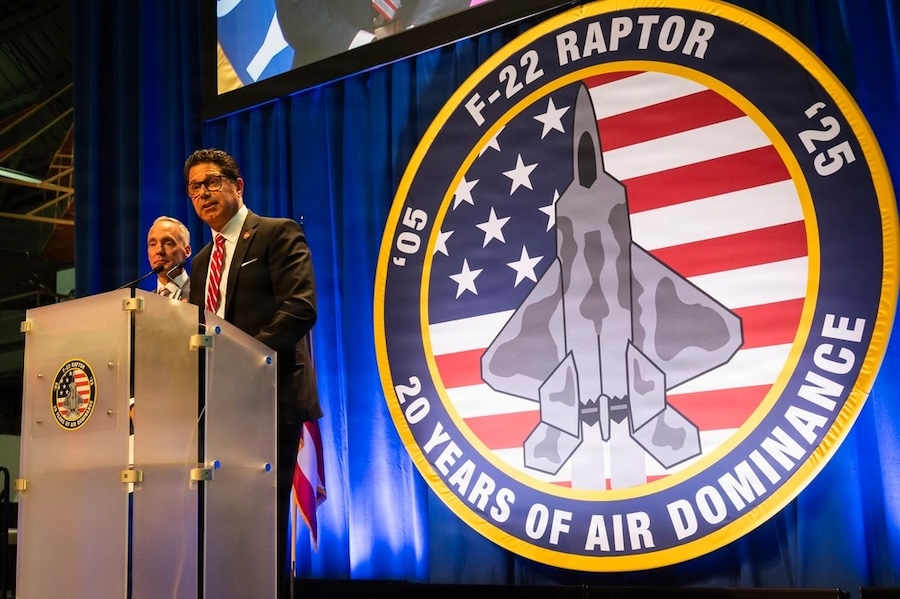
Senior military leaders, industry representatives and former officials attended the celebration. The event highlighted the aircraft’s evolution from a Cold War-era concept into a central element of modern air combat.
The F-22 Raptor was originally conceived in the early 1980s under the Advanced Tactical Fighter program. It was designed to counter emerging Soviet aircraft and advanced air defense systems.
After a competitive evaluation between prototype designs, the Air Force selected the YF-22 in 1991. Development progressed through extensive testing before the aircraft entered operational service in December 2005.
The fighter introduced a combination of stealth, supercruise capability and high maneuverability. It later expanded its mission set to include precision strike, electronic warfare and intelligence operations.
Brian Machuca, deputy director of the F-22 Program Office, highlighted the aircraft’s evolving role. He emphasized its contribution to operations ranging from the Global War on Terrorism to deterrence against major powers.
Machuca also underscored the collaborative effort behind the program. He thanked engineers, maintainers and industry partners for sustaining the aircraft’s operational effectiveness.
Lt. Gen. Linda S. Hurry, commander of Air Force Materiel Command, stressed the importance of teamwork in sustaining the platform. “We drive speed. We drive Warfighter Readiness. We drive continuous modernization that makes our Air Force the greatest in the world. We clearly cannot do any of this without our industry partners. It is truly a team sport,” she said.
“From concept development during the height of the Cold War to operations today, the Raptor has given America unquestioned air-to-air advantage against any and all adversaries. This program leads the way in fifth-generation interoperability. It can partner with collaborative combat aircraft for unmatched performance in the most contested of airspaces. This gives options to our nation’s leaders and provides assurance for our joint partners that our Air Force controls the skies,” Hurry added.
The aircraft’s production run was limited compared to initial plans. A 2009 decision capped the fleet at 187 operational aircraft, with a total of 195 units including test platforms.
The F-22 made its combat debut in 2014 during operations in Syria. It conducted strike missions, provided close air support and contributed to broader air campaign coordination.
Retired Gen. T. Michael Moseley described the aircraft’s significance in maintaining air superiority. “Because of its unmatched ability to control the skies, the F-22 is referred to as the ‘Invincible Air Machine,’ said Moseley”.
“It was specifically designed to provide essential air superiority for the entire joint military team. It is the modern apex predator stretching from a long legacy of American air dominance beginning with the very first American combat aviators in World War I through all the legendary aircraft that we are surrounded by here in this museum, and that brought us to today,” he said.
Despite its age, the F-22 remains a core component of U.S. air power. Ongoing upgrades and funding allocations are expected to keep the aircraft operational into the 2030s.
Officials said the platform continues to serve as a key deterrent. Its presence is defined not only by combat operations, but by its ability to maintain uncontested control of the airspace.





![CENTCOM chief says U.S. forces remain ready after ‘generational’ defeat of Iran despite fragile ceasefire [VIDEO]](https://defence-industry.eu/wp-content/uploads/2026/04/centcom-chief-says-us-forces-remain-ready-after-generational-defeat-of-iran.jpeg)
![Team Lynx details XM30 infantry fighting vehicle concept as U.S. Army program nears key decision [VIDEO]](https://defence-industry.eu/wp-content/uploads/2026/04/team-lynx-details-xm30-infantry-fighting-vehicle-concept.jpeg)