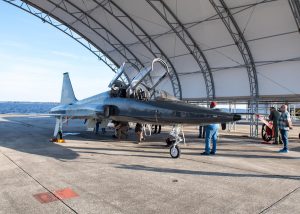
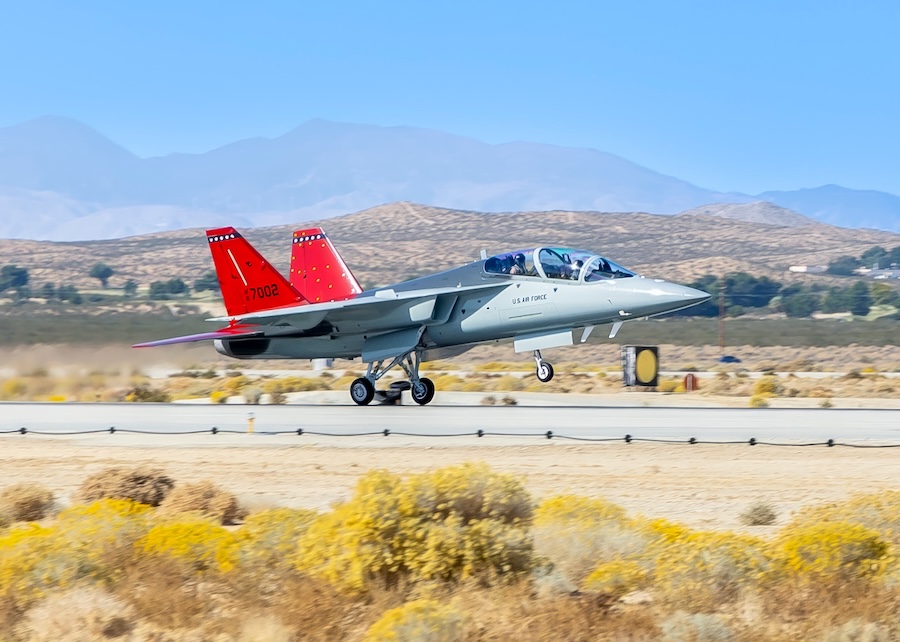
“The aircraft delivery is the first physical representation of progress within the program,” said Brig Gen Matthew Leard, Director of AETC Plans, Program, Requirements, and International Affairs. The T-7A will replace the ageing T-38 Talon, which has been in service for more than sixty years.
Red Hawk over the Alamo!
The first T-7A #RedHawk advanced trainer has arrived at @JBSA_Official in Texas to start training future @USAirForce fighter and bomber pilots. The new advanced trainer brings safe, leading-edge capabilities to the @AETCommand. pic.twitter.com/PgwlburK81
— Boeing Defense (@BoeingDefense) December 5, 2025
Named in honour of the Tuskegee Airmen, the aircraft will be assigned to the 99th Flying Training Squadron, known as the Red Tails, and introduced into the training pipeline over several years. Lt Col Michael Trott, who commands the squadron, said, “We intend to continue the legacy of breaking barriers and challenging assumptions by utilizing the advanced capabilities of the T-7 training system,” adding, “The 99th will re-write what pilot production looks like and shape the future of pilot training for the next generation of warfighters in America.”
Leard noted that the T-38 is increasingly costly to maintain and no longer aligned with current or future platforms. “The T-38 has been life-extended multiple times,” he said, adding, “There’s an escalating cost of retaining the airplane and keeping it flyable. Additionally, it’s no longer aligned with current or future aircraft.”
For AETC the T-7A represents a shift in pilot training methodology. Maj Gen Gregory Kreuder, 19th Air Force commander, said, “From day one, students won’t just be learning to fly; they’ll be learning to manage information, interpret data from advanced sensors, and make critical decisions in a complex environment, all from within the trainer,” adding, “This aircraft enables us to close the gap between basic pilot training and the realities of fifth generation plus warfare, producing more capable, intuitive warfighters right out of the gate.”
Leard compared the leap in capability to the evolution from simple mobile devices to modern software driven platforms. He said, “The T-7 is the open platform we’re going to need for the future.” Built on open architecture, the aircraft can be updated as technology changes, and its fly by wire system allows instructors to tailor handling qualities throughout training.
Kreuder said the service must reshape its training to match the aircraft’s capabilities. “We will employ the T-7 in complex, multi-domain scenarios that were previously impossible in our training aircraft,” he said. “The challenge, then, is to adapt our training syllabi to leverage that new capability.” He added, “We must avoid plugging our new jet into an old model. Therefore, we are actively developing our new curriculum from the ground up with a focus on data-driven and individualized learning paths.”
Kreuder also highlighted the shift from traditional flying skills to cognitive demands. “Our legacy T-38 built incredible ‘stick and rudder’ aviators and served us well for many decades; however, it is ill-suited to prepare our pilots for the aircraft we have today and are acquiring in the near future,” he stated. Leard said many skills learned in the T-38 no longer align with modern digital cockpits, forcing training units to retrain graduates.
Kreuder said the T-7A is intended to build the mindset required by advanced aircraft, with students learning rapid decision making and complex system management. “We will forge tactical problem-solvers who are not just great aviators but are also comfortable multi-tasking as critical nodes in a data-rich environment by preparing students to manage sensor fusion, process large amounts of information, and make rapid, data-driven decisions,” he said. Leard added, “The T-7 is more about displaying and ingesting large amounts of information. That really is the challenge of the fifth-gen or sixth-gen world.”
The aircraft integrates with a Ground-Based Training System and includes Live Virtual Constructive capability that links simulators and aircraft in the same scenario. According to AETC, this approach reduces required flying hours while maintaining proficiency. Leard said the LVC system offers long-term flexibility, comparing it to hardware that gains capability through software upgrades.
Kreuder said the command is investing in instructors and digital infrastructure. “We’re building the digital infrastructure and empowering our Airmen, both pilots and maintainers, to innovate and shape how we train our warfighters so they will continue to dominate in any future fight,” he said.
The programme includes 351 aircraft, 46 simulators and related systems, with plans eventually to replace the T-6 Texan as well. Test work will continue at Edwards Air Force Base while the 99th Flying Training Squadron develops Type 1 maintenance and pilot training.
Leard said early training will begin as the aircraft matures. “Rather than wait for the full envelope and then start all the Type 1 training, the Type 1 training will happen in parallel,” he added.
Initial Operational Capability is planned for August 2027 with fourteen aircraft assigned to the 99th Squadron. The Air Force intends to procure forty to sixty aircraft per year by 2033, completing final purchases around 2035 or 2036, with the T-38 remaining in service until the transition is complete.
The service plans deliveries to Columbus Air Force Base in Fiscal 2027, Laughlin Air Force Base in Fiscal 2032, Vance Air Force Base in Fiscal 2034, and Sheppard Air Force Base in Fiscal 2035.
Source: Joint Base San Antonio.