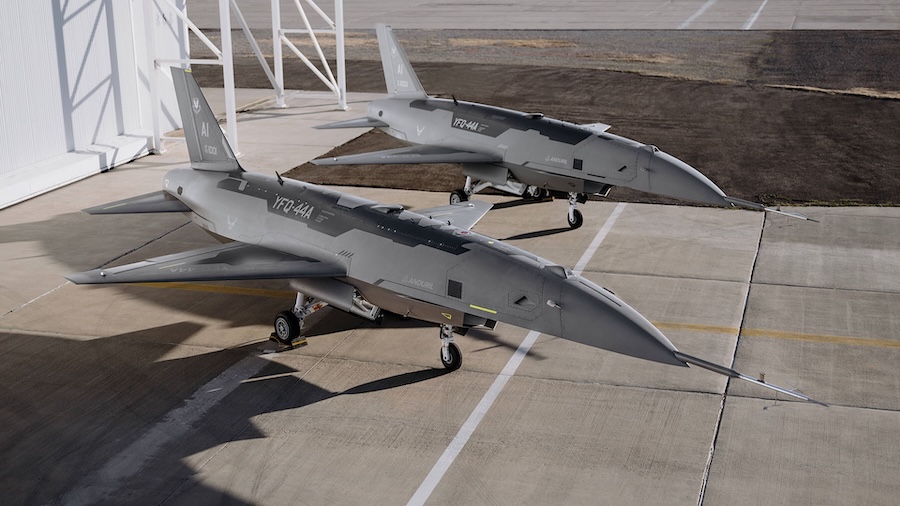
The initiative reflects the department’s shift toward faster acquisition cycles, innovation and a software-first mindset. The A-GRA is being integrated by mission autonomy vendors RTX Collins and Shield AI, which have begun semi-autonomous flight testing in partnership with General Atomics on the YFQ-42 platform and Anduril on the YFQ-44, respectively.
By demonstrating that the architecture functions across different airframes and mission autonomy systems from separate vendors, the Air Force is showing that mission software can be separated from specific vehicle hardware. Officials say this removes barriers to technology integration and fosters a more competitive and innovative ecosystem.
“Verifying A-GRA across multiple partners is critical to our acquisition strategy,” said Col. Timothy Helfrich, Portfolio Acquisition executive for Fighters and Advanced Aircraft. “It proves that we are not locked into a single solution or a single vendor. We are instead building a competitive ecosystem where the best algorithms can be deployed rapidly to the warfighter on any A-GRA compliant platform, regardless of the vendor providing the algorithm.”
The A-GRA follows a Modular Open System Approach designed to prevent vendor lock by establishing a universal standard for mission autonomy. This framework allows the Air Force to quickly onboard new software and algorithms from both traditional and non-traditional industry partners, supporting efforts to build a more agile and lethal force capable of staying ahead of evolving threats.
“We are seeing the vision of a modular, adaptable force come to life,” the Agile Development Office director said. “Integrating A-GRA onto multiple platforms so quickly demonstrates that our open-system approach works. It allows us to iterate tactics and capabilities across the fleet at a pace that keeps us ahead of the threat.”
As the program progresses, officials said continuous evaluation of the A-GRA will provide the foundational data required to field an operational capability. The effort supports the National Defense Strategy by developing platforms that complement major weapons systems and by keeping the Air Force on track to deliver an affordable, adaptable and potent force multiplier for the joint force.