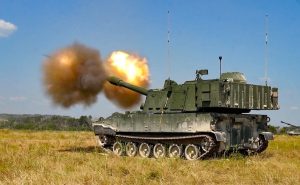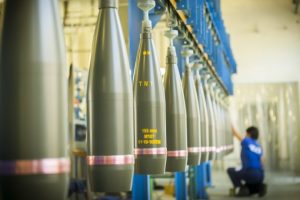
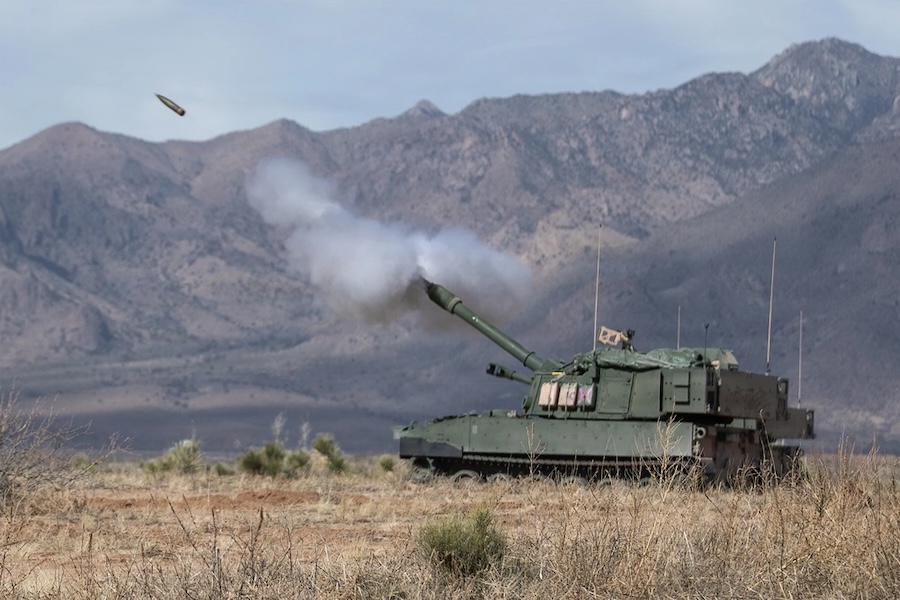
The final exercise saw the 40-ton artillery platform fire 155mm rounds during a series of live missions across the desert range. The qualification marked a key step in the Army’s broader modernization effort aimed at preparing formations for future combat environments.
The “Defender” battalion, a core unit of the 1st Armored Division Artillery, completed its crew-level certification on Feb. 24. The milestone followed weeks of progressive training designed to build artillery expertise through increasingly complex drills.
The training program followed the established Field Artillery gunnery tables and the Army’s “crawl-walk-run” methodology. Soldiers first completed individual skill tests and simulator training before transitioning to hands-on work with the Paladin system.
The process culminated in Artillery Table VI, the final live-fire qualification event. During this stage, crews were required to demonstrate their ability to conduct complex fire missions under evaluation.
Command Sgt. Maj. Bradley Beavers, the battalion’s senior enlisted leader, explained the importance of this final stage of training. “Crews go through and they complete an artillery Table Level VI, which is a section-level certification.”
Beavers added that the certification formally validates the crew’s readiness to operate the system. “It’s basically the start that locks in all the crews for the cannon.”
During the exercise, artillery crews conducted several missions designed to test their operational readiness. According to Beavers, each howitzer fired between 20 and 25 rounds during the qualification.
He noted that the event concluded successfully for all crews involved. “Today they went over five separate missions; each gun shot around 20-to-25 rounds, and everyone was successful.”
The achievement also marked an important milestone for the soldiers’ professional development. “Everybody’s feeling pretty good here at the end of this because they’re now locked in as chiefs and gunners and number one men, and they’re ready to move on with their training to the next level.”
Fort Bliss provides a large training environment that allows units to conduct extensive live-fire exercises with new equipment. The installation’s 1.12 million acres enable soldiers to refine tactics and test modern platforms at their home station.
Command Sgt. Maj. Robert Theus, Fort Bliss Garrison command sergeant major, highlighted the importance of the installation during a visit to observe the training. “Well, it’s one of the reasons ‘It’s better at Bliss.’”
He emphasized that the base offers unique opportunities for large-scale training. “We have more training land out here than there is at NTC [the National Training Center], and you can do things here at Bliss in a training environment you can’t do anywhere else in the world.”
The M109A7 Paladin represents a major technological upgrade for U.S. Army artillery units. Its 675-horsepower engine, shared with the Bradley Fighting Vehicle, enables the system to move quickly with armored formations.
The platform also features an all-electric turret that replaces the hydraulic systems used in earlier models. This change improves reliability and simplifies maintenance for soldiers operating the system.
Beavers said the new howitzer offers clear operational advantages. “Oh, it’s absolutely an enhancement.”
He added that the improved system provides faster and more accurate fire support. “The vehicles are faster, they’re more accurate, which gives us more accurate and timely fires; it allows us to move, get in position, and shoot faster.”
Theus also highlighted the benefits of the platform’s shared chassis with the Bradley vehicle. “Being on the Bradley Chassis makes it easier to work on because the parts are easy to get to as opposed to the old Alpha 6.”
He noted that this improvement will benefit soldiers responsible for maintaining the equipment. “So, I know the crews out here, where they spend a lot of their time on maintenance, are particularly happy about that because they’re on a platform that’s going to be easier to work on.”
The modernization effort comes as the U.S. Army seeks to maintain its technological edge over peer competitors. New systems such as the M109A7 are intended to ensure artillery units can operate effectively alongside modern armored formations.
For Beavers, the arrival of the new howitzers has particular significance following the battalion’s recent deployment in Europe. “I worked with a lot of European armies, and I can tell you that they’re starting to acquire equipment, and they’re getting better artillery equipment, and I kind of watched ours get stagnant.”
He concluded that the new platform demonstrates the Army’s continued commitment to maintaining operational superiority. “So, it’s nice for us to get a hold of something new ourselves and show that we’re still the best Army in the world.”